-
by sayum
10 August 2026 10:54 AM







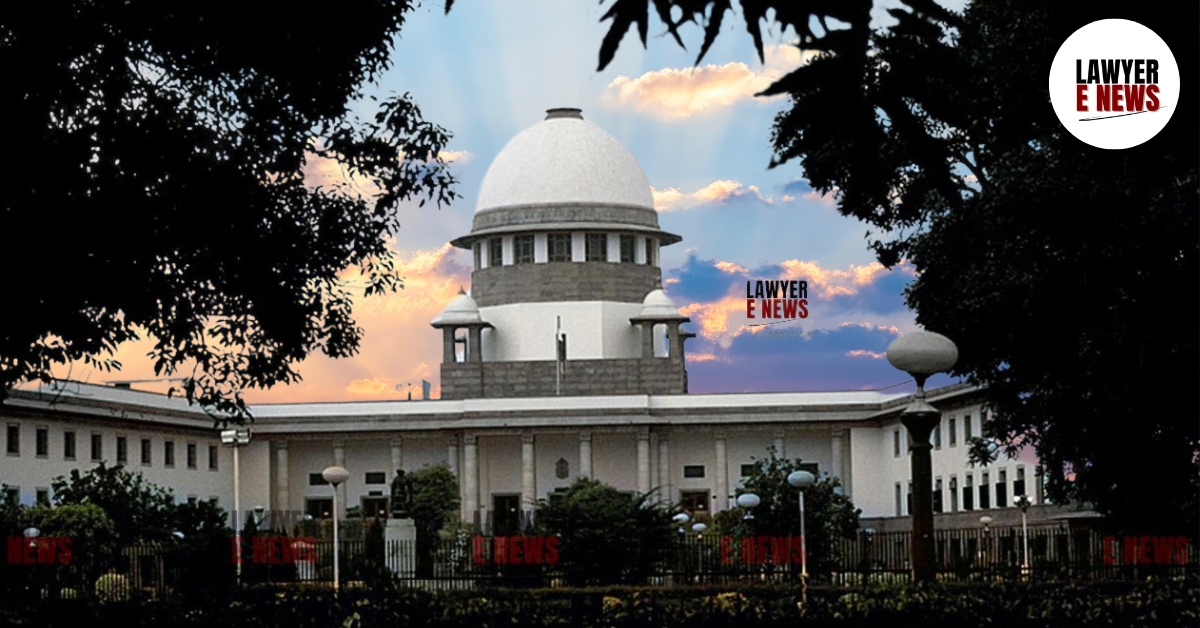
“Green Paver Blocks Strike Balance Between Public Utility and Ecological Preservation”: In a landmark judgment Supreme Court of India dismissed appeals filed by the Chandigarh Administration, thereby upholding directions issued by the Punjab and Haryana High Court regarding infrastructural modifications within the Capitol Complex, a UNESCO World Heritage Site. The case, Chandigarh Administration v. Registrar General, High Court of Punjab and Haryana, revolved around two contentious issues: the construction of a verandah in front of Courtroom No.1 and the laying of green paver blocks in the kutcha parking area within the High Court premises. The Chandigarh Administration contended that these measures posed a risk to the Outstanding Universal Value (OUV) of the Capitol Complex and violated both UNESCO Operational Guidelines and the Chandigarh Master Plan, 2031.
Rejecting these apprehensions, the Supreme Court held that neither direction amounted to an irreversible or impermissible alteration and reaffirmed the constitutional validity and public importance of both interventions. The verdict underscores the judiciary’s balanced approach in harmonizing heritage conservation with contemporary infrastructure needs.
The litigation originated in a Public Interest Litigation before the Punjab & Haryana High Court, wherein the Court, concerned with practical impediments in the functioning of the High Court and the environmental impact of unmanaged parking, issued multiple directions between November 2024 and February 2025.
The High Court first directed the construction of a verandah in front of Courtroom No.1 to provide protection to lawyers and litigants from harsh weather. It also later mandated the development of the kutcha parking area using green paver blocks interspersed with tree plantations to alleviate a severe parking shortage without compromising environmental integrity. The Chandigarh Administration challenged these directions, citing potential conflict with UNESCO’s heritage preservation rules and restrictions under the Chandigarh Master Plan, 2031.
I. Does the construction of a verandah in a UNESCO-recognized heritage complex violate international heritage preservation obligations?
The Chandigarh Administration invoked Paragraph 172 of the Operational Guidelines for the Implementation of the World Heritage Convention, which cautions States against any “major restorations or new constructions” that might compromise the Outstanding Universal Value (OUV) of heritage sites. According to the administration, the verandah would alter the original design of Monsieur Le Corbusier, the architect of the Capitol Complex.
However, the Supreme Court dismissed this argument, observing: “Neither such verandah can be said to be a major restoration nor a new construction within the main structure of the High Court building.” [Para 34]
Referring to historical correspondence from 1956, the Court pointed out that the very same verandah was considered for construction at that time, but was shelved solely due to the personal preference of the then Chief Justice:
“It is a different story that the then Chief Justice... turned down the said proposal based on his personal perception without any collective discussion.” [Para 30]
The Court noted that similar verandahs already exist in front of Courtrooms 2 to 9, and their design can be replicated using modern, non-invasive architectural techniques:
“The additional verandah can even be in the form of a collapsible/removable structure... Such an addition would unquestionably not violate the mandate of paragraph 172.” [Para 36]
On the practicality and public utility of the structure, the Court added: “While Court Room Nos. 2 to 9 provide shelter... the area in front of Court Room No.1 is unprotected and exposes the lawyers and litigants to sun, winds and rain.” [Para 37]
The Court concluded that the construction of the verandah does not amount to an irreversible decision that could threaten the World Heritage status, stating:
“If so required, the administration would not be precluded from seeking ex-post facto approval for this minimal protective measure.” [Para 39]
II. Can a parking solution involving green paver blocks in a green belt area be permitted under the Chandigarh Master Plan, 2031?
The Administration argued that the kutcha area was a designated green belt and no form of construction—permanent or otherwise—was permissible under the Master Plan. It warned that laying green paver blocks would permanently alter the land’s character and prevent restoration of vertical greenery.
The Supreme Court rejected this narrow interpretation of environmental planning, asserting the primacy of sustainable development. Drawing from the precedent in Rajeev Suri v. Delhi Development Authority, the Court stated: “Environment and development are not sworn enemies... harmony is to be upheld and hurdles minimized by resorting to active mitigating measures.” [Para 42]
It acknowledged the acute parking crisis: “Reportedly, 3000 to 4000 four-wheeler vehicles access the High Court campus on any given working day... while the underground facility accommodates only 600.” [Para 43]
Emphasizing the eco-friendly nature of green pavers, the Court remarked: “The green paver blocks are scientifically known eco-friendly alternatives... they allow rainwater to percolate into the ground.” [Para 44]
It also upheld the High Court’s solution of combining pavers with extensive tree plantation, noting: “The suggestion... to plant suitable number of trees at regular intervals in between the green paver blocks would simultaneously create a green cover and facilitate parking.” [Para 44]
The Court affirmed the High Court’s vision: “The order passed... facilitates sustained development and... would greatly help in resolving the crisis of acute shortage of parking space in the High Court.” [Para 3.1]
The Supreme Court dismissed the appeals filed by the Chandigarh Administration.
It upheld the High Court’s orders dated 29th November 2024, 13th December 2024, 7th February 2025, and 21st February 2025.
On the issue of contempt proceedings initiated against the Chief Engineer for non-compliance, the Court granted temporary relief: “The contempt proceedings... shall be kept in abeyance for a period of twelve weeks... to enable the CA to comply with the order.” [Para 46]
The Supreme Court’s judgment is a clear affirmation of the judiciary’s constitutional role in balancing heritage conservation with public functionality and infrastructural needs. The Court stressed that good governance must evolve to reflect the changing needs of society, without compromising historical legacies. It found the High Court’s orders to be well-reasoned, proportionate, and in conformity with international and environmental norms, reinforcing the principle that “sustainable development is not antithetical to heritage preservation.”
Date of Decision: May 28, 2025