-
by sayum
29 August 2026 9:28 AM








“Cruelty once condoned cannot be a ground for divorce. Continued cohabitation, family vacations, and efforts to reconcile defeat claims of mental or financial cruelty.” - Division Bench of the Telangana High Court comprising Justice Moushumi Bhattacharya and Justice B.R. Madhusudhan Rao delivered a detailed and emphatic judgment, rejecting the husband's appeals against a Family Court's decision denying him divorce and granting restitution of conjugal rights to the wife.
The Court, affirming the Family Court’s findings, held that no credible evidence of cruelty or desertion was established under Sections 13(1)(ia) and 13(1)(ib) of the Hindu Marriage Act, 1955, and that the husband's conduct amounted to condonation of alleged acts of cruelty, attracting the bar under Section 23(1)(b) of the Act.
"No Extraordinary Circumstance to Break the Marriage": Appeals Dismissed, Divorce Denied, Restitution Decree Upheld
The Court dismissed both Family Court Appeals filed by the husband challenging the common order dated 28.01.2021 passed by the XV Additional District Judge-cum-II Family Judge, Ranga Reddy District, which:
Dismissed his petition for divorce under Section 13(1)(ia) and (ib), HMA, and
Allowed his wife’s petition for restitution of conjugal rights under Section 9 of the Hindu Marriage Act.
The High Court found that despite making vague and unsubstantiated allegations of cruelty, the husband continued to cohabit with the respondent-wife even after filing for divorce, and this act of reconciliation nullified his claim under Section 23(1)(b), which prohibits relief where cruelty is condoned.
“We agree with the Trial Court’s conclusion that there are no extraordinary features in the appellant’s FCOP for grant of divorce on the ground of cruelty… the alleged acts were condoned by the appellant including admitted cohabitation,” observed the Court [Para 46].
Cruelty Allegations Must Be Specific and Proven—Not Vague, General, or Based on Third Parties’ Conduct
The husband’s case was primarily founded on claims of financial cruelty, inappropriate conduct by the wife’s father, and strained family interactions. He also sought to introduce new evidence related to a partition suit filed by the wife on behalf of the children.
However, the High Court found these claims factually unsubstantiated and legally insufficient.
On financial cruelty, the Court held: “There is no pleading whatsoever to show how much money was transferred by the respondent from the joint account… vague pleadings are not sufficient to make out a case of ‘financial cruelty’ under Section 13(1)(ia)” [Paras 16–18].
Similarly, on desertion, the Court noted that the appellant had not proven two years of continuous separation before filing the petition—a statutory precondition under Section 13(1)(ib) [Para 19].
“Cruelty by In-Laws Is Not Cruelty by Spouse”: Court Rejects Allegations Against Wife’s Father as Basis for Divorce
The husband alleged that the wife’s father caused a commotion at his aunt's residence, which he sought to rely upon as evidence of cruelty.
The Court flatly rejected the claim:
“Even if the incident were true, an act of the respondent’s father cannot be transmitted to the respondent as cruel conduct on her part… the absence of complaint or evidence is sufficient to reject this ground” [Para 21]
Repeated Cohabitation, Kerala Trip, and Reconciliation Attempts Defeated Claim of Cruelty
Crucially, the Court cited numerous instances of the husband and wife living together after 2015, including:
Holidays taken together with the children in Kerala,
Continued cohabitation in Hyderabad until January 2017,
Email and phone records showing communication and reconciliation efforts, and
Statements before the Court where the husband expressed willingness to reunite.
“There are several admitted instances of the appellant celebrating family life with the minor children… and also willingness to join the respondent and live in Hyderabad,” the Court observed [Para 44].
These acts, the Court said, amounted to “condonation” of any alleged cruelty and attracted the bar under Section 23(1)(b) of the Hindu Marriage Act [Para 45].
Restitution of Conjugal Rights Not "Automatic"—Court Found Legal and Factual Basis
Rejecting the husband’s argument that the Family Court had automatically granted restitution to the wife upon dismissing his divorce petition, the High Court clarified:
“There is no basis in the appellant’s contention… the evidence clearly shows he was also attempting to relocate and live with the wife and children in Hyderabad. Hence, restitution was rightly decreed” [Paras 36–38].
The Court upheld the positive findings of the Family Court that the wife had consistently expressed willingness to protect the marriage, while the husband had failed to provide maintenance and had defaulted despite multiple orders.
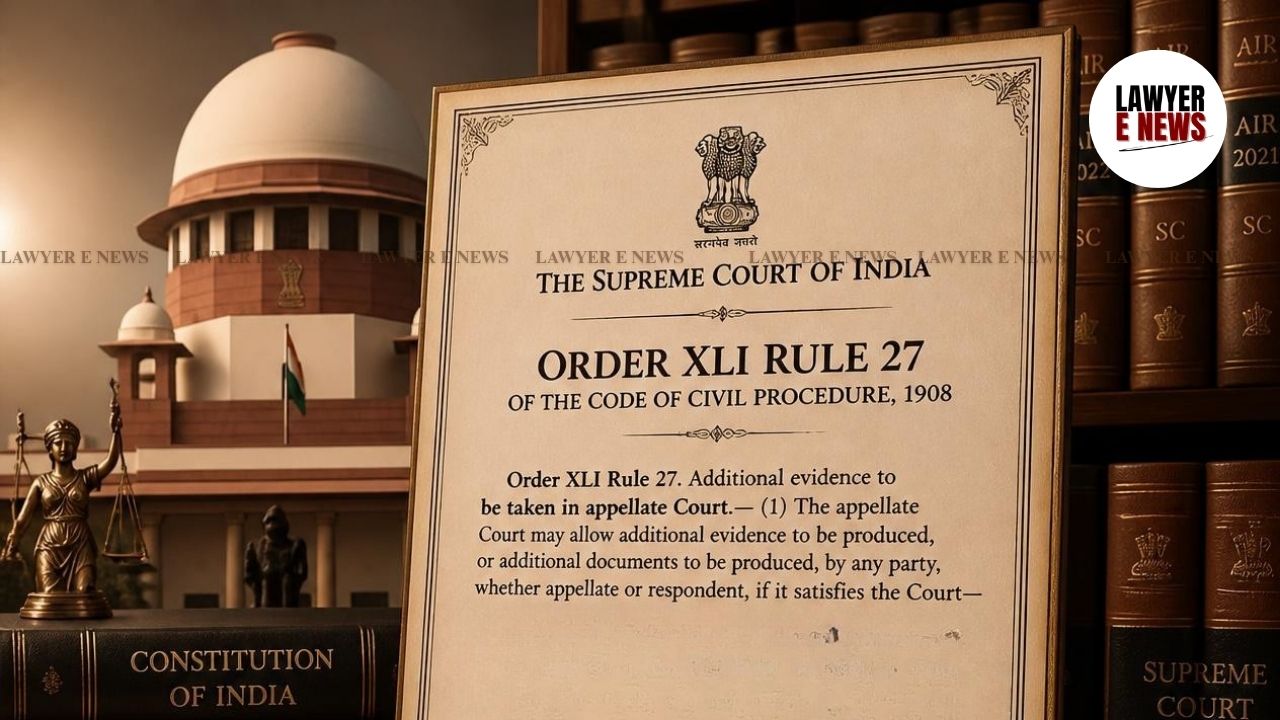
Attempt to Introduce New Evidence During Appeal Rejected: “Due Diligence” Not Shown Under Order XLI Rule 27 CPC
The husband attempted to introduce partition suit records and a sale deed during the appellate proceedings, arguing that these proved financial manipulation by the wife.
The High Court dismissed these applications (I.A. Nos. 1 and 2 of 2024 and I.A. No. 1 of 2025) under Order XLI Rule 27 CPC, holding:
“The appellant has not shown any bona fides or exercised due diligence… the documents were available prior to the impugned order but were not placed before the Trial Court” [Para 33].
Moreover, the Court clarified that even the partition suit filed on behalf of the minor children did not amount to cruelty, and had not been pleaded as a ground for divorce or in the appeal [Para 30].
Judicial Bias Allegation Against Family Judge Rejected as “Baseless and Belated”
The husband also alleged judicial bias, arguing that the Family Court judge who conducted reconciliation proceedings should not have passed the final judgment.
The High Court firmly rejected this argument, noting that:
No objection was raised during trial,
The Family Court acted within its duty under Section 9 of the Family Courts Act, and
The judge ensured confidentiality by sealing the mediation report.
“The appellant actively participated in the reconciliation and never sought recusal. The allegation is not only belated but unfair to the respondent” [Para 41].
No Legal Grounds for Divorce—Appeals Dismissed, Family Court’s Decree Affirmed
In conclusion, the Telangana High Court found that: “The appellant failed to produce evidence of cruelty… The Trial Court’s finding of absence of extraordinary circumstances is justified… The wife’s plea for restitution of conjugal rights was based on consistent willingness to reconcile and protect the family” [Para 54].
Date of Decision: 19 August 2025