-
by sayum
28 August 2026 10:07 AM







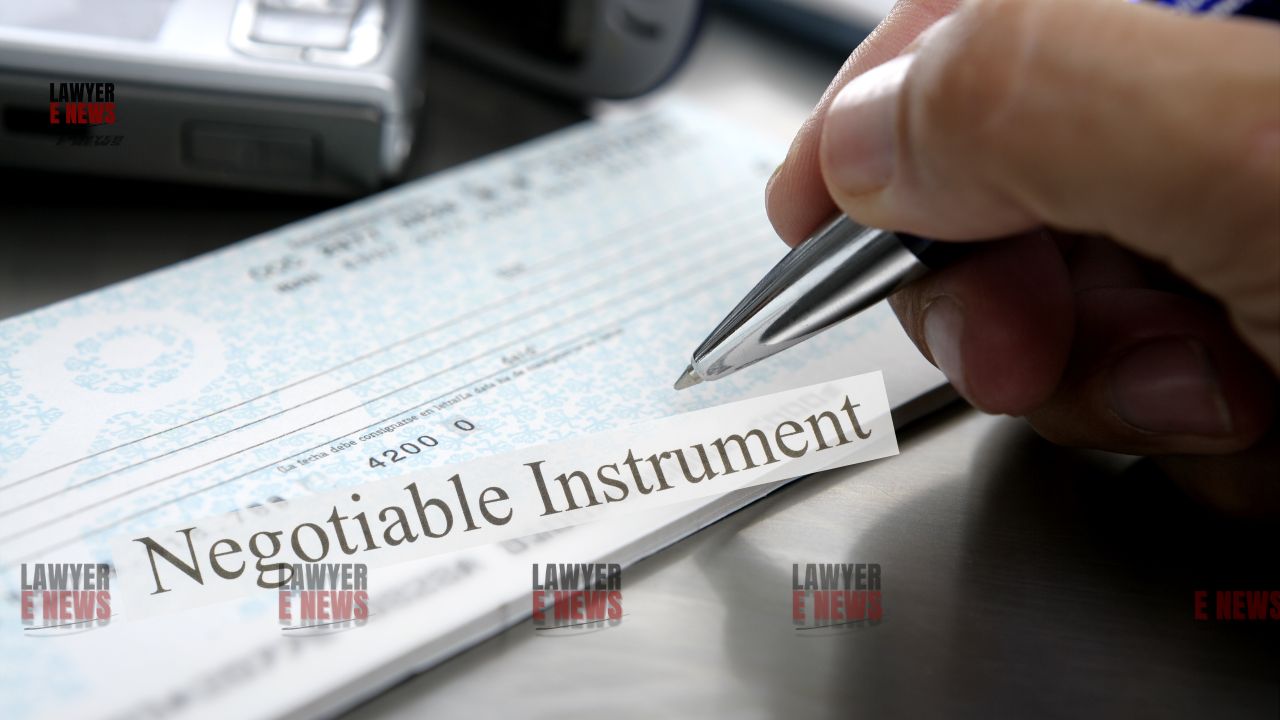
“No Summons Without Legal Sanction—Even a Five-Day Delay Requires Judicial Application of Mind” - Supreme Court of India delivered a decisive ruling that reshapes procedural discipline in cheque bounce litigation. The Court quashed criminal proceedings under Section 138 of the Negotiable Instruments Act, 1881, holding that summons issued without condoning delay—even if minimal—are legally unsustainable.
The Bench comprising Justice Ahsanuddin Amanullah and Justice K. Vinod Chandran overruled the Delhi High Court’s endorsement of a summoning order despite a five-day delay in filing the complaint, declaring that “there cannot be an automatic or presumed condonation.”
“Even a Short Delay Must Be Judicially Evaluated—Presumption of Timeliness Is a Legal Error”
The case arose when M/s MSN Woodtech filed a complaint under Section 138 NI Act against H.S. Oberoi Buildtech Pvt. Ltd. and its directors. The complaint, however, was filed five days beyond the prescribed 30-day limitation under Section 142(b) of the Act. The Trial Court ignored this lapse, wrongly assuming that the complaint was timely filed and proceeded to issue summons.
The High Court of Delhi upheld this order, noting that the Trial Court could condone delay even without a formal application, especially since the delay was minor.
The Supreme Court sharply disagreed: “From a purely legal point of view where facts are admitted that the complaint was filed beyond the time prescribed under the statute, there cannot be an automatic or presumed condonation.”
“Even for the sake of argument, if it is assumed that the power under Section 142 of the Act exists for the Court to condone delay, the first requirement is that the Court has to take note of the fact that there is a delay.”
“Power to Condone Is Not License to Presume—There Must Be a Reasoned Satisfaction Based on Affidavit or Application”
While the complainant argued that the delay was inadvertent and that an affidavit had been prepared but not filed, the Supreme Court clarified that intention to file is not equivalent to filing.
The Court emphasized: “Once the statute prescribes a mandatory time limit for filing a complaint, there cannot be any deviation from the same except when an application accompanying the complaint is filed seeking condonation disclosing reasons for the delay.”
The Justices further noted that Section 142(b) of the NI Act, although allows condonation, does not nullify the obligation to apply judicial mind to a formal application. Merely possessing the power to condone does not entitle a court to ignore the delay altogether or act upon a non-existent application.
“Trial Courts Cannot Short-Circuit Procedure—Issuance of Summons Is Not Mechanical”
The Court found fault in both the Trial Court’s assumption that the complaint was timely, and the High Court’s casual approval of that presumption:
“The High Court opining that though there may have been delay but still the Trial Court is well within its power to condone... is erroneous.”
“The same not having been done, the order cannot be sustained.”
By quashing the summoning order and the complaint itself, the Court sent a clear message that procedural shortcuts cannot replace legal compliance.
“This Ruling Does Not Affect Civil Proceedings for Recovery—Criminal Process Not a Substitute for Due Process”
The Court made it clear that its ruling applies only to the criminal proceedings and does not prejudice the civil case for recovery:
“We have been informed that the civil proceedings for recovery of the amount have been instituted by the respondent. We would only observe that the same will not be prejudiced in any manner by the present order.”
This distinction underscores that criminal prosecution under Section 138 NI Act is not a collection tool, and must follow strict procedural mandates.
With this ruling, the Supreme Court has fortified the procedural safeguards embedded in Section 142 of the Negotiable Instruments Act, ensuring that cognizance under Section 138 is not treated casually or presumptively. The verdict serves as a critical checkpoint against mechanical issuance of summons, reaffirming that every step in criminal law must be anchored in conscious judicial satisfaction and legal compliance.
“Even a delay of five days is not trivial when the statute mandates strict limitation and the judicial process is invoked to curtail liberty,” the Court’s reasoning implicitly conveys.
This decision marks a significant reaffirmation of the rule of law in cheque bounce litigation, and will likely compel lower courts across the country to adopt greater procedural diligence before issuing summons under the NI Act.
Date of Decision: 09.09.2025