-
by sayum
30 August 2026 4:28 AM







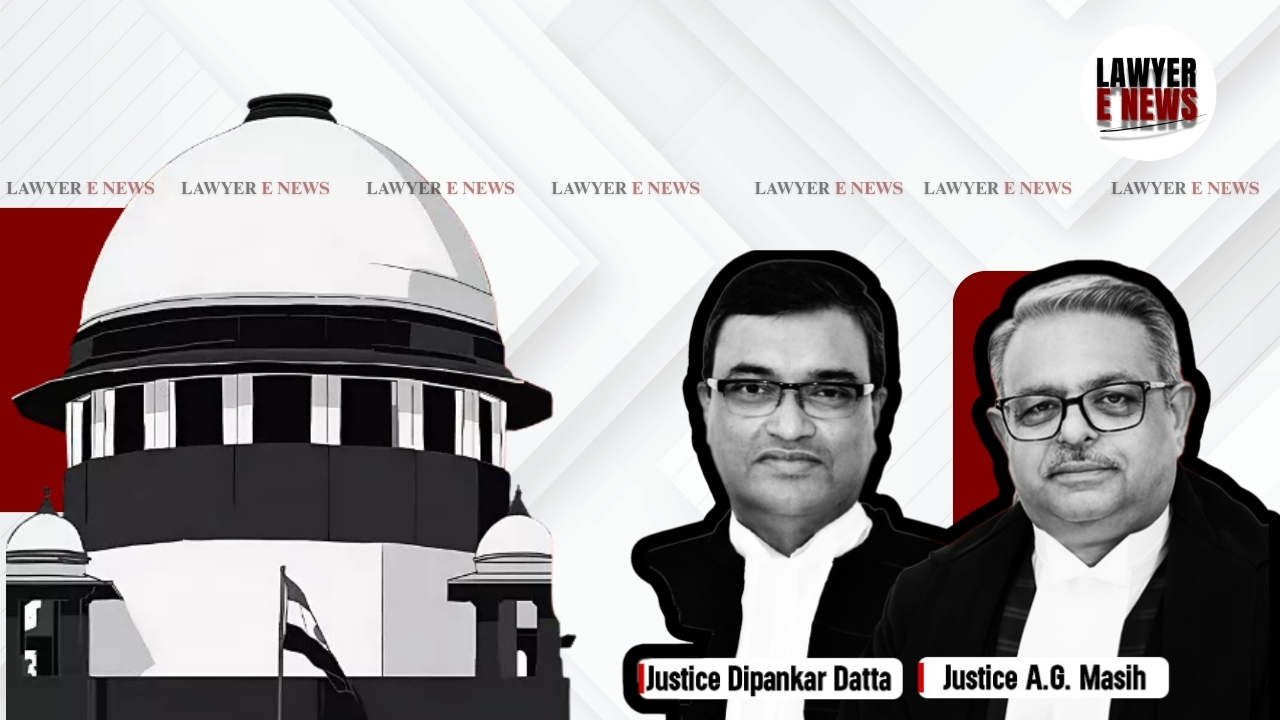
“In-House Procedure Fills the Constitutional Gap Between Misconduct and Impeachment” — Supreme Court Upholds Legality of In-House Mechanism, Says It Does Not Violate Judges’ Fundamental Rights or Judicial Independence.
In a significant judgment Supreme Court of India rejected a constitutional challenge filed by a sitting High Court Judge against key provisions of the In-House Procedure adopted by the Supreme Court in 1999. The Court ruled that the procedure for internal inquiry into judicial misconduct, including the Chief Justice of India’s power to forward findings to the President and Prime Minister, does not violate Articles 14, 21, 124(4), or the Judges (Inquiry) Act, 1968.
The Court categorically held that the In-House Procedure is not unconstitutional, nor does it “create a parallel or extra-constitutional removal mechanism.” Instead, it is a “fact-finding, non-punitive mechanism” that ensures accountability without compromising judicial independence.
“The in-house inquiry or its report forming part of the Procedure in itself does not lead to removal of a Judge... thus, it is not a removal mechanism, much less an extra-constitutional one.”
The verdict came in the case of XXX v. Union of India, where a High Court judge challenged the legal validity of paragraphs 5(b) and 7(ii) of the In-House Procedure after he was subjected to an inquiry concerning the discovery of burnt currency notes in his official residence.
“Complaint of Misconduct Cannot Be Sheltered by the Cloak of Judicial Office”
According to the facts narrated by Justice Dipankar Datta, who authored the judgment, the Petitioner — then a Judge of the Delhi High Court — was probed after currency notes were found charred in a fire incident at his government residence. Though the judge claimed that the money was planted, he did not deny the fire or the discovery of cash.
Upon the Chief Justice of India receiving the report, an in-house Committee was constituted. The Petitioner was given access to all evidence and an opportunity to respond, which he did. The Committee concluded that serious misconduct was proved and warranted removal proceedings. The CJI subsequently forwarded the report and the Petitioner’s response to the President and Prime Minister. A public press release confirmed this step, triggering the present litigation.
The judge argued that these actions breached his fundamental rights and circumvented the only constitutionally prescribed method of removal — impeachment under Article 124(4).
“The In-House Procedure Is Not Toothless — But It Is Not Binding on Parliament”
The Petitioner, represented by Senior Advocate Kapil Sibal, contended that the In-House Procedure allowed the CJI to unilaterally trigger impeachment-like consequences without the safeguards of a full inquiry under the Judges (Inquiry) Act, 1968. He also took exception to the uploading of photos and videos related to the fire incident on the Supreme Court website, calling it a "public conviction" without trial.
The Court, however, rejected these arguments.
“Withdrawal of judicial work from a Judge is an extreme measure that the Procedure expressly permits… but the recommendation of the CJI is not binding on Parliament, nor does it have any legal effect unless acted upon in accordance with the Constitution.”
Notably, the Court held that the Chief Justice of India is not merely a conduit:
“We have no hesitation to say that the CJI is not a mere post office between the Committee and the President/the Prime Minister… He is clearly an important person, if not the most, in maintaining institutional interest and credibility.”
The forwarding of the Committee's report, therefore, was held to be valid, and the CJI's recommendation — even if it included advice for removal — was considered within the constitutional and procedural framework.
“Judicial Independence Does Not Mean Unfettered Liberty to Act As One Wishes”
The judgment provides a powerful reaffirmation of judicial accountability. The Bench drew a careful distinction between judicial independence and judicial immunity:
“Judicial independence signifies flexibility of thought and the freedom to adjudicate without pressure — not unfettered liberty to act as one might wish.”
The Court described the In-House Procedure as a crucial ethical self-regulatory mechanism, born out of the “yawning gap” between minor judicial impropriety and the high constitutional threshold of impeachment.
“The Constitution’s silence on cases that do not rise to the level of proved misbehaviour creates a significant structural vulnerability, which has since been addressed by the Procedure.”
Uploading of Evidence "Improper" but Not Fatal to Inquiry
The Court took note of the Petitioner’s objection to the uploading of sensitive material on the Supreme Court’s website but found the complaint belated and unmerited, observing that the Petitioner had not raised any objection at the relevant time.
“Placing incriminating evidence in the public domain is not a measure provided in the Procedure... but the Petitioner acquiesced in such uploading and cannot now seek relief.”
"Not All Misbehaviour Warrants Impeachment — But All Misconduct Must Be Accounted For"
The Court reinforced the importance of internal disciplinary control over the judiciary, while recognising that not all misconduct may justify removal.
“Frivolous complaints cannot be avoided… but the path of probity can never be abandoned by a Judge.”
The judgment dismissed the argument that the Chief Justice lacked legal authority, by relying on Section 3(2) of the Judges (Protection) Act, 1985, which allows the Supreme Court to take ‘such action’ as permitted under any law.
“We place sufficient emphasis on the word ‘otherwise’ in Section 3(2)… the Procedure fits well within that mould.”
Court Rejects Petitioner’s Conduct, Calls It Delayed and Opportunistic
The Court severely criticised the timing of the writ petition, pointing out that the Petitioner only challenged the process after receiving an adverse report.
“Having failed, he seeks to challenge the very process he willingly submitted to. This conduct does not inspire confidence.”
The Court reiterated that waiver of fundamental rights may not be strictly permissible, but deliberate delay and tactical silence could disentitle a litigant from discretionary relief.
Final Holding: "CJI’s Recommendation Is Valid, Procedure Is Legal, Petition Dismissed"
Concluding its 125-page judgment, the Bench declared:
“We find the provision in paragraph 7(ii) of the Procedure requiring the CJI to write to the President and the Prime Minister to be quite in order, legal and valid.”
The Court refused to invalidate the internal inquiry, stating that the CJI’s communication to constitutional authorities does not usurp Parliamentary functions, nor does it violate the principles of natural justice.
The Court also distinguished the precedent in Sub-Committee on Judicial Accountability (1991), stating that it dealt with a different legal issue, and that the In-House Procedure had since evolved with full judicial approval.
The judgment firmly establishes that:
The In-House Procedure is not unconstitutional;
The CJI may forward recommendations to constitutional authorities without violating separation of powers;
Judges are not immune from internal scrutiny for misconduct;
The right to reputation cannot override the right of the judiciary to protect its institutional integrity;
The procedure is ethical, moral, and legally sanctioned, deriving force from both judicial precedent and statutory interpretation.
Date of Decision: August 7, 2025