-
by sayum
30 August 2026 6:58 AM







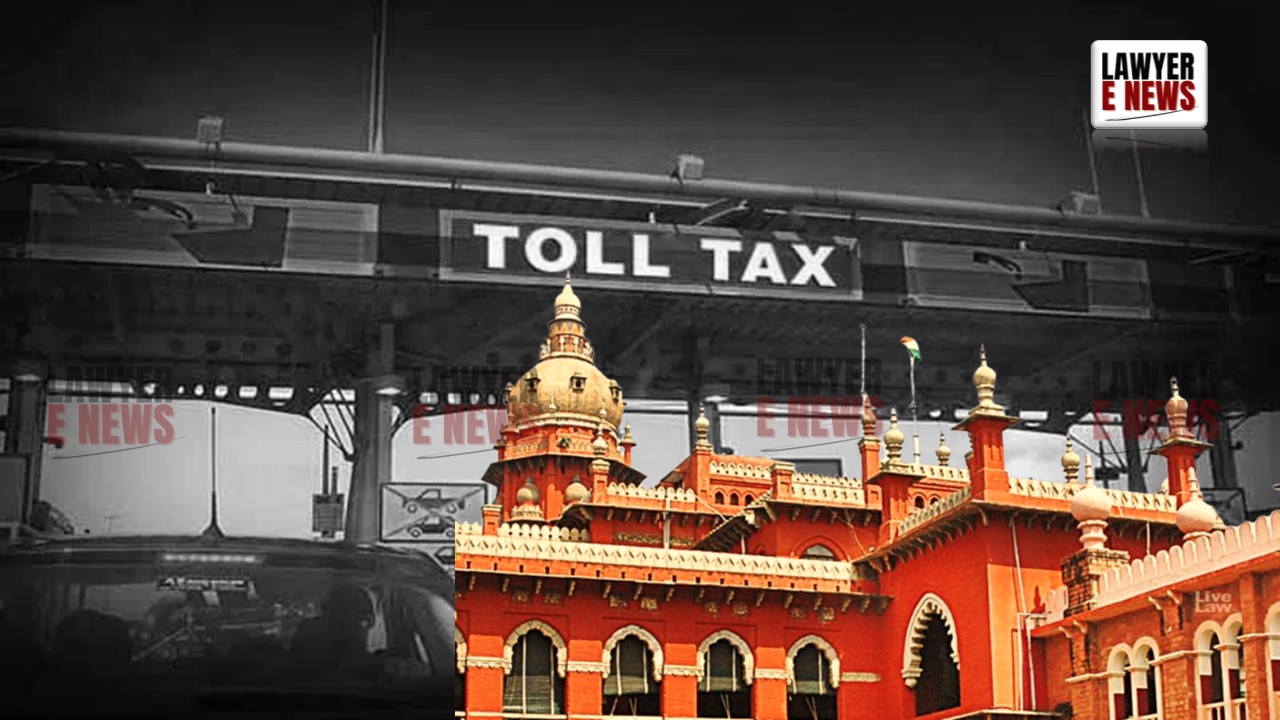
“A Jolt Is Necessary to Make Officials Act”, In a scathing judgment Madras High Court, through Justice N. Anand Venkatesh, took a hard stand against the Tamil Nadu State Transport Corporation (TNSTC) and related government bodies for their brazen defiance of toll payment obligations. Deciding the case titled M/s Madurai-Kanyakumari Tollway Private Limited & Others v. Tamil Nadu State Transport Corporation & Others (W.P. Nos. 31006 of 2024 & batch), the Court observed that “the Corporations have placed themselves in a precarious situation” by failing to settle long-pending dues that ballooned to ₹276 crores, and directed an unprecedented coercive measure: stopping all TNSTC buses from passing through the petitioners' toll plazas from 10th July 2025.
The Court’s firm tone was evident when it stated, “unless and otherwise the order which will jolt the officials is passed, they will not take efforts to settle this dispute, which has been going on for many years together.” The Court also ordered police protection for the toll operators, setting a powerful example of judicial enforcement of statutory rights.
The petitioners, a group of tollway operators led by M/s Madurai-Kanyakumari Tollway Private Limited, approached the Court invoking the National Highway Fee (Determination of Rates and Collection) Rules, 2008, against the continued evasion of toll fee payments by state-run transport corporations. The legal dispute revolved around both the massive arrears owed and consistent violations of mandatory FASTag regulations by government buses plying through national highways in Tamil Nadu.
The toll operators presented a detailed calculation, showing that even after adjusting previous payments of ₹48.5 crores, the principal outstanding toll amounted to ₹113 crores, which further escalated to ₹276 crores when interest and penalties were accounted for. The petitioners argued that the state’s deliberate failure to comply with statutory obligations severely impacted infrastructure maintenance and violated their concession agreements.
The Court took note of several prior rulings in favour of toll operators, particularly the orders passed in W.P. No. 27064 of 2014 and similar cases where Division Benches had clearly held that state buses cannot be exempt from paying tolls.
The core legal issue revolved around the enforceability of toll dues against state transport undertakings and whether coercive measures, including stopping buses, could be justified in light of persistent non-payment and FASTag violations.
Justice N. Anand Venkatesh did not mince words in condemning the state’s conduct. He remarked, “no effort was made to find out a solution towards settling the dues payable to the petitioners,” and further noted that “on at least three occasions, the Hon'ble Division Bench of this Court has repeatedly held that if the dues are not cleared, the buses belonging to the Corporations can be stopped.”
Confronted with the plea of public inconvenience, the Court acknowledged, “This Court is aware of the potential consequences since ultimately it is the common man who is using these government buses who will be adversely affected.” However, it clarified that the chronic nature of non-compliance justified the stringent remedy. “Unless and otherwise the order which will jolt the officials is passed, they will not take efforts to settle this dispute,” the Court stressed.
On the aspect of FASTag violations, the Court observed blatant disregard of statutory mandates and Ministry of Road Transport and Highways notifications by TNSTC, thereby aggravating the breach of statutory duties.
Justice Venkatesh directed the petitioners to enforce a stoppage of all government buses at their toll plazas starting from 10th July 2025, until such time the corporations either cleared their dues or provided a viable payment solution.
“The longer the payments are delayed, the more the penalty and interest will escalate, potentially reaching astronomical proportions,” the Court warned, highlighting the consequences of continued delinquency.
Given the anticipated friction at toll gates, the Court issued a firm directive to the Director General of Police: “There shall be a direction to provide sufficient police protection at all toll plazas belonging to the petitioners. The Police shall ensure that no undue pressure is exerted on the toll plazas belonging to the petitioners to permit the buses belonging to the Corporations to ply.”
The Court made it clear that the onus was entirely on the state transport corporations to rectify their defaults if they wished to resume unhindered highway access. The matter was adjourned to 16th July 2025 for further monitoring, with the Court retaining seisin over the enforcement process.
The Madras High Court’s ruling stands as a rare but resounding assertion of private rights against state apathy in the context of public infrastructure management. By directing the stoppage of state-run buses for toll evasion and FASTag non-compliance, the Court balanced its awareness of public inconvenience against the greater public interest in maintaining the rule of law and contractual integrity.
In the Court’s own words, “the problem of road maintenance is interlinked with the failure of these State Enterprises to pay the toll charges.” This case is now a watershed moment in India’s judicial efforts to ensure that even government bodies are not above statutory compliance.
Date of Decision: 08 July 2025