-
by sayum
25 August 2026 11:12 PM







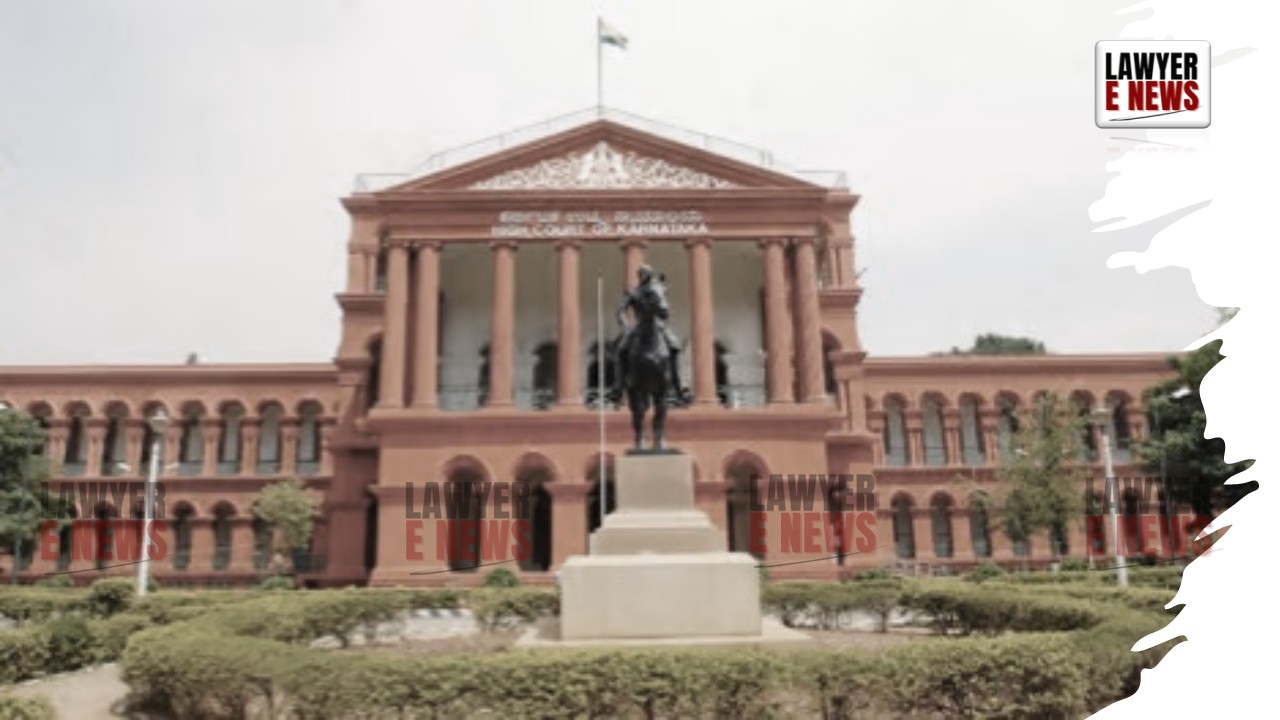
In a strong reaffirmation of the principles of criminal jurisprudence, the High Court of Karnataka on 11 December 2025, set aside the conviction of two accused—Lakshmamma @ Lakshmi and Chandra—who had been sentenced to life imprisonment for the alleged murder of Lakshmamma's husband. The High Court ruled that the entire prosecution case was based on an uncorroborated, hostile eyewitness, unproven motive, and absence of consistent circumstantial evidence, thereby making the conviction unsustainable in law.
The judgment, delivered by a Division Bench comprising Justice K.S. Mudagal and Justice Venkatesh Naik T, came in Criminal Appeal, arising out of the judgment dated 09 November 2018 passed by the II Additional District and Sessions Judge, Ramanagara in S.C. No.5022/2014, which had convicted the appellants under Section 302 read with Section 34 of the Indian Penal Code, 1860.
The High Court emphasised that while the victim’s death was undoubtedly homicidal, the prosecution failed to establish any direct or credible circumstantial link between the accused and the crime. The Court declared, “If the prosecution has not been able to lay the foundational facts for invoking Section 106 of the Evidence Act, it cannot straightaway invoke the said section and throw the entire burden on the accused to establish their innocence.”
“When the chain of circumstances is broken and eyewitness turns hostile, conviction cannot stand”
The central prosecution theory revolved around an alleged conspiracy between the wife (Accused No.2) and her paramour (Accused No.1) to eliminate her husband due to their illicit relationship. The prosecution claimed that on the night of 5 March 2014, the duo strangled the victim with a towel while he slept in their farmhouse. However, their narrative rested entirely on the account of PW5—the victim’s own daughter and alleged eyewitness, who during the trial, completely turned hostile.
The High Court noted with concern that PW5, the only claimed eyewitness, denied every key allegation made by the prosecution. As the Bench observed, “She stated she did not know how her father died, denied knowledge of any scuffle, denied having seen Accused No.1 at their house, and denied ever giving any such statement to the police.”
This hostile testimony dealt a fatal blow to the prosecution’s case. The Court held that, “Once the alleged eyewitness fails to support the case and her testimony remains uncorroborated, the entire edifice of the prosecution collapses.”
Interestingly, the prosecution did not even examine Siddaraju, the son of the deceased, who was present at the scene on the night of the alleged murder. The Court remarked that this omission “seriously affected the credibility and completeness of the investigation”.
“Motive must be proved by cogent evidence; hearsay is no substitute”
The alleged motive of illicit relationship between the two accused was relied upon heavily by the prosecution, but the High Court found that no direct or credible evidence was presented to support this. PW1, the deceased’s brother, testified about panchayats held in the village to advise Accused No.1 to stay away from Accused No.2, but admitted that all his knowledge was hearsay.
The Bench held that, “In the absence of credible, direct evidence establishing the motive, and with the alleged eyewitness denying any such relationship, the prosecution’s theory of motive remains a mere allegation.”
The Court further observed, “Motive is only a link in the chain of circumstantial evidence. When that chain itself is broken at every link, the motive cannot resurrect a failed case.”
“Medical evidence cannot substitute proof of guilt – it can only establish the cause of death”
There was no dispute that the death was homicidal. The medical officer (PW6), who conducted the post-mortem, confirmed that the victim died of asphyxia due to strangulation, and injuries were consistent with manual strangulation. However, the Court made it clear that medical evidence by itself cannot establish the identity of the killer.
In the words of the Bench, “Though the medical evidence confirms the death was not accidental or suicidal, it does not by itself prove the participation of the accused in the crime. Without ocular or credible circumstantial support, the conviction cannot be sustained on this ground alone.”
Notably, no incriminating recovery was made from the accused. The alleged murder weapon—a towel—was not recovered from their possession, nor linked to them forensically.
“Presumption under Section 106 cannot be applied in absence of prosecution’s own burden being met”
The State had argued that since the death occurred inside the matrimonial home, the onus was on Accused No.2 to explain the cause of death under Section 106 of the Indian Evidence Act. The High Court rejected this argument outright, observing that this section presumes special knowledge only after the prosecution lays the groundwork.
The Court clarified, “Section 106 is not a substitute for the prosecution’s primary burden. Only after establishing initial facts, can the Court call upon the accused to explain the circumstances. This foundational burden was never discharged in this case.”
Conviction Based on Uncorroborated Official Testimony Amounts to Miscarriage of Justice
Ultimately, the Trial Court had convicted the accused by relying heavily on the testimony of the doctor (PW6) and police officials, without appreciating the fact that all independent civilian witnesses had either turned hostile or were hearsay. The High Court found this deeply flawed.
The Bench stated, “The conviction was rendered on the uncorroborated testimony of official witnesses, despite the complete collapse of the prosecution’s primary evidence. This is not only legally impermissible, but amounts to a miscarriage of justice.”
Appeal Allowed – Conviction Set Aside – Compensation Directed to Victim’s Children
Allowing the appeal, the High Court acquitted both accused, setting aside the life sentence imposed on them. They were ordered to be released forthwith, if not required in any other case, and the fine amount was directed to be refunded.
In a significant direction under Section 357A of the CrPC, the matter was referred to the District Legal Services Authority, Ramanagara, to determine and disburse compensation to the victim’s children, namely PW5 Nisarga and Siddaraju.
The Court placed on record its appreciation for Sri P.D. Subrahmanya, Amicus Curiae for Appellant No.2, awarding him an honorarium of ₹15,000/-.
Date of Decision: 11 December 2025