
-
by sayum
25 August 2026 12:32 PM







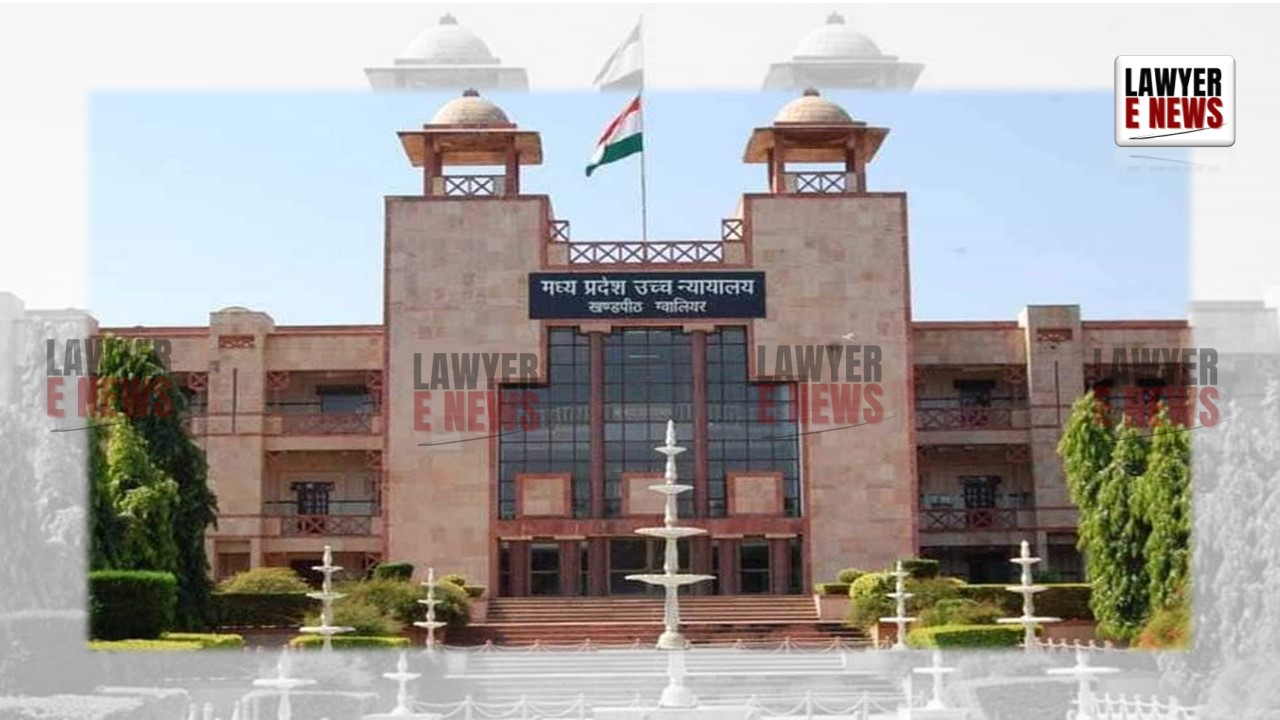
“Distinct FIRs arising in different States give rise to separate causes of action; protection under Article 20(2) and Section 300 CrPC not attracted” – In a significant ruling clarifying the scope of double jeopardy under criminal law, the High Court of Madhya Pradesh at Gwalior dismissed a petition under Section 482 CrPC filed by Vaman Narayan Ghiya, a man accused in a high-profile antiquities theft and smuggling case. The Court refused to quash the criminal proceedings pending before the Magistrate at Karera, Shivpuri, holding that the protection under Article 20(2) of the Constitution and Section 300 CrPC is not applicable where separate FIRs pertain to distinct offences committed across different States.
Justice Rajesh Kumar Gupta upheld the concurrent orders passed by the Trial Court and Revisional Court in Karera, observing that the acquittal of the petitioner by the Rajasthan High Court did not operate as a bar against his prosecution in a different case registered in Madhya Pradesh.
“Each FIR involves different stolen artefacts recovered from different jurisdictions—no blanket immunity from prosecution” – High Court affirms territorial distinctiveness of offences
The central issue before the Court was whether the petitioner, who had already been acquitted in Sessions Case No. 76/2006 arising from FIR No. 146/2003 at P.S. Vidhyadhar Nagar, Jaipur, could again be tried in Criminal Case No. 272/2007 arising from FIR No. 39/2001 at P.S. Karera, Shivpuri (M.P.), for offences involving similar acts relating to antique idol theft and trafficking.
Rejecting the petitioner’s plea, the Court held: “The registration of every FIR in another State apart from Rajasthan is a different cause of action… Therefore, the concept of double jeopardy is not made out on the present facts and circumstances of the case.”
It was further clarified: “Protection under Section 300 CrPC is attracted only when the second prosecution is for the same offence and by a Court of competent jurisdiction. Distinct FIRs registered in different States constitute separate causes of action.”
“Earlier acquittal was on benefit of doubt—not a clean acquittal—and covered different facts and charges”
The petitioner, through senior counsel, relied on his acquittal by the Rajasthan High Court in D.B. Criminal Appeal No. 809/2012, which had reversed his conviction for offences including Section 411, 413 IPC and Sections 3, 5, 14, 25 of the Antiquities and Art Treasures Act, 1972. It was contended that the trial at Karera involved the same idol of Shiv-Parvati, and thus amounted to a second trial for the same offence.
However, the High Court pointedly rejected this argument, noting: “The Rajasthan High Court did not grant a clean acquittal, but instead gave the petitioner the benefit of doubt. Even otherwise, the acquittal related to different FIRs and offences and does not create a statutory bar to continuation of trial in Madhya Pradesh.”
The Court further held that even if some evidence or idols overlapped across FIRs, the offences, their ingredients, and territorial context were entirely distinct, and hence, no bar under Article 20(2) or Section 300 CrPC could be invoked.
“Only Court within whose jurisdiction the offence is committed can try it—Jaipur trial had no bearing on Karera jurisdiction”
The petitioner’s core legal plea rested on Section 300 CrPC and Article 20(2) of the Constitution, claiming that he had already been tried and acquitted for the same charges. He challenged the jurisdiction of the Magistrate at Karera to proceed further.
Justice Gupta, however, emphasized the principle of territorial jurisdiction, observing: “As per Sections 177–189 CrPC, only the court within whose jurisdiction the crime has been committed has the competency to try the case. Thus, the proceeding before the Jaipur Court cannot operate as a bar to the proceeding before the Trial Court at Karera in this matter.”
“Same facts ≠ Same offence – Article 20(2) protects only against identical charges, not similar facts”
In a key legal analysis, the Court drew upon the landmark Supreme Court judgment in State of Bombay v. S.L. Apte & Anr. (1961) 3 SCR 107, where it was held that for double jeopardy to apply, the two offences must be identical in ingredients, not merely similar in underlying facts.
Justice Gupta echoed this principle: “Though the allegations of facts in the two complaints might be substantially similar, the benefit of the ban cannot be invoked unless the offences are the same. The emphasis is not on the facts alleged, but on the ingredients which constitute the offences.”
“13 separate FIRs reflect widespread smuggling activities spanning multiple jurisdictions”
The Court noted that the petitioner was named in at least 13 different FIRs spread across Rajasthan and Madhya Pradesh, each involving different thefts, recoveries, and offences, including:
FIR No. 39/2001, P.S. Karera, M.P. (Shiv-Parvati idol theft)
FIR No. 84/1989, P.S. Ataru, Dist. Baran
FIR No. 31/2000, P.S. Bhanpura, Mandsaur (M.P.)
FIR No. 113/06, P.S. Bayana, Bharatpur, among others
The Court found that each FIR constituted an independent offence, with its own set of facts, evidence, and territorial nexus.
“Invocation of inherent jurisdiction under Section 482 CrPC to quash proceedings unjustified”
Dismissing the petition under Section 482 CrPC, the High Court reiterated that inherent powers are to be exercised sparingly, and only in cases where there is a clear abuse of process or failure of justice.
Justice Gupta held: “This is not a fit case for interference in the proceedings pending before the trial court. The findings of the Trial Court and Revisional Court are conclusive. The defense of double jeopardy is unavailable.”
The Court, while dismissing the petition, directed the Trial Court at Karera to conduct proceedings expeditiously, preferably on a day-to-day basis, and to conclude the matter as early as possible.
It clarified: “This Court has not expressed any opinion on the merits of the case. The trial shall be decided on its own merit.”
Date of Decision: 9 December 2025





