-
by sayum
05 August 2026 3:07 PM








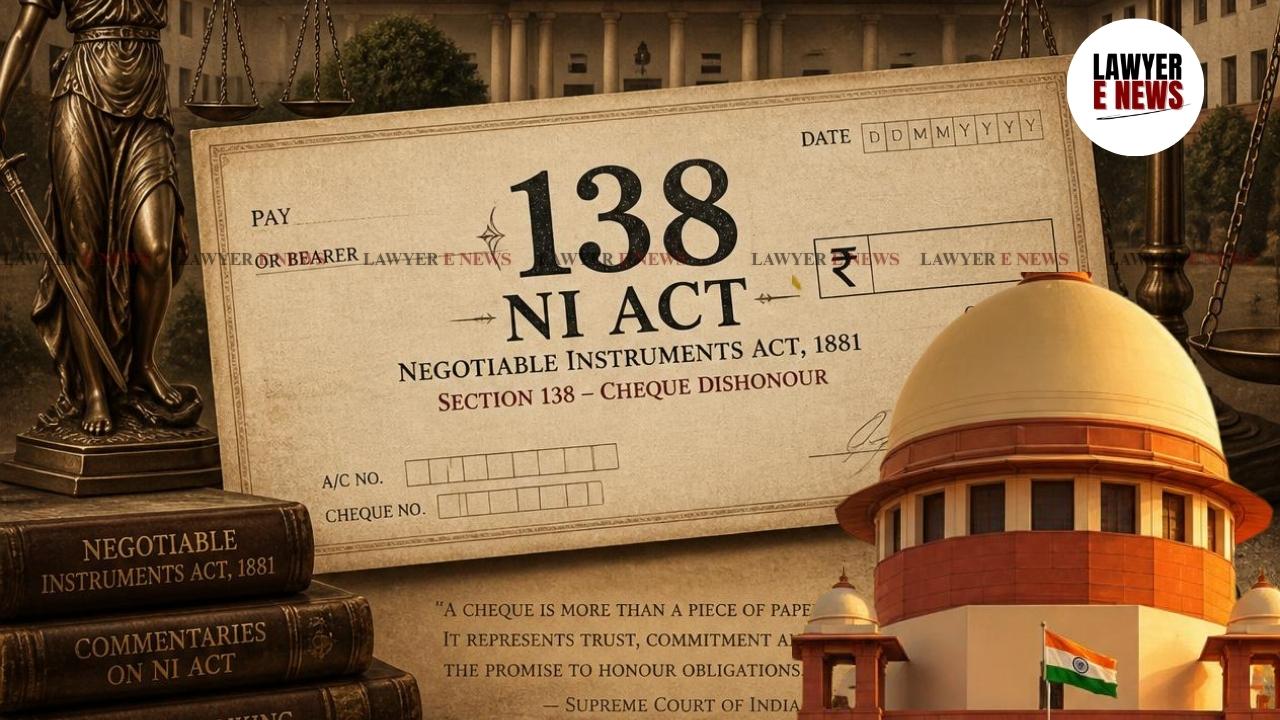
“Payee Under Section 138 NI Act Qualifies as ‘Victim’ Entitled to Direct Appeal Under Section 372 Cr.P.C.” — Punjab and Haryana High Court clarifying that victims of cheque dishonour offences under Section 138 of the Negotiable Instruments Act (NI Act) have a direct right of appeal against acquittal under Section 372 of the Code of Criminal Procedure, 1973 (Cr.P.C.) before the Sessions Court, without the necessity of seeking leave from the High Court under Section 378(4) Cr.P.C.
Justice Harpreet Singh Brar observed: “The complainant, being a payee or holder of a dishonoured cheque, is a victim within the meaning of Section 2(wa) Cr.P.C. and entitled to prefer an appeal under the Proviso to Section 372 Cr.P.C., without seeking prior leave from the High Court.”
A Shift in Appellate Rights for Cheque Dishonour Complaints
The appeal arose from a cheque bounce complaint filed by M/s Chawla Trading Company, where the Judicial Magistrate First Class, Ambala, acquitted the accused Darshan Singh on 10.06.2013 in a complaint involving dishonour of a cheque for ₹2,50,000. The complainant sought leave to appeal under Section 378(4) Cr.P.C. before the High Court.
Justice Brar, while considering the evolving legal position, held that recent authoritative pronouncements by the Supreme Court grant an unfettered right of appeal to victims under Section 372 Cr.P.C. and directed the appeal to be transferred to the Sessions Court.
Which Forum Is Correct for Appeal Against Acquittal in Section 138 NI Act Cases?
The core legal question before the High Court was whether a complainant under Section 138 NI Act is required to seek leave of the High Court under Section 378(4) Cr.P.C. or can directly appeal before the Sessions Court under the Proviso to Section 372 Cr.P.C.
Supreme Court’s Landmark Ruling in Celestium Financial Clarifies the Right of Victims
Justice Brar extensively quoted from the Supreme Court’s judgment in M/s Celestium Financial v. A. Gnanasekaran Etc., 2025 (3) RCR (Criminal) 208, where the Court authoritatively held:
“The victim of a crime must have an absolute right to prefer an appeal which cannot be circumscribed by any condition precedent… A payee or holder of a cheque is a victim within the meaning of Section 2(wa) Cr.P.C. entitled to appeal under Section 372 Cr.P.C.”
It was noted that while Section 378(4) Cr.P.C. requires leave of the High Court for complainants to appeal, the Proviso to Section 372 Cr.P.C. creates an independent and unconditional right of appeal for victims.
Interpretation Applies Retrospectively — Supreme Court Doctrine of Prospective Overruling Considered
Relying on the Supreme Court’s ruling in Directorate of Revenue Intelligence v. Raj Kumar Arora, Criminal Appeal No. 1319 of 2013 (decided 17.04.2025), the High Court reiterated the principle:
“A judgment interpreting a provision of law is retrospective in application, since it declares what the law always was, unless stated otherwise.”
Thus, the High Court held that the interpretation granting direct appeal rights to victims under Section 372 Cr.P.C. applies retrospectively even to pending cases like the present one.
High Court’s Analysis on Distinction Between Victim and Complainant
Justice Brar emphasized the distinct statutory rights:
“Section 378 Cr.P.C. requires leave only for complainants; whereas, the Proviso to Section 372 confers an unqualified right to appeal upon victims. Since a payee under Section 138 NI Act qualifies as a victim under Section 2(wa) Cr.P.C., such complainant can directly appeal before the Sessions Court.”
The Court cited supporting precedents from its own jurisdiction, including Raj Kumar v. Rajender, CRM-A-826-2025 (decided 07.07.2025), and Satish Kumar v. Jugal Kishor, CRM-A-2700-MA-2018 (decided 02.07.2025).
Details of the Judgment: Appeal Transferred to Sessions Court
In view of the above legal position, the High Court disposed of the appeal with the following directions:
“The Sessions Judge, Ambala, shall treat the present leave to appeal application as an appeal under Section 372 Cr.P.C. and entrust the same to the appropriate court for disposal on merits.”
The Registry was directed to transfer the complete record to the Sessions Court for further proceedings.
Victims in Cheque Dishonour Cases Have Direct Right of Appeal Before Sessions Court
Summing up, Justice Brar concluded:
“Victims in cheque dishonour complaints under Section 138 NI Act are entitled to file an appeal against acquittal directly before the Sessions Court under Section 372 Cr.P.C. without any leave requirement from the High Court.”
This judgment aligns with recent Supreme Court jurisprudence strengthening victims’ rights in cheque dishonour cases, simplifying appellate processes, and reducing procedural hurdles for complainants.
Date of Decision: 14 July 2025