-
by sayum
24 August 2026 6:22 AM







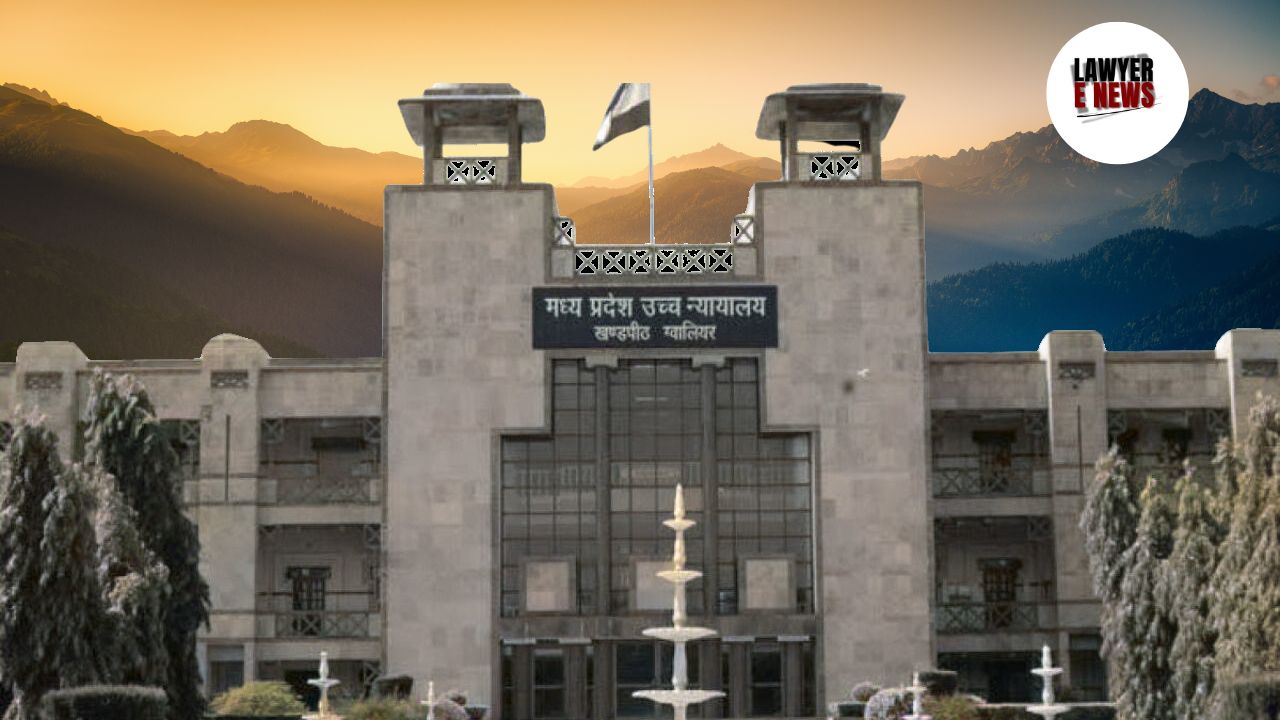
Judicial Review Not Warranted at Charge-Sheet Stage—Allegations of Negligence Must Be Decided in Inquiry: Madhya Pradesh High Court has dismissed a writ petition challenging a departmental charge-sheet, holding that mere issuance of a charge-sheet does not give rise to a cause of action warranting judicial interference under Article 226 of the Constitution.
Delivering the judgment on January 28, 2025, Justice Vinay Saraf emphasized that: “Issuance of a charge-sheet is not a punishment. Courts should refrain from interfering in disciplinary proceedings unless the charge-sheet is issued by an incompetent authority or violates principles of natural justice.”
The writ petition was filed by Ajay Singh Raghuvanshi, a retired General Manager of the M.P. Rural Road Development Authority (MPRRDA), challenging a charge-sheet issued on January 27, 2021, just three days before his retirement. The charge-sheet alleged lapses in the preparation of the Detailed Project Report (DPR) for a bridge over the Banganga River, which collapsed in August 2020 due to excessive rainfall and water discharge from the Sanjay Sarovar Dam.
"Negligence or Misconduct?—Departmental Inquiry Must Decide, Not the Court"
The petitioner contended that he played no role in preparing the DPR, as he was posted as General Manager, PIU-II, Seoni, only after the DPR had been prepared and initially sanctioned. He further argued that his only role was to sign a checklist under the Pradhan Mantri Gram Sadak Yojana (PMGSY), and even this was done based on approvals by higher authorities.
However, the High-Level Inquiry Committee found that the DPR contained major flaws, including failure to account for the presence of a major upstream dam that significantly impacted flood calculations. The Committee held that:
“The failure to include the impact of Sanjay Sarovar Dam in the DPR resulted in the bridge being submerged and ultimately destroyed. The petitioner, as the General Manager, failed in his duty to properly scrutinize the DPR before approving it.”
Rejecting the petitioner’s argument that negligence does not constitute misconduct, the Court held: “Whether the petitioner’s role was mere negligence or amounted to misconduct is a question of fact that must be determined in the departmental inquiry. The Court cannot conduct a roving inquiry at this preliminary stage.”
The Court relied on several Supreme Court precedents, including:
Union of India v. Kunisetty Satyanarayana, (2006) 12 SCC 28, which held that: “No writ lies against a mere charge-sheet unless issued by an incompetent authority or vitiated by mala fide.”
Executive Engineer, Bihar State Housing Board v. Ramdesh Kumar Singh, JT 1995 (8) SC 331, which ruled that: “Judicial review is not warranted at the charge-sheet stage.”
"Timing of Charge-Sheet Before Retirement Does Not Prove Mala Fide": Court Rejects Petitioner’s Allegations
The petitioner alleged that the charge-sheet was issued just three days before his retirement to harass him and with mala fide intent. The Court, however, dismissed this argument, holding that:
“The mere fact that a charge-sheet was issued before retirement does not establish mala fide intent. Since the alleged lapses occurred during the petitioner’s tenure, the employer was within its rights to initiate disciplinary proceedings.”
The Court cited the Supreme Court’s ruling in Special Director v. Mohd. Ghulam Ghouses, AIR 2004 SC 1467, stating: “A charge-sheet does not affect any fundamental right of an employee, and he is free to contest the allegations in departmental proceedings.”
"Charge-Sheet Does Not Violate Natural Justice—Petitioner Must Participate in Inquiry"
The petitioner argued that the charge-sheet was arbitrary, as he had no role in the DPR’s approval process. The Court, however, noted that the petitioner had signed key documents certifying the DPR’s correctness, which formed the basis for technical sanction.
“The petitioner’s signature on the DPR check-list suggests that he had at least some role in the process. Whether his actions were a mere lapse or professional misconduct must be examined through an inquiry, not a writ petition.”
The Court ruled that there was no violation of natural justice, as:
The charge-sheet did not impose any penalty.
The petitioner had an opportunity to defend himself before the inquiry officer.
"No Grounds for Judicial Interference—Petitioner Must Face Inquiry"
Dismissing the petition, the Court ruled: “This Court does not find any valid reason to interfere with the departmental proceedings. The petitioner must present his defense before the inquiry officer. The correctness of the allegations cannot be determined at this stage.”
Disciplinary Proceedings Must Follow Due Process, Courts Should Not Prematurely Intervene
The Madhya Pradesh High Court reaffirmed the settled legal principle that courts should not interfere with disciplinary proceedings at the charge-sheet stage. The petitioner remains free to contest the allegations before the inquiry officer, but he cannot seek premature judicial intervention.
The writ petition was dismissed, with the Court refraining from imposing costs but making it clear that departmental inquiries must be allowed to proceed without unnecessary judicial obstruction.
This judgment reinforces the judiciary’s reluctance to interfere in internal disciplinary processes, emphasizing that allegations of negligence or misconduct must be assessed through established inquiry mechanisms.
Date of Decision: 28/01/2025