-
by sayum
28 August 2026 12:24 PM







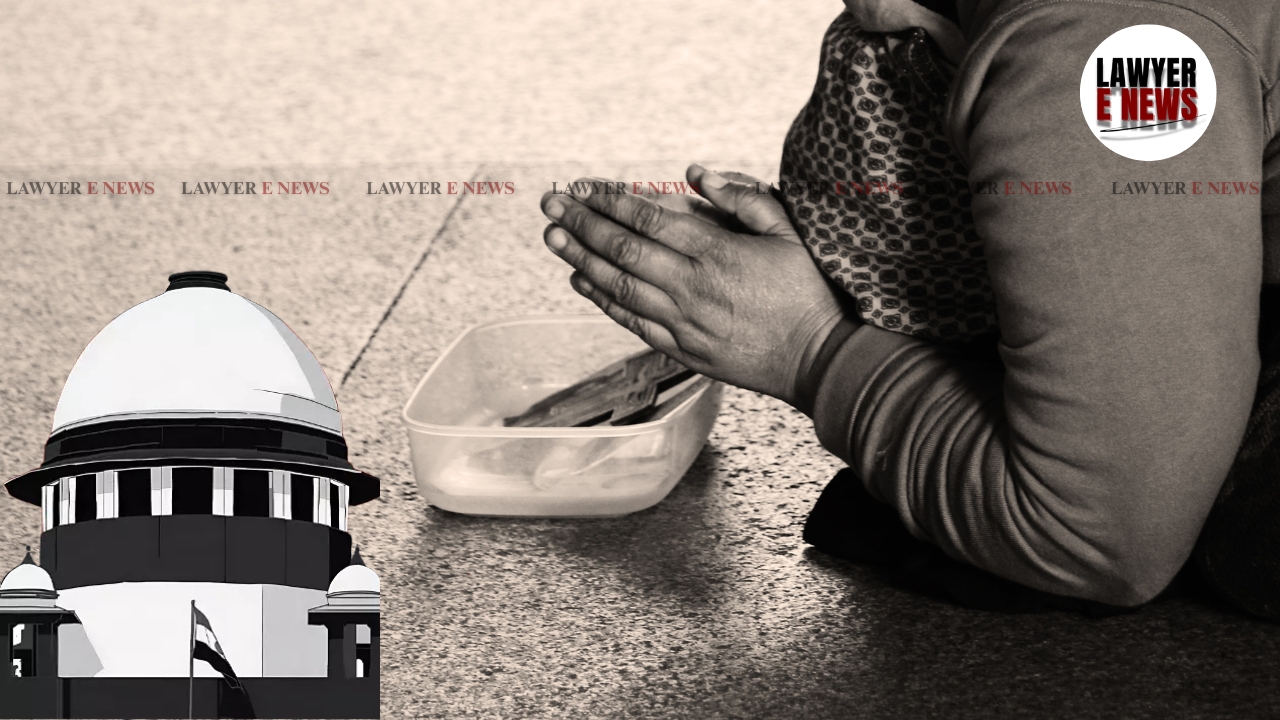
“Beggars’ Homes Must Be Constitutional Sanctuaries, Not Quasi-Penal Institutions”— Supreme Court of India delivered a landmark ruling on the constitutional rights of beggars and destitute persons institutionalized in government-run Homes. A Bench comprising Justice J.B. Pardiwala and Justice R. Mahadevan held that the deaths caused by cholera in the Lampur Beggars’ Home in Delhi, following a contaminated water outbreak, amounted to a grave violation of the right to life and dignity under Article 21 of the Constitution.
The Court condemned the colonial legacy of anti-begging laws, the punitive and custodial nature of certified institutions, and directed an all-India structural reform in the administration and functioning of Beggars’ Homes, transforming them from penal-style shelters into spaces of rehabilitation, dignity, and constitutional care.
Calling for a "paradigm shift from control to compassion," the Court emphasized that persons housed in Beggars' Homes are not convicts or undertrials but vulnerable citizens entitled to the full protection of fundamental rights.
“To Treat Poverty as a Crime Is to Betray the Constitution”—Supreme Court Calls Out Colonial Mindset in Anti-Begging Laws
The Court’s analysis traced the historical trajectory of vagrancy laws, stating that their origins in the Elizabethan Poor Laws of 1601 and their subsequent adoption during British colonial rule in India reflected a deeply punitive and moralistic view of poverty. Observing that "the suspicion of poverty as a moral failing rather than a socio-economic condition has informed anti-begging statutes in independent India too," the Court called this a “jurisprudential anachronism”.
“The Indian constitutional framework post-1950 marks a decisive normative shift,” the Court held, referencing Articles 38, 39(e), 41, and 47 of the Directive Principles. “These provisions articulate the constitutional expectation of a compassionate State—one that acts as a trustee of the well-being of the poor, the sick, and the destitute.”
Justice Mahadevan wrote, “A beggars’ home, maintained by the State, is thus a constitutional trust—not a discretionary charity. Its administration must reflect the values of constitutional morality—ensuring liberty, privacy, bodily autonomy, and dignified living conditions.”
“Even Prisoners Enjoy Dignity—Beggars, Who Are Not Offenders, Deserve No Less”
Relying on Francis Coralie Mullin v. Administrator, Union Territory of Delhi (1981) and Inhuman Conditions in 1382 Prisons, In Re (2016), the Supreme Court underscored that Article 21 has been judicially expanded to include the right to health, dignity, shelter, and humane treatment.
Quoting the Francis Coralie Mullin judgment, the Bench reminded: “The right to life includes the right to live with human dignity and all that goes along with it, namely, the bare necessaries of life such as adequate nutrition, clothing and shelter…”
The Court was categorical in holding that inmates of Beggars’ Homes must be treated with the same, if not greater, constitutional compassion as convicted prisoners, because they are not offenders under any penal law.
“Institutionalisation, if at all necessary, must be in the nature of protective custody and must be accompanied by meaningful rehabilitation—not coercive detention,” the Court observed.
Deaths from Cholera in Delhi Beggars’ Home a Direct Constitutional Breach—State Cannot Escape Liability by Blaming Bureaucracy
The case originated in 2000, when the petitioner, M.S. Patter, filed a Public Interest Litigation after multiple reports emerged about the death of at least six inmates and hospitalization of over a hundred more due to a cholera outbreak at the Lampur Beggars’ Home in Delhi. Subsequent inquiries revealed contamination of drinking water due to broken sewerage, malfunctioning chlorinators, and administrative neglect.
The Court declared these deaths to be a direct violation of Article 21, noting that the State’s attempts to downplay the deaths as “natural” and disown responsibility were factually and morally indefensible.
The judgment recorded: “The presence of E. coli, faecal contamination, and non-functional chlorinator systems are not administrative lapses but constitutional infractions when they result in preventable deaths of those in State custody.”
It also held that disciplinary actions alone were not sufficient, and that “compliance is not merely administrative but constitutional in nature”.
Court Monitored Reforms Since 2004 Resulted in Compliance—but Orders All-India Implementation to Prevent Repeat Tragedies
While noting that the Delhi Government had taken several corrective steps—including improvements in sanitation, staffing, diet, vocational training, medical facilities, and overall living conditions—the Supreme Court emphasized that such progress must not remain an isolated compliance under judicial supervision.
“The progress achieved should not remain confined to the Homes that were subject to scrutiny in the present case,” the Court noted. “All States and Union Territories are required to institutionalise similar reforms in Beggars’ Homes and analogous institutions under their control.”
The Court further observed that “the administration of such institutions cannot be left to the vagaries of under-staffed departments or ad hoc measures. They must function under a constitutional framework.”
“The State’s Duty Is Not Charity, But Justice”—Nationwide Binding Guidelines Issued for Humane and Dignified Institutional Care
In its final directions, the Court issued a model constitutional framework for all Beggars’ Homes across India, mandating reforms in eight key areas, including medical care, sanitation, infrastructure audits, food safety, vocational training, legal aid, gender sensitivity, and accountability mechanisms.
“The Union of India, through the Ministry of Social Justice and Empowerment, shall, within three months, frame and notify model guidelines to facilitate uniform implementation of the aforesaid directions,” the Court directed.
It also mandated that every death due to negligence in such institutions shall trigger both compensation and departmental/criminal action against the erring officials.
Liberty was granted to the parties to approach the Court again for further directions if any difficulties arose in implementation.
From Penalism to Protection—Supreme Court Rewrites the Future of Institutional Care for the Marginalised
In unequivocal terms, the Supreme Court reframed the relationship between the State and the destitute, rejecting paternalism and affirming constitutional trust.
By holding that failure to maintain humane conditions in Beggars’ Homes is a violation of fundamental rights, the Court has transformed the jurisprudence on poverty, dignity, and institutionalisation in India.
As Justice Pardiwala aptly concluded: “The failure to ensure humane conditions in such Homes does not merely amount to maladministration; it constitutes a constitutional breach of the fundamental right to life with dignity.”
Date of Decision: 12 September 2025