
-
by sayum
29 August 2026 3:15 PM







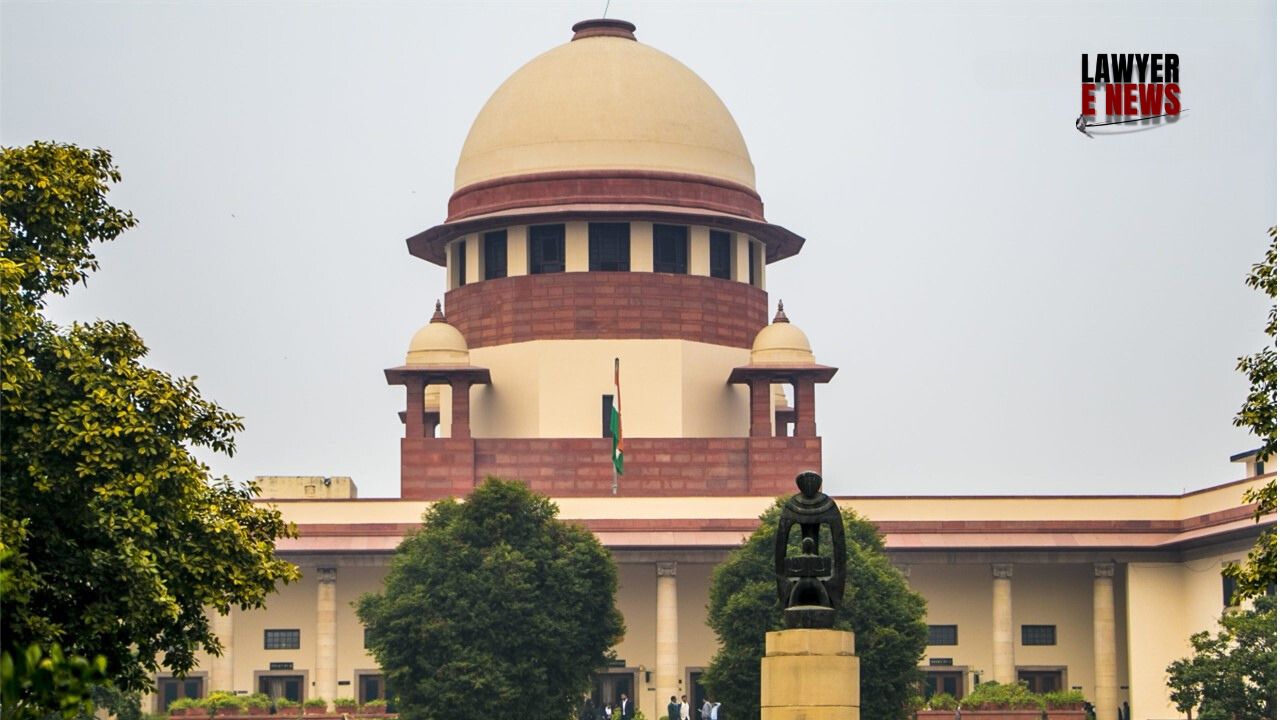
“Judicial Discretion Cannot Be Arbitrary — Bail Order Without Reasons Is Unsustainable”, In a judgment that reaffirms the foundational principle of judicial accountability, the Supreme Court of India set aside a bail order granted by the Jharkhand High Court on the ground that it lacked any judicial reasoning.
The High Court had released the respondent-accused on bail in a high-profile murder case involving the assassination of a mining project coordinator and his bodyguard, without recording any reasons or applying its mind to the seriousness of the allegations or the accused’s long history of criminal antecedents.
Setting aside the order, the Supreme Court held emphatically:
“Bail in a case involving serious offences and multiple criminal antecedents cannot be granted mechanically, without assigning reasons. Judicial discretion must be backed by judicial reasoning.”
The case arose out of the murder of Sharat Babu, a project coordinator in the Chatti Bariatu Mining Project, and his bodyguard, Rajendra Prasad, who were ambushed and shot dead on May 9, 2023, while on their way to the company office in Hazaribagh, Jharkhand. The attack, allegedly orchestrated by a group of armed assailants, led to registration of FIR No. 156/2023 under Sections 302, 307, 333, 353 read with Section 34 of IPC and Section 27 of the Arms Act.
During the investigation, the respondent, Jugeshwar Mahto alias Yogeshwar Mahto, was named by co-accused and subsequently arrested on September 5, 2023. A chargesheet was filed on November 16, 2023 naming six accused, including the respondent.
A bail application filed before the Trial Court was rejected after noting the respondent’s confessional statement, his involvement as disclosed by co-accused, and the fact that he had over twenty-five pending criminal cases.
However, in a brief, non-speaking order, the Jharkhand High Court, on April 8, 2024, granted bail to the respondent without assigning any reasons, prompting the State to file the present appeal before the Supreme Court.
“When Liberty Is at Stake, Reason Must Prevail”
The Supreme Court found the High Court’s order wholly unsustainable in law. The Bench comprising Justice B.V. Nagarathna and Justice K.V. Viswanathan held:
“The High Court has straightaway proceeded to state that it is inclined to release the respondent on bail… without assigning any reasons.” [Para 13]
The Court noted the gravity of the charges, including murder and use of firearms, and observed:
“The respondent is alleged to be involved in a murder which took place in broad daylight… The charges against him are under serious penal provisions of the IPC and Arms Act.” [Para 14]
The Bench also took note of the State’s affidavit, which showed that the respondent had a long record of more than twenty criminal cases against him, and was not named in the FIR but identified during investigation through the statements of co-accused. This, the Court observed, was a material fact that should have been considered.
“Judicial Discretion Is Not Unfettered — It Must Be Guided by Reason”
The Court strongly emphasised that grant of bail, especially in heinous offences, must be accompanied by a reasoned order:
“Absence of reasons leads to arbitrary exercise of discretion. Such orders cannot withstand judicial scrutiny.” [Para 14]
The Supreme Court reiterated the settled position of law that bail orders must reflect an application of mind to the nature of allegations, evidence collected, and the antecedents of the accused. It reminded the courts below that grant of bail is not a matter of routine, especially in cases involving murder, organised crime or acts that shake public confidence.
“The Respondent Shall Be Deemed to Be in Judicial Custody”
On setting aside the bail order, the Court clarified that the respondent, who was already in custody for other cases, “shall now be recorded as having surrendered in the present case”. This effectively ensures that the accused does not gain undue benefit from the earlier grant of bail.
The Court concluded:
“We find that the appellant/State has made out a case for setting aside the impugned order. Consequently, the impugned order is set aside.” [Para 18]
This judgment sends a clear message to High Courts and subordinate judiciary: granting bail in serious criminal matters without reasons violates judicial discipline and invites correction from constitutional courts. The Supreme Court has yet again affirmed that liberty and justice are not mutually exclusive, and that the exercise of judicial discretion must be reasoned, responsible, and in tune with the rule of law.
By setting aside the bail of an accused with over two dozen prior cases in a brutal double murder, the Court has underscored the importance of balancing individual rights with societal interest and integrity of criminal trials.
Date of Decision: August 8, 2025