-
by sayum
29 August 2026 3:15 PM







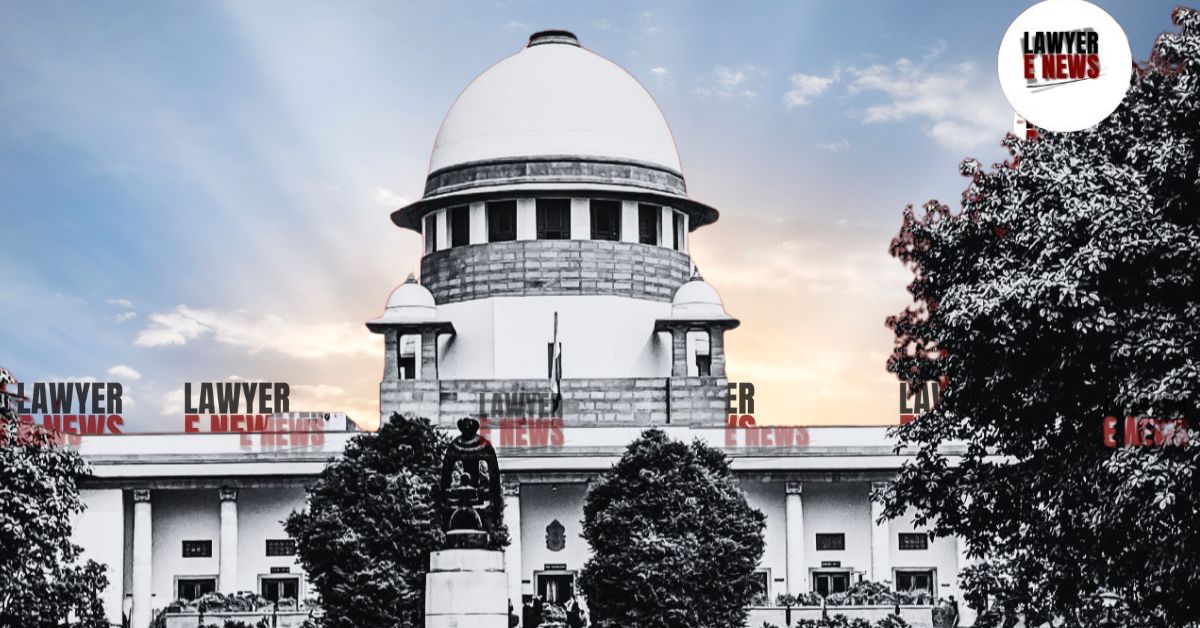
“Continued Custody Without Trial Is Injustice: 5.5 Years Without Charges Cannot Be Justified” — Supreme Court delivering a crucial judgment on bail under anti-terror law UAPA. The Court refused to cancel bail granted to an accused imprisoned for over five years without trial, while simultaneously upholding denial of bail to another accused with direct links to banned terrorist outfits.
“Accused Cannot Be Allowed to Languish in Jail Without Trial”
In a landmark decision that navigates the constitutional right to liberty under a stringent anti-terror regime, the Supreme Court of India declared that an accused cannot be subjected to indefinite incarceration without the commencement of trial. While dealing with twin appeals, the bench comprising Justice Vikram Nath and Justice K.V. Viswanathan made significant observations on the application of UAPA and the limits of pre-trial detention.
“The trial has not commenced despite lapse of 5-1/2 years. Accused cannot be allowed to languish in jail without being given a fair and speedy trial,” the Court observed, setting a firm deadline of two years for the trial’s conclusion.
Arrests Under UAPA for Alleged Terror Links and Conspiracy
The origin of the case lies in an FIR dated January 10, 2020, registered at Suddanguntepalaya Police Station, Bangalore, on the basis of information from the Economic Offences Wing. The FIR invoked serious charges under:
Sections 120-B IPC,
Section 25(1B)(a) of the Arms Act,
Sections 18, 18-A, 18-B, 19, 20, 38 & 39 of the Unlawful Activities (Prevention) Act, 1967 (UAPA).
The case was later transferred to the National Investigation Agency (NIA) and re-registered as RC No.4/2020/NIA/DLI. The two appellants before the Supreme Court were:
Saleem Khan (Accused No.11), arrested on 20.01.2020,
Mohd. Zaid (Accused No.20), secured under warrant on 09.03.2020.
The charge-sheet was filed on 13.07.2020, but even after 5.5 years, no charges were framed and the trial had not commenced.
Can Bail Be Cancelled Under UAPA When Accused Is Associated With an Organisation Not Declared Banned?
The High Court of Karnataka, in an order dated 21.04.2022, granted bail to Saleem Khan while denying the same to Mohd. Zaid. The Union of India challenged the grant of bail, contending that Saleem Khan’s association with the “AL-Hind” group indicated a larger conspiracy.
However, the Supreme Court dismissed the Union's appeal, upholding the High Court’s reasoning.
“The allegations found in the charge-sheet related to his connections with an organisation by the name of AL-Hind, which admittedly is not a banned organisation under the schedule to UAPA,” the Court noted.
“To say that he was attending meetings of the said organisation, AL-Hind and others would not amount to any prima facie offence,” the bench held, decisively clarifying that mere association without overt unlawful acts cannot justify charges under UAPA.
Can Bail Be Denied Based on Alleged Role in Operating Dark Web and Aiding Banned Terrorist Organisations?
In contrast, the Court upheld the denial of bail to Mohd. Zaid, who had approached the Supreme Court challenging the High Court's refusal.
The Court found the High Court's analysis to be sound and based on material from the investigation:
“The High Court has found his involvement with banned terrorist organisations, his active role in operating dark web and assisting the members of the banned terrorist organisations,” the judgment stated.
Even though Zaid was granted bail in another UAPA case by the Madras High Court, the bench observed that in the current case, the nature of evidence and allegations were of graver import.
Details of the Judgment: Supreme Court Declines to Interfere in Bail Decisions, But Demands Speedy Trial
The Supreme Court refused to interfere with the Karnataka High Court’s well-reasoned order, stating:
“We are not inclined to delve deep into the facts and the reasonings… The reasons given for grant of bail to Saleem Khan… and the reasons given for refusal to grant bail to Mohd. Zaid… is fully justified and reasonable.”
At the same time, it expressed dismay at the delay in prosecution:
“It may not be just and proper to interfere… when the accused has already been in custody for 5-1/2 years.”
Recognising that there are over 100 witnesses, the Court issued a strict direction:
“The Trial Court be directed to expedite the trial and conclude the same within a period of two years… The prosecution is also directed to ensure full cooperation… It also goes without saying that the accused will also extend full co-operation.”
Importantly, it warned that any attempt by the accused to delay trial could result in cancellation of bail.
Bail and Liberty Must Balance With National Security — But Delay Cannot Be Weaponised Against Accused
The judgment offers a judicious blend of constitutional liberty and national security imperatives. It recognises that UAPA is a potent tool, but also that bail is not to be denied solely on suspicion, especially when trials are inordinately delayed.
“We do not find any justification to interfere…” the Court concluded, dismissing both appeals — one by the Union seeking cancellation of bail, and the other by Zaid seeking grant of bail.
Date of Decision: August 20, 2025