-
by sayum
23 August 2026 2:56 PM







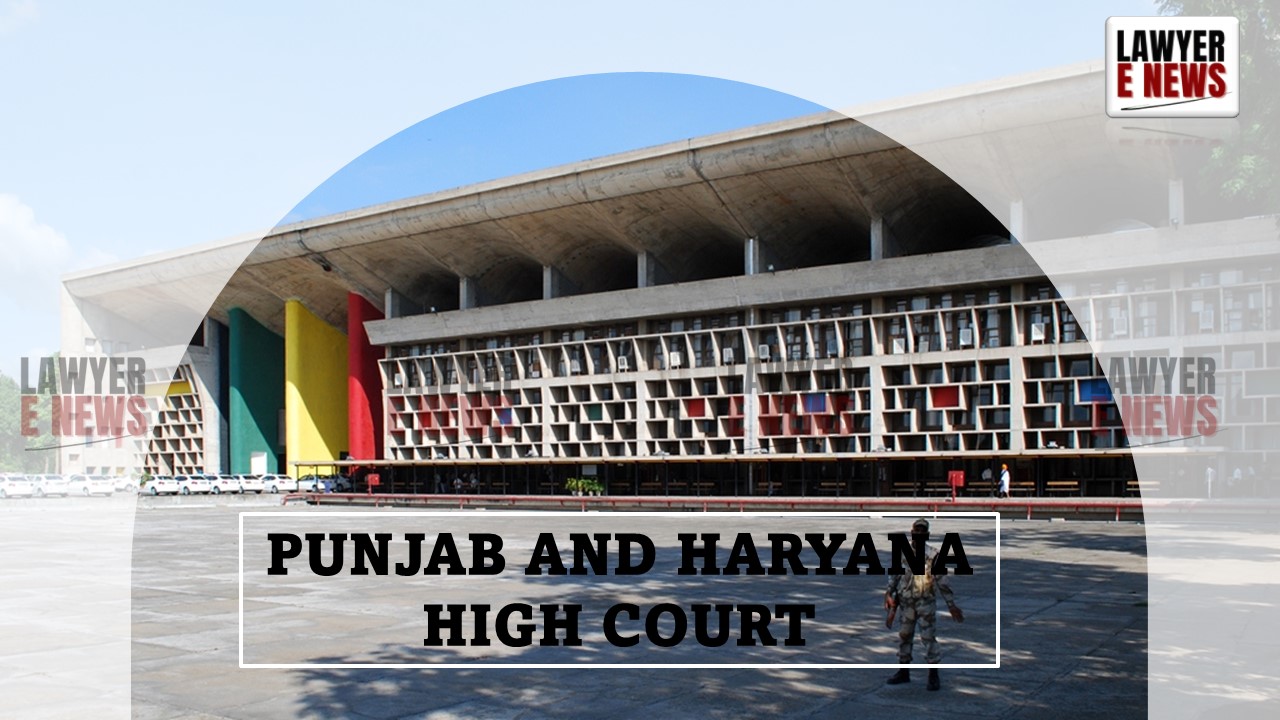
“Every life deserves a certain amount of dignity, no matter how poor or damaged the shell that carries it”— In a seminal ruling, the Punjab & Haryana High Court, comprising Justice Ashwani Kumar Mishra and Justice Rohit Kapoor, has commuted the death penalty of two convicts involved in the gruesome kidnapping and murder of a 16-year-old boy to life imprisonment for the remainder of their natural lives.
The Constitutional Shield on Death Row
The Division Bench, allowing the Letters Patent Appeals in Vikram Singh @ Vicky Walia & Jasbir Singh @ Jassa v. State of Punjab, held that the fundamental right to life and human dignity under Article 21 of the Constitution does not extinguish even after a convict has been condemned to death. The Court set aside the Single Judge's order, ruling that the cumulative effect of illegal solitary confinement, inordinate delay in deciding mercy petitions, and procedural lapses constituted sufficient "supervening circumstances" to warrant commutation.
“The fundamental right under Article 21, does not get extinguished even after a convict has been condemned to death and if the basic right of human dignity... is infringed, before the execution of such convicts, the same may be considered as a ground for commuting the death sentence.”
Illegal Solitary Confinement: The ‘Sunil Batra’ Standard
A pivotal aspect of the judgment was the Court's finding on the illegal segregation of the appellants. The Bench noted that the convicts were kept in separate cells from December 2006 to 2009, long before their death sentences became "final, conclusive and indefeasible." Relying on the Supreme Court’s dictum in Sunil Batra v. Delhi Administration, the High Court clarified that Section 30(2) of the Prisons Act, 1894, which permits the confinement of a prisoner under sentence of death in a cell apart from others, applies only when the death sentence is executable and beyond judicial or constitutional review.
The Court termed the segregation prior to the exhaustion of judicial remedies as violative of Article 21, rejecting the State's defense that the prisoners were merely kept in "statutory segregation."
“To see a fellow being is a solace to the soul. Communication with one's own kind is a balm to the aching spirit. Denial of both, with complete segregation superimposed, is the journey to insanity.”
Executive Apathy and The Agony of Delay
The judgment delivered a stinging critique of the executive apathy displayed by the State authorities. The Court calculated an "unreasonable and unexplained delay" of more than four years attributable solely to the State. This included a failure to inform the convicts of their right to file mercy petitions, misrouting petitions to the President instead of the Governor, and a one-year delay in merely communicating the rejection of the mercy plea to the convicts.
The Bench observed that the appellants were forced to live in the "shadow of death" for over twenty years. Citing Shatrughan Chauhan v. Union of India, the Court held that keeping a convict in suspense creates adverse physical conditions and psychological stress—often referred to as the Death Row Phenomenon—which amounts to torture.
“As between funeral fire and mental worry, it is the latter which is more devastating, for, funeral fire burns only the dead body while the mental body burns the living one.”
Balancing Justice with Societal Interest
While acknowledging the heinous nature of the crime—the kidnapping and murder of a young student for ransom—the Court held that gravity of the offence is irrelevant in post-mercy proceedings where the focus shifts to the violation of the convict's constitutional rights.
However, striking a balance between the rights of the convicts and the cry of the victim for justice, the Bench refused to grant a simple life imprisonment which would attract remission. Instead, the Court substituted the death penalty with imprisonment for the remainder of their natural lives, explicitly barring any commutation or premature release under any statute.
Date of Decision: 19/12/2025