-
by sayum
29 August 2026 9:28 AM







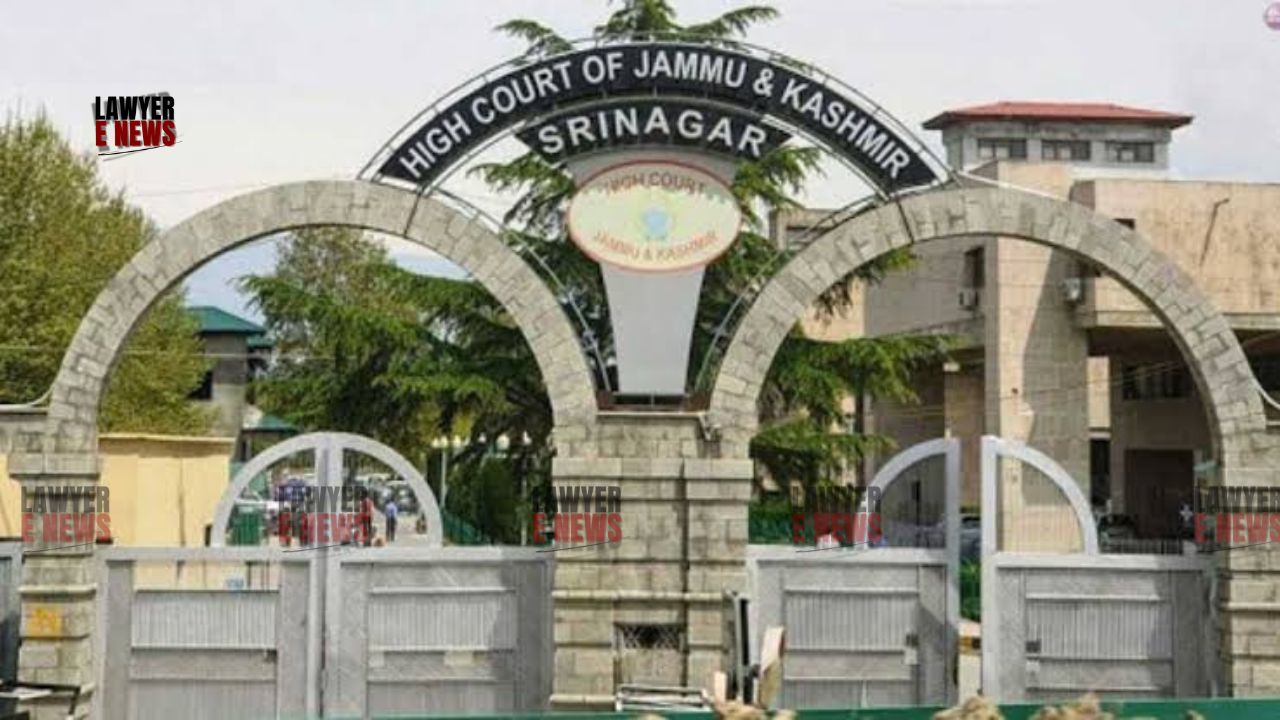
In a significant pronouncement on service jurisprudence and constitutional equality, the High Court of Jammu & Kashmir and Ladakh at Srinagar holding that the exclusion of academic arrangement appointees from the purview of the Jammu and Kashmir Civil Services (Special Provisions) Act, 2010 does not violate Articles 14 and 16 of the Constitution. The Division Bench of Justices Sanjeev Kumar and Sanjay Parihar observed that the classification made by the Act between different categories of appointees was constitutionally valid and rooted in intelligible differentia.
The Court concluded, "Article 14 does not require that persons unequally situated must be treated alike. Equality before law mandates equal treatment of equals, not of unequals."
The judgment partially set aside the Tribunal’s earlier decision and directed the government to initiate a scrutiny-based regularization process for certain eligible appointees engaged prior to the commencement of the 2010 Act.
“Nomenclature is Irrelevant; Nature of Appointment Governs Eligibility for Regularization”
The central issue in the case revolved around whether contractual lecturers appointed on an academic arrangement basis—some having served since 2003—could be treated at par with those engaged on ad hoc, contractual, or consolidated terms under the J&K Civil Services (Special Provisions) Act, 2010. The petitioners had challenged the constitutional validity of Sections 3(b), 10(2), and 10(2A) of the Act, which explicitly excluded "academic arrangement" appointees from regularization benefits.
Rejecting the government’s rigid reliance on the term “academic arrangement”, the Court clarified, “It is not the nomenclature but the nature of the appointment and the terms and conditions subject to which it is made that determines whether the appointment qualifies to be an ad hoc, contractual, or consolidated appointment.”
On facts, the Court found that many of the petitioners were engaged against sanctioned posts, had served for more than seven years, and were paid consolidated salaries. Such appointments, the Court held, fall squarely within the scope of the Act’s protection, regardless of how the government labeled them.
“Academic Arrangements Are Not Meant to Become Perennial Employment Substitutes”
Tracing the legislative intent behind the J&K Civil Services (Special Provisions) Act, 2010, the Court noted that the law was designed to regularize only those temporary employees who were working against clear vacancies on ad hoc, contractual, or consolidated basis.
Discussing the distinction between such appointments and academic arrangements, the Court stated: “Academic arrangements are created to meet seasonal or fluctuating demands in colleges based on student enrollment, and do not require the existence of clear vacancies. This fundamental difference forms a rational basis for their exclusion.”
The Court condemned the government’s prolonged reliance on temporary academic appointments in degree colleges, noting that, “The respondents have failed either to create additional posts or to fill up existing vacancies of lecturers. Government Degree Colleges are being run almost entirely on stop-gap academic arrangements year after year.”
This, according to the Court, “compromises educational standards and denies equal opportunity to meritorious candidates who wait for regular appointments through the Public Service Commission.”
"Appointments Cannot Be Denied Regularization Simply Due to a Misleading Label"
In a particularly emphatic portion of the judgment, the Bench held: “Appointments that meet the criteria laid out in the Act—made against clear vacancies, continued for more than seven years—cannot be denied regularization merely because they were labeled as ‘academic arrangement’.”
The Court recognized that many petitioners had continued in service for years, often under protection of interim orders of courts or tribunals, and had fulfilled all material conditions under the 2010 Act. Their continued engagement, performance of full-time teaching duties, and payment from government funds rather than college funds all pointed to a de facto contractual or consolidated employment.
Hence, the Court held, “Such engagements cannot be excluded from the benefit of regularization envisaged under the Act of 2010.”
Court Issues Mandamus to Identify Eligible Candidates for Regularization
While upholding the constitutional validity of the impugned provisions, the High Court proceeded to protect the rights of genuinely eligible appointees. It directed the government to constitute a High-Level Committee headed by the Chief Secretary to identify all candidates who:
Were engaged prior to the commencement of the 2010 Act
Were appointed against clear sanctioned vacancies
Have completed seven years or more of continuous service
The Court ordered that such eligible appointees be regularized under the Act. It further directed that “those who completed seven years before the Act came into force shall be regularized from the date of commencement of the Act, while those who completed seven years thereafter shall be regularized from the actual date of eligibility.”
The Court unequivocally barred the government from continuing with future academic arrangements in the same manner, directing that “no fresh academic arrangements shall be made against clear vacancies” and that such vacancies be referred to the J&K Public Service Commission for regular recruitment.
Classification is Constitutionally Valid: “There Exists an Intelligible Differentia”
On the challenge to Section 3(b) of the Act, the High Court observed that the classification between contractual/ad hoc/consolidated appointees and academic arrangement employees was legitimate. The Court relied on the Constitution Bench decision in State of West Bengal v. Anwar Ali Sarkar to reiterate that Article 14 permits reasonable classification based on intelligible differentia.
It stated: “Tenure appointments, or for that matter academic arrangement appointments, are not intended to continue beyond the academic session and therefore constitute a class altogether different from ad hoc, contractual, or consolidated appointments.”
Accordingly, the Court held that the exclusion under Section 3(b) was “neither arbitrary nor discriminatory, but rather consistent with the object of the Act.”
A Cautionary Note: “2010 Act Itself is Constitutionally Vulnerable, But Not Under Challenge Here”
In a rare but candid observation, the Bench commented that the 2010 Act, which itself legalized backdoor appointments and avoided fair recruitment under Articles 14 and 16, was “constitutionally vulnerable”. However, since the validity of the Act as a whole was not under challenge, and the Act has since been repealed post-reorganization of the State, the Court left the issue open.
It observed: “The Act of 2010, which aims at regularizing the services of temporary employees appointed on ad hoc, contractual, or consolidated basis, therefore strikes at the root of Articles 14 and 16 of the Constitution… but this question is rendered academic in the present case.”
Clear Mandate to Government to End Ad Hocism and Restore Constitutional Recruitment
With clarity and constitutional reasoning, the High Court concluded: “Holding a post for more than seven years against a sanctioned vacancy cannot be brushed aside merely by invoking the label of ‘academic arrangement’.”
The judgment stands as a strong critique of bureaucratic inertia, temporary governance, and educational mismanagement, and sends a message to the administration that constitutional rights cannot be compromised by mere contractual wording.
Date of Decision: 30 August 2025