-
by sayum
08 August 2026 1:54 PM







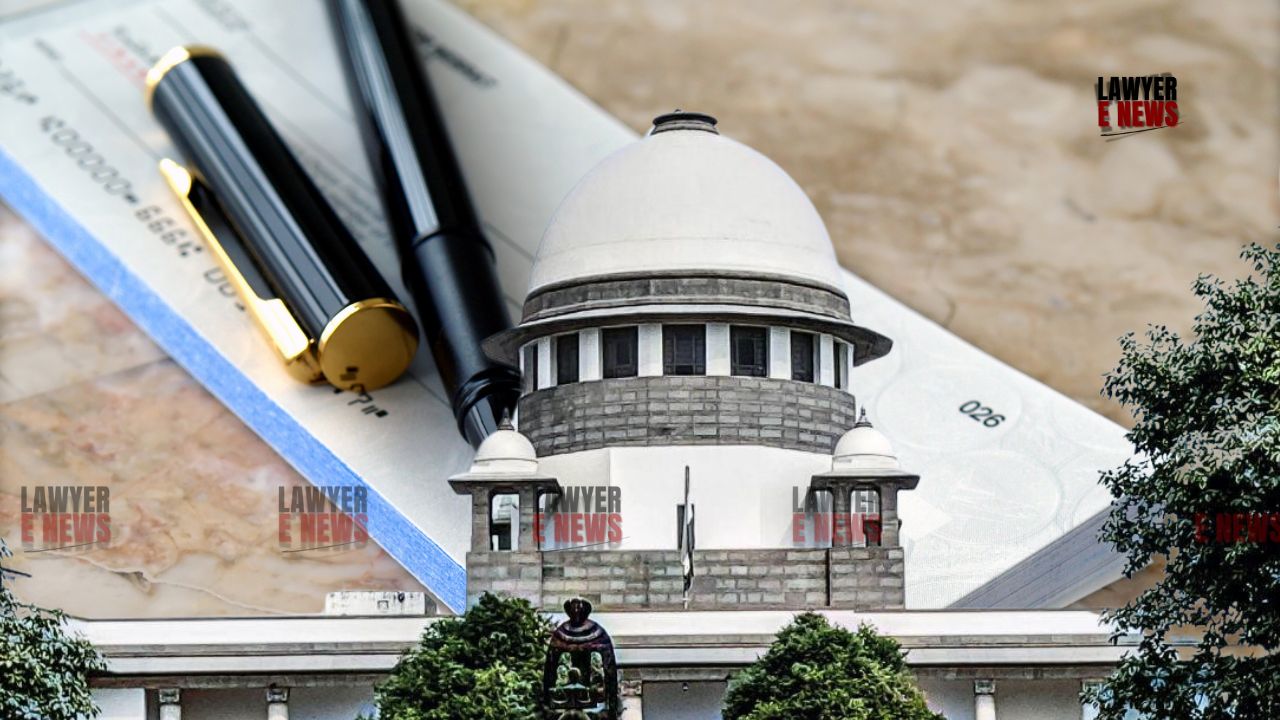
“Procedure is only a handmaiden and not a mistress of justice. However, the said adage has been followed only in the breach in this case.” - Supreme Court delivered a key judgment reiterating that criminal procedure must serve justice, not frustrate it. Addressing the permissibility of amending a complaint under Section 138 of the Negotiable Instruments Act, 1881, the Court held that such an amendment—even after cognizance is taken—is legally valid if it does not prejudice the accused and merely cures a formal or typographical error.
The Court observed that “a simple issue of an amendment to a complaint has held up a trial under Section 138... for nearly two years” and strongly criticized the High Court for allowing technical objections to obstruct the course of justice.
The appellant, Bansal Milk Chilling Centre, had filed a complaint on 8 April 2022 under Section 138 of the NI Act, alleging that the respondents had purchased dairy products and issued three cheques totaling ₹14 lakhs, which were dishonored. Summons were issued. Before cross-examination of the complainant, an application was filed seeking to amend the complaint—specifically, to correct a factual assertion that the respondents had purchased “Desi Ghee (milk products)” to “milk”, stating that this was a typographical mistake.
The Trial Court allowed the amendment, finding that it was moved at an initial stage and caused no prejudice to the accused. However, the Punjab and Haryana High Court set aside that order, declaring that the amendment was not merely clerical but altered the nature of the complaint, and suspected that it was designed to avoid liability under GST, since milk attracts no tax, unlike Desi Ghee.
The pivotal legal question before the Supreme Court was whether an amendment to a criminal complaint under Section 138 NI Act can be permitted after cognizance is taken, particularly when it seeks to rectify a factual misstatement.
The Court emphatically held that such an amendment can be permitted, stating:
“It is fallacious to contend that in no circumstance can amendments to complaints be allowed after cognizance is taken.”
Citing its own decision in S.R. Sukumar v. S. Sunaad Raghuram (2015) 9 SCC 609, the Court reaffirmed that:
“If the amendment sought to be made relates to a simple infirmity which is curable by means of a formal amendment and by allowing such amendment, no prejudice could be caused to the other side... the court may permit such an amendment.”
The Court rejected the High Court’s view that the change from "Desi Ghee" to "milk" altered the complaint’s nature or was made to manipulate GST liability. It observed:
“The High Court completely misdirected itself in delving into the aspects of leviability of GST which would be the concern of the appropriate authorities under the relevant statute.”
More importantly, it reminded that the fundamental test is whether any prejudice is caused to the accused. In this case, the Court found none, noting: “The amendment was moved at a stage when... cross-examination was awaited... and it could not be said that by allowing the amendment, failure of justice would occasion.”
Invoking the celebrated ruling in U.P. Pollution Control Board v. Modi Distillery (1987) 3 SCC 684, the Court underlined that criminal prosecutions should not be quashed for easily curable flaws. It quoted with approval: “It would be a travesty of justice if the big business house... is allowed to defeat the prosecution launched and avoid facing the trial on a technical flaw which is not incurable.”
The Supreme Court set aside the order passed by the High Court in CRM-M No. 53932 of 2023 and restored the Trial Court’s order dated 2 September 2023 allowing the amendment. The bench directed the Trial Court to proceed expeditiously and clarified that the parties are at liberty to apply for recall of witnesses already examined, if necessary.
The Court concluded: “It was a curable irregularity which the Trial Court rightly addressed by allowing the amendment. It could not be said that the amendment altered the nature and character of the complaint.”
This judgment reaffirms a vital procedural safeguard: Courts must not allow justice to be derailed by hyper-technicalities, especially where no real prejudice is shown. The Supreme Court has emphatically held that the NI Act does not bar amendments to complaints, even after cognizance is taken, so long as the core complaint remains the same and the accused suffers no unfair disadvantage.
By asserting that “procedure is only a handmaiden and not a mistress of justice”, the Court delivered a strong message against overformalism and ensured that complainants are not punished for curable drafting errors.
Date of Decision: 25 July 2025