-
by sayum
29 August 2026 3:15 PM







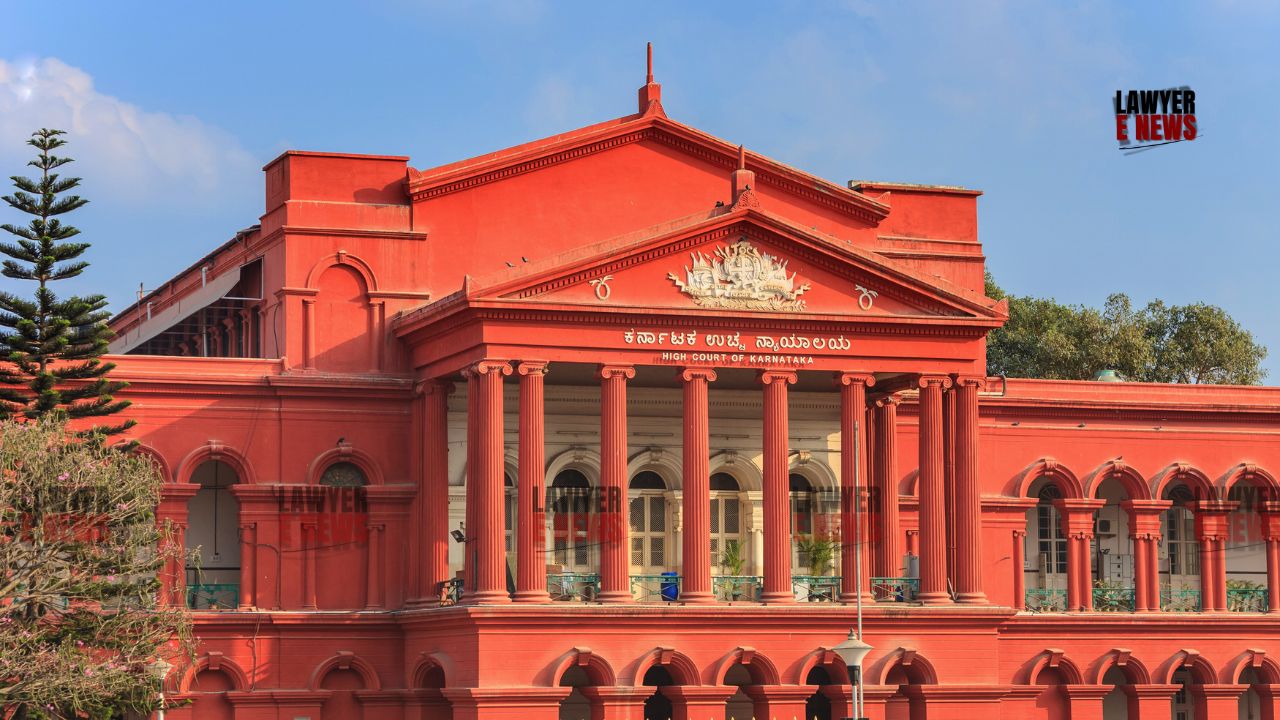
“A person becomes a candidate only upon filing a valid nomination—any conduct prior to that cannot be judged as corrupt practice under election law,” declared the Karnataka High Court while dismissing an election petition alleging large-scale bribery against the Congress MP from Davanagere.
High Court at Bengaluru delivered a crucial verdict clarifying the legal cut-off for corrupt practices under the Representation of People Act, 1951. The Court held that all allegations of bribery and inducement, even if true, were legally irrelevant as they occurred before the candidate filed her nomination, and thus, no cause of action arose within the statutory framework.
“Candidate” Means After Nomination, Not Before: Court Refuses to Consider Pre-Nomination Acts
The petition filed by Suban Khan had sought to declare the election of Smt. Prabha Mallikarjun to the 17th Lok Sabha as illegal and void, citing alleged distribution of money, goods, and pressure cookers to voters on 6th April 2024, just before polling in Davanagere.
The petitioner invoked Section 123(1)(A)(b) of the Representation of the People Act, alleging “bribery” to influence votes and filed the petition under Sections 80, 81, 100 read with Section 123 of the Act. However, the High Court rejected the entire petition at the preliminary stage itself by applying the statutory definition of “candidate” under Section 79(b).
Justice M.I. Arun observed, “A person becomes a candidate only after he has been duly nominated... In the instant case, Respondent No.1 filed her nomination on 12.04.2024. All allegations pertain to 06.04.2024, and hence, cannot be treated as corrupt practices.”
The Court cited the binding precedent of Subhash Desai v. Sharad J. Rao [(1994) Supp (2) SCC 446], where the Supreme Court held that “corrupt practices under Section 123 can only be judged after a person becomes a candidate by filing the nomination paper.”
“Even If Bribery Is Accepted As True, Petition Still Fails Without Legal Cause”: Court Dismisses Plea
The petitioner had detailed in Paragraphs 12 and 12A of the election petition that: “The Respondent No.1 distributed ₹1 crore through agents at each booth, with ₹2,000–3,000 being paid per voter... and pressure cookers were distributed by her husband and father-in-law with her consent, to influence votes.”
However, the Court dismissed these claims as legally immaterial under Section 123. Justice M.I. Arun stated:
“Even if all the allegations made in the petition are taken as true, since they precede the nomination date, they do not constitute corrupt practice... It has to be construed that the petition lacks valid cause of action.”
The Court further rejected reliance on the “Congress Guarantee Card” as an inducement, noting that the petitioner himself had dropped that ground in light of an earlier judgment in EP No. 7 of 2024.
The High Court thus allowed I.A. No. 2/2024, an application filed under Order VII Rule 11(a) of the Civil Procedure Code and Section 86(1) of the RPA, which sought dismissal of the petition for failure to disclose a cause of action.
“Representation of People Act Cannot Apply Retrospectively to Pre-Nomination Conduct”: Court Declares Legal Limitation Clear
Reinforcing the legal sanctity of statutory timelines under electoral law, the Court held:
“The framers of the Act required courts to judge the conduct of a candidate or their agents only after such person becomes a candidate... Acts done before nomination, even if political, cannot fall within Section 123.”
Referring again to Mohan Rawale v. Damodar Tatyaba [(1994) 2 SCC 392], the Court highlighted the Supreme Court’s declaration that “allegations referring to a period before nomination cannot amount to corrupt practice.”
Justice Arun concluded: “Any allegation of corrupt practice against the respondent, made in respect of the period prior to the filing of nomination on 12.04.2024, cannot be taken into consideration for judging the legality or validity of the election.”
Timing of Allegation Is Determinative in Election Disputes, Not Just the Act Alleged
The Karnataka High Court has once again drawn a firm constitutional line around the definition and temporal scope of “corrupt practice” under election law. The ruling underscores that electoral integrity must be tested within legal bounds, and not all political acts—however questionable—qualify for judicial intervention unless squarely falling within the statutory framework.
The petition was rejected in entirety, with pending interim applications disposed of accordingly.
Date of Decision: 31st July, 2025