-
by sayum
30 August 2026 4:28 AM







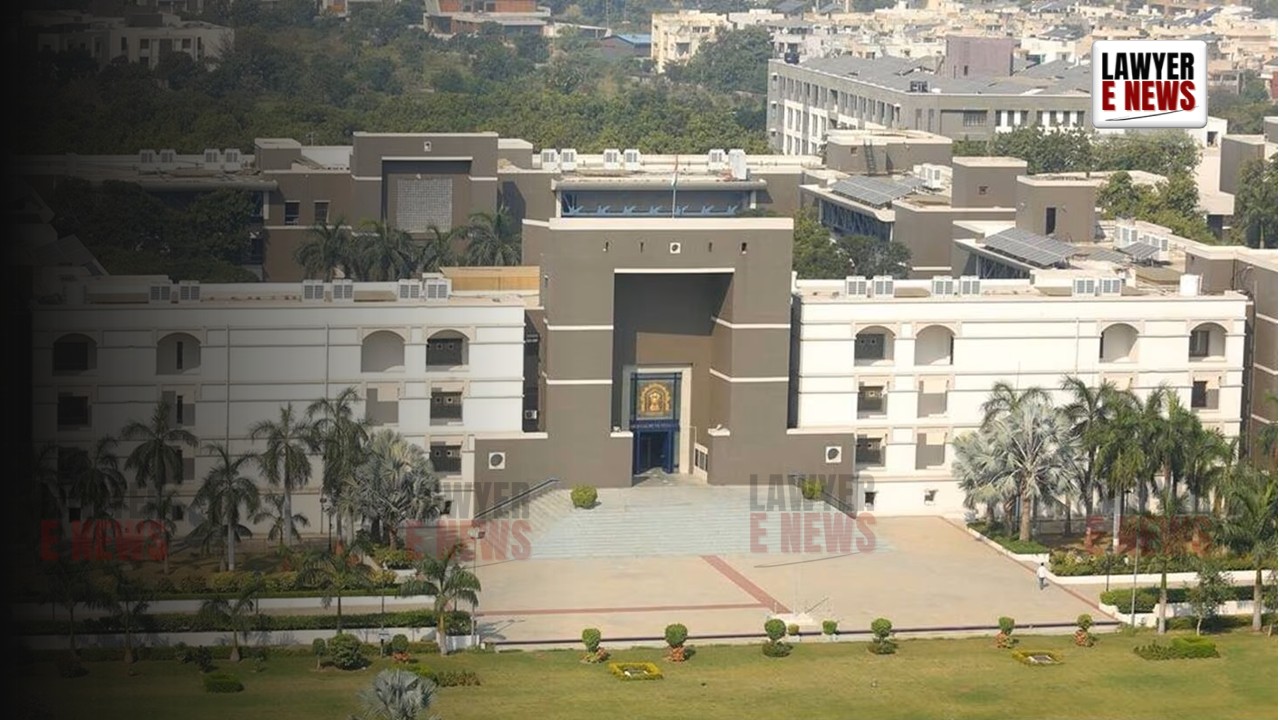
"High Court's Constitutional Powers Under Article 215 Not Restricted by Statutory Limitations": Division Bench of the Gujarat High Court comprising Justice A.S. Supehia and Justice R.T. Vachhani passed a significant and strongly worded judgment in a suo motu contempt proceeding. The judgment addresses grave misconduct by Advocate Devesh Bhatt, who systematically indulged in scandalous allegations and malicious actions against Judicial Officers, Hon'ble Judges, and even the Hon'ble Chief Justice of Gujarat High Court.
The Court convicted Advocate Bhatt for civil and criminal contempt, sentencing him to simple imprisonment of three months along with forfeiture of a ₹5 lakh security deposit and an additional ₹1 lakh exemplary cost. This crucial ruling reaffirms the judiciary's inherent constitutional authority to punish contempt and emphasizes zero tolerance towards scandalizing judicial institutions.
The suo motu contempt proceedings were initiated against Advocate Devesh Bhatt, who repeatedly issued scandalous and defamatory statements against numerous Judges and Judicial Officers through malicious legal notices, newspaper publications, and frivolous criminal complaints. Despite repeated judicial orders, Advocate Bhatt absented himself from court proceedings, blatantly disregarded non-bailable warrants, breached bail conditions, and even violated explicit undertakings given before the Court.
The Bar Council of Gujarat, noting his conduct, had already barred him from practicing in any court across the state.
Due to his persistent defiance and non-cooperation, the Court eventually appointed Advocate Kurven K. Desai from the Legal Aid Panel to represent him.
“Statutory Limitation Under Section 20 Cannot Curtail High Court’s Constitutional Authority Under Article 215”
A critical legal question raised was whether the limitation of one year prescribed under Section 20 of the Contempt of Courts Act restricts the constitutional powers of the High Court under Article 215.
The Court categorically ruled: “The inherent jurisdiction of High Courts under Article 215 of the Constitution of India to initiate suo motu contempt proceedings is a constitutional power that cannot be limited by procedural restrictions under the Contempt of Courts Act, 1971.”
Relying upon the landmark decision in Prashant Bhushan, In re (2021), the Bench highlighted:
“The power to punish for contempt of itself is a constitutional power vested in this Court. Such power cannot be abridged or taken away even by legislative enactment.” (Paras 37-47)
"Malicious Prosecution of Sitting Judges and Amicus Curiae Amounts to Direct Obstruction of Justice”
On Advocate Bhatt’s repeated misuse of judicial procedures, seeking unwarranted permission under Section 197 CrPC and Prevention of Corruption Act, 1988, to prosecute sitting Judges and the Court-appointed Amicus Curiae, the Court expressed grave concern and held this conduct as obstructive and scandalous:
“Issuing notices seeking prosecution against Judges and filing criminal complaints against Amicus Curiae amount to direct obstruction to the course of judicial administration and constitute criminal contempt as defined under Section 2(c) of the Act.” (Paras 25-26, 54-57)
"Egregious Misconduct Necessitates Exemplary Punishment to Uphold Dignity and Majesty of Courts"
The Court severely criticized Advocate Bhatt’s persistent misconduct, refusal to tender an apology, and continued attack on judicial integrity, stating that such egregious behavior calls for stringent action to uphold judicial sanctity:
“The summary jurisdiction of this Court demands dealing with blatant disregard to the rule of law wherein the dignity and honour of Judges are scandalized. It is imperative to curb this nuisance with an iron hand to uphold the majesty of law, administration of justice, and public confidence.” (Paras 55-56)
The Bench meticulously analyzed Advocate Bhatt's long-drawn misconduct and declared his actions a clear case of civil and criminal contempt under Sections 2(b) and 2(c) of the Contempt of Courts Act, 1971. It emphasized that repeated instances of scandalizing Judges and Judicial Officers, publishing defamatory public notices, and filing frivolous complaints severely obstructed the administration of justice.
Regarding adherence to procedural fairness, the Bench noted: “Contempt proceedings being summary, no full-fledged charge needs to be framed. The only requirement is that the contemnor is informed about the contemptuous conduct briefly, sufficing the requirements of fairness under Section 15 of the Act.” (Paras 48-49)
The Court, satisfied with adherence to procedural fairness, pronounced Advocate Bhatt guilty on all counts.
To send a strong and clear message to discourage similar misconduct by members of the Bar, the Bench handed down an exemplary punishment, stating explicitly:
“Such blatant disregard for the dignity of the judicial process demands exemplary punishment.” (Para 60)
The sentence includes:
Simple imprisonment for three months.
Forfeiture of ₹5 lakh security deposited earlier.
Additional exemplary cost of ₹1 lakh payable within three weeks.
Additionally, the Bench quashed Advocate Bhatt’s criminal complaint against the Amicus Curiae (Senior Advocate Mr. Asim J. Pandya), terming it: “Obstructive to the administration of justice by attempting to prevent the Amicus Curiae from assisting the Court.” (Para 67)
The High Court further directed its Registry to circulate the order to all judicial authorities, Bar Associations, and the Bar Council of Gujarat, ensuring the contemnor cannot circumvent restrictions on practice.
This landmark judgment by the Gujarat High Court clearly delineates the boundaries advocates must respect and uphold in interactions with judicial institutions. By explicitly affirming the unrestrained constitutional power under Article 215, it reiterates that statutory provisions like limitation under the Contempt of Courts Act cannot curtail constitutional jurisdiction.
More significantly, the ruling emphasizes the imperative duty of advocates to protect judicial dignity and authority, serving as a stern warning against attempts to scandalize or obstruct justice. By imposing exemplary punishment, the judgment seeks to preserve judicial sanctity, reinforce public confidence in legal institutions, and establish a robust precedent against misuse of judicial processes.
Date of Decision: 23 July 2025