-
by sayum
23 August 2026 2:56 PM







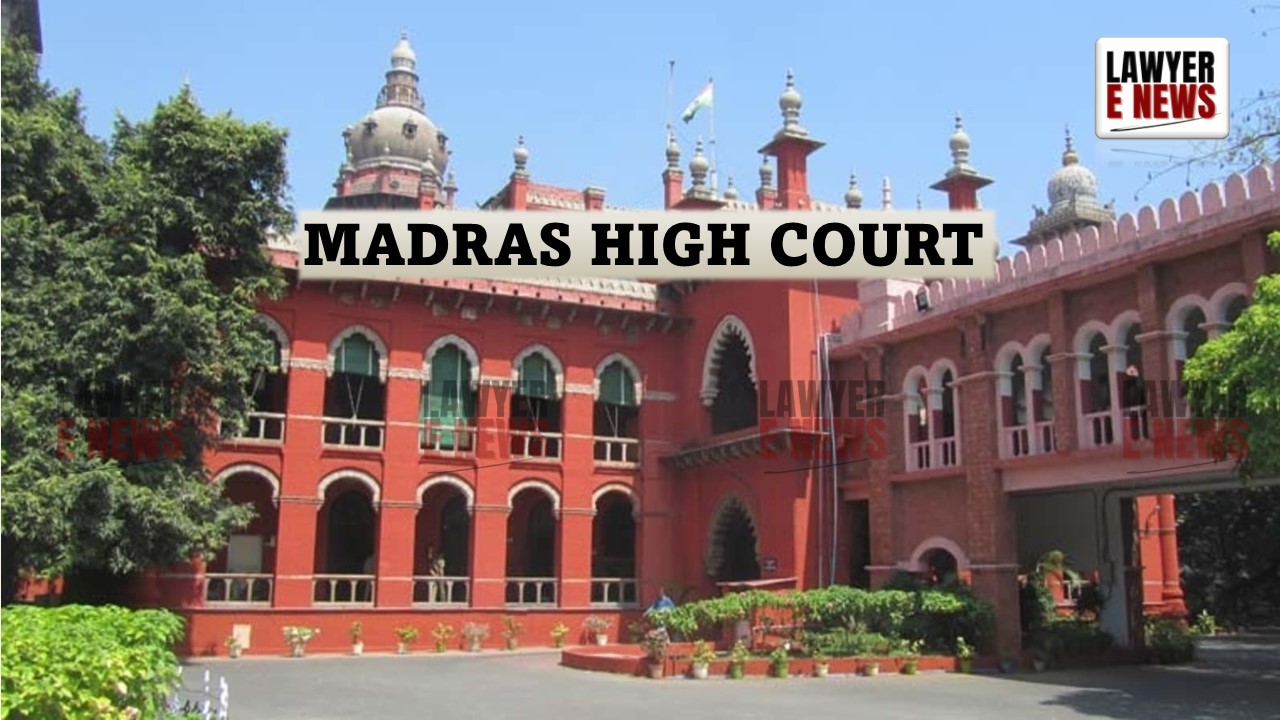
“Probate Court Is Not a Forum for Title or Adoption Disputes—Its Jurisdiction Is Limited to Proving the Will”, In a significant ruling that reaffirms the legal effect of adoption and the limited scope of probate jurisdiction, the Madras High Court on 12 January 2026 dismissed an appeal filed by Mrs. Leela Kumari and H. Nirmal Chand seeking revocation of a probate granted in 2009. The Division Bench comprising Justice C.V. Karthikeyan and Justice K. Kumaresh Babu holding that the appellants, being remote collateral relatives, had no caveatable interest in the estate of the deceased testatrix Meena Bai, who had lawfully adopted the second respondent P. Gyanchand.
“An adopted son stands in the position of a natural child under Section 12 of the Hindu Adoption and Maintenance Act, 1956 and becomes a Class I heir—remote Class II relatives are excluded from inheritance and have no standing to contest probate proceedings,” the Court declared while affirming the order of the learned Single Judge who had earlier dismissed the revocation application.
The Court further ruled that the appellants’ application was hopelessly barred by limitation, stating that “under Article 137 of the Limitation Act, a challenge to probate must be brought within three years—filing it after thirteen years without explanation is fatal.”
“Adoption Was Admitted and Never Denied—You Cannot Reopen What Was Accepted in Earlier Litigation”
Tracing the history of the case, the Court noted that the testatrix Meena Bai had adopted the second respondent P. Gyanchand through a registered adoption deed dated 26 September 1990. Her Will, executed on 16 May 1990, bequeathed her estate in favour of her adopted son, and probate was granted by the Court on 10 February 2009.
Years later, in 2022, the appellants—collateral relatives through the husband’s family—sought to revoke the probate, alleging that the adoption was fabricated and that they had been in possession of title deeds. The Court was not persuaded.
“When in earlier proceedings you have admitted the adoption, and your written statements state the relationships as described in the plaint to be ‘substantially correct’, you cannot turn around years later and claim othaerwise,” the Bench observed.
Relying on Order VIII Rule 5 of the Code of Civil Procedure, 1908 and Section 53 of the Bharatiya Sakshya Adhiniyam, 2023, the Court clarified that “facts once admitted in pleadings need not be proved again, and cannot be reagitated in subsequent proceedings unless specifically denied.”
“Probate Court Does Not Decide Titles or Inquire into Adoption—Its Function Is Limited to Genuineness of the Will”
The Court reiterated the foundational principle that probate proceedings are not meant to be converted into title suits.
“Whether the adoption was valid, or whether title deeds were in possession of the applicants, are issues completely outside the scope of probate jurisdiction,” the Bench remarked, underscoring that the only questions before a probate court are whether the Will is genuine, properly executed, and attested.
In this case, the Will was registered, the attesting witnesses were examined, and the adoption deed was a registered public document. The appellants never challenged the adoption through a separate civil suit.
“There was no fraud, no concealment, no defective procedure—none of the conditions required under Section 263 of the Indian Succession Act for revocation of probate were satisfied,” the Court held.
“You Sat Silent for 13 Years—Revocation Plea Is Not Just Weak, It's Legally Dead”
Perhaps most damning to the appellants’ case was the delay. The application to revoke the probate was filed in 2022—13 years after the grant in 2009. The Court held such delay to be not only unreasonable but also clearly barred by law.
“Article 137 of the Limitation Act applies to applications under the Indian Succession Act—once the three-year period lapses, without explanation, the right to apply is extinguished,” the Court said, citing the Supreme Court’s judgments in Lynette Fernandes v. Gertie Mathias, Kerala SEB v. T.P. Kunhaliumma, and Krishna Kumar Sharma v. Rajesh Kumar Sharma.
The Court rejected the argument that limitation did not apply, noting that this legal position had been conclusively settled.
“Probate is not an open wound that can be reopened at will—it is a solemn and conclusive determination, and challenges must be timely and grounded in law.”
“Class I Heir Through Adoption—Once Accepted, Cannot Be Undone by Remote Heirs”
Dismissing the argument that adoption needed to be proved afresh, the Court invoked Section 12 of the Hindu Adoption and Maintenance Act and held that once adopted, Gyanchand stood in law as Meena Bai’s son for all purposes.
“The legal effect of adoption is to place the adopted child in the same position as a natural born child—once that status is accepted and not challenged, it is binding and displaces any claim by collateral relatives,” the Court observed.
Further, it noted that the appellants had never brought any suit challenging the adoption as fraudulent or invalid.
“You cannot claim inheritance rights while simultaneously refusing to legally challenge the very adoption that lawfully displaces your claim,” the Bench observed sharply.
No Caveatable Interest, No Meritorious Grounds, No Timely Challenge—Appeal Dismissed with Costs
The Madras High Court concluded that the appeal was devoid of merit and based on stale claims and afterthoughts.
“There is no legal infirmity in the probate granted in 2009. The application to revoke it, filed after thirteen years, is not just belated—it is legally untenable. The appeal is dismissed with costs,” the Court ordered.
With this ruling, the Court once again drew a clear line in the sand regarding the finality of probate orders, the effect of admitted adoption, and the strict limitation applicable to revocation petitions.
Date of Decision: 12 January 2026