-
by sayum
26 August 2026 1:49 PM







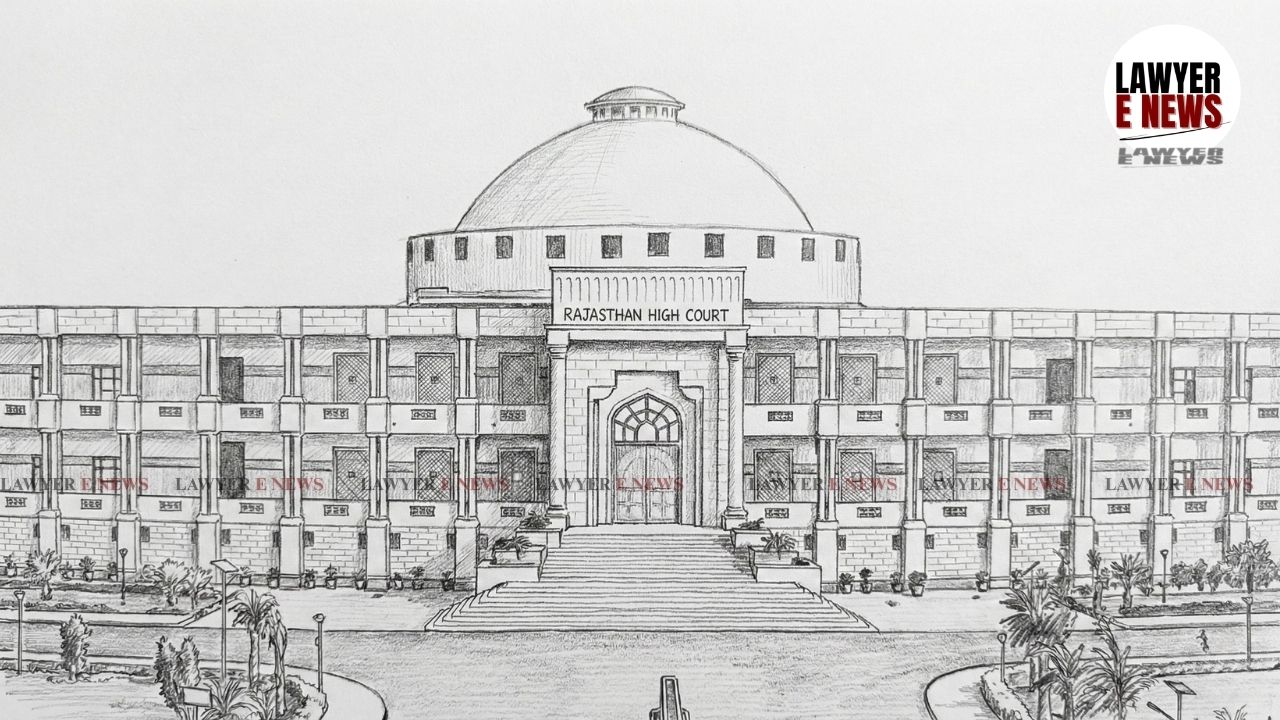
"Demand can be proved either by circumstantial or electronic evidence and not necessarily by direct testimony of the complainant and conviction can be sustained even if the complainant turns hostile, provided the demand is otherwise established", Rajasthan High Court has upheld the conviction of an Assistant Engineer of Jaipur Vidyut Vitaran Nigam Limited and his associate under the Prevention of Corruption Act, 1988, holding that demand of illegal gratification can be proved through electronic evidence even when both complainants turn hostile.
Justice Pramil Kumar Mathur dismissed the joint appeal filed by Prithvilal Meena, Assistant Engineer, and Hemraj alias Foru, a private person who acted as middleman, observing that acceptance of bribe through an agent or middleman is deemed to be acceptance by the public servant himself and personal recovery from the public servant is not indispensable.
Background of the Case
The prosecution case was that on 29th January 2016, the appellant Prithvilal Meena along with his staff inspected electricity meters at the complainants' premises and verbally imposed a VCR penalty of Rs. 80,000. Subsequently, he demanded illegal gratification for settlement of the matter. On 1st February 2016, the complainants submitted a written complaint before the Anti-Corruption Bureau, Bundi. The demand was verified by the ACB through voice recording, and on 2nd February 2016, a trap was organised.
During the trap, the tainted amount of Rs. 5,500 treated with phenolphthalein powder was passed to appellant Hemraj, who kept the money in his trouser pocket on the directions of appellant Prithvilal Meena. Both appellants were present together in the same room when the trap party arrived. The phenolphthalein test of appellant Hemraj's hands and pocket was positive. The trial court convicted both appellants and sentenced Prithvilal Meena to five years rigorous imprisonment under Section 13(1)(d) read with Section 13(2) of the Act and Hemraj to four years rigorous imprisonment under Section 8 of the Act.
Legal Issues
The primary questions before the Court were whether the conviction could be sustained when both complainants turned hostile, whether the voice recording was admissible as electronic evidence, and whether acceptance of bribe through a middleman could be attributed to the public servant.
Court's Observations and Judgment
"Proof of demand of illegal gratification is sine qua non for constituting an offence under the Act. However, demand can be proved either by circumstantial or electronic evidence and not necessarily by direct testimony of the complainant"
The Court noted that complainant PW-8 Ramphool turned hostile and complainant PW-13 Kailash resiled in cross-examination. However, the Court observed that the mere fact that complainants turned hostile does not ipso facto demolish the prosecution case, particularly when documentary and electronic evidence stand proved.
"The voice recording is admissible electronic evidence when accompanied by a valid certificate under Section 65-B(4) of the Indian Evidence Act, the device was in lawful control, the recording was made in original state and unaltered, and the voice is properly identified"
The Court found that the certificate under Section 65-B(4) was duly exhibited as Ex. P-38 by PW-14 Tarunkant Somani, the leader of the trap team. The appellant Prithvilal Meena did not dispute the voice recording during trial nor challenged its authenticity in cross-examination.
"The appellants had refrained from giving their voice sample for testing despite lawful notice, therefore under Section 114(g) of the Indian Evidence Act an adverse inference may be drawn for withholding the best evidence"
The Court reproduced the transcripts of voice recordings dated 1st February 2016 and 2nd February 2016, which clearly disclosed demand by appellant Prithvilal Meena accompanied by threat of VCR penalty and his direction for acceptance of money through the middleman.
"It is neither legally mandated nor practically feasible that a shadow witness must overhear every word; what is required is proof beyond reasonable doubt, not proof through any particular mode. Trap proceedings are not conducted in artificial laboratory conditions"
Addressing the defence argument that the shadow witness did not overhear the entire conversation, the Court observed that in real life situations, the accused often insists on private conversation and close proximity of a third person may arouse suspicion and frustrate the trap.
"Acceptance of bribe through an agent or middleman is deemed to be acceptance by the public servant himself; thus, personal recovery from the public servant is not indispensable"
Relying upon the Supreme Court's decision in Devinder Kumar Bansal v. State of Punjab, the Court held that when the middleman acts on behalf of the principal accused, both are acting in concert, the money is meant for an official favour, and recovery from the middleman is duly proved, then recovery from the middleman is sufficient to attribute constructive acceptance to the public servant.
"A private person who accepts or obtains illegal gratification as a conduit for a public servant is squarely covered under Section 8 of the Prevention of Corruption Act. The concerted action of both the appellants establishes criminal conspiracy under Section 120-B IPC"
The Court found that the chain of circumstantial evidence including electronic evidence, recovery of tainted amount, positive phenolphthalein test, documentary evidence in form of red diary containing entries relating to meter checking, and presence of both accused together satisfies the Panchsheel test propounded in Sharad Birdhichand Sarda v. State of Maharashtra.
"The chain of evidence is complete and consistent only with the theorem of guilt of the appellants and excludes every possible hypothesis of innocence"
The Court dismissed the appeal and affirmed the conviction and sentence, directing both appellants to surrender forthwith to serve the remaining sentence.
Date of Decision: 9th March, 2026