
-
by sayum
26 August 2026 1:49 PM







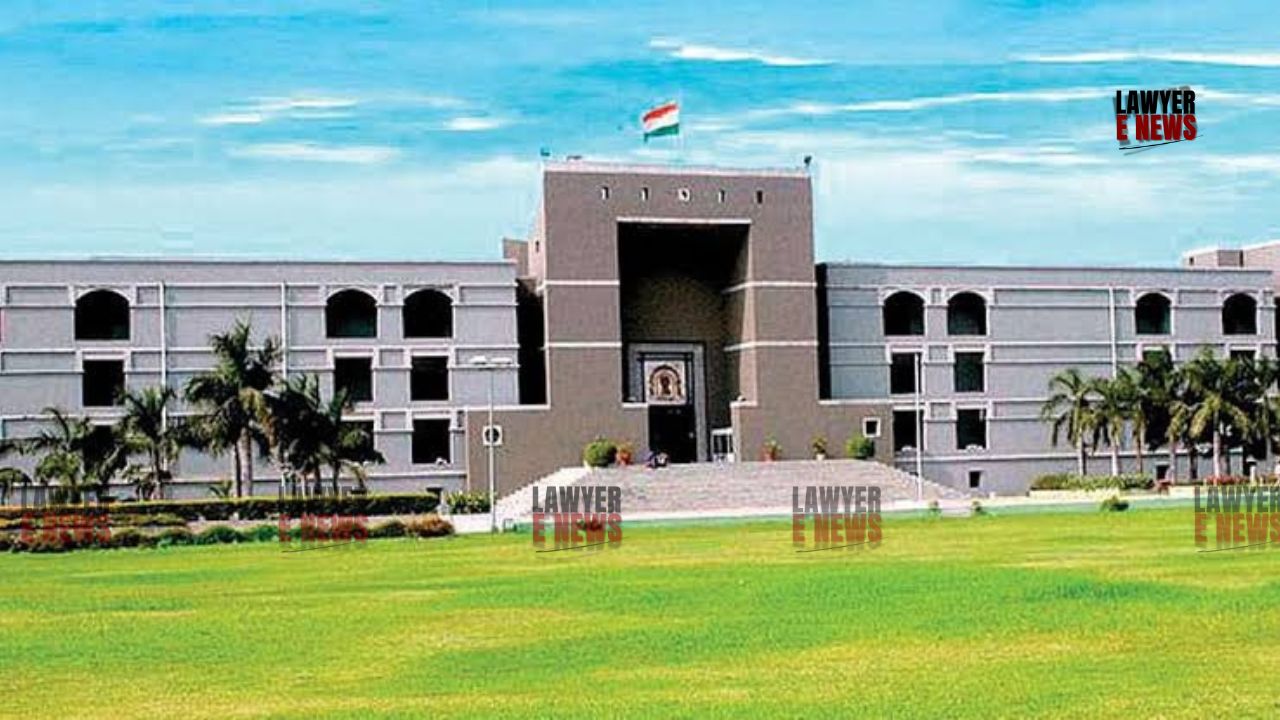
"The Revenue Authority Cannot Travel Beyond The Statute And Impose Consequences Not Contemplated By The Act", In a significant ruling protecting the rights of bona fide purchasers of agricultural land, the Gujarat High Court has quashed an order directing vesting of 8 Acres 32 Gunthas of agricultural land in the State Government under Section 79A of the Bombay Land Revenue Code — holding that the provision confers no power of confiscation or forfeiture whatsoever, and that suo motu proceedings initiated after an unexplained delay of 11 years are wholly unsustainable in law.
Justice Divyesh A. Joshi quashing the order dated 30.05.2012 of the Special Secretary (Appeals), Revenue Department, which had confirmed the orders of the Assistant Collector and Collector directing vesting of the petitioners' land in the State Government on the ground of breach of tenure conditions (Sharat Bhang).
The petitioners had purchased agricultural land admeasuring 8 Acres 32 Gunthas at Moje Ghanshyampur, Taluka Limbdi, District Surendranagar from the heirs of one Raja Bechar under a registered sale deed dated 19.03.1990. Mutation Entry No. 650 in their favour was certified on 24.05.1992. Eleven years later, in 2003, the Assistant Collector initiated suo motu proceedings under Section 79A alleging breach of tenure conditions, and in 2006 passed an order vesting the land in the State Government — relying solely on an admission made by the petitioners, who were illiterate persons unaware of the legal consequences. The Collector and Special Secretary (Appeals) confirmed this order, prompting the present writ petition.
Whether Section 79A of the Bombay Land Revenue Code empowers a revenue authority to order vesting of land in the State Government or annul a registered sale deed. Whether suo motu proceedings initiated after an unexplained delay of 11 years are legally sustainable. Whether a bona fide purchaser holding title under a valid and unchallenged registered sale deed can be treated as an "unauthorised occupant" under Section 79A.
"The Authority Cannot Suddenly Awaken After More Than A Decade And Unsettle Vested Rights"
Justice Joshi found the questions raised entirely settled by a catena of binding precedents and ruled decisively in favour of the petitioners on every ground.
On the threshold issue of delay, the Court placed heavy reliance on the Supreme Court's landmark judgment in Joint Collector Ranga Reddy District v. D. Narsing Rao [(2015) 3 SCC 695], where the Apex Court had dealt with exercise of suo motu revisional powers after nearly five decades and ruled that unexplained and inordinate delay in invoking such power "would itself tantamount to fraud upon statute apart from being arbitrary and opposed to rule of law." The Supreme Court had laid down the governing principle in the following terms: "delayed exercise of revisional jurisdiction is frowned upon because if actions or transactions were to remain forever open to challenge, it will mean avoidable and endless uncertainty in human affairs, which is not the policy of law. Because, even when there is no period of limitation prescribed for exercise of such powers, the intervening delay may have led to creation of third-party rights, that cannot be trampled by a belated exercise of a discretionary power especially when no cogent explanation for the delay is in sight."
Applying this principle, the Court found that the mutation entry in favour of the petitioners had been certified as far back as 1992, and the Assistant Collector had initiated proceedings only in 2003 — an unexplained silence of 11 years. The Court held: "exercise of power by the Assistant Collector tantamounts to arbitrary and illegal exercise of such power." It drew direct support from this Court's own judgment in Devjibhai Kalabhai Patel v. Collector, Rajkot (SCA No. 21269 of 2017) — since confirmed by the Division Bench in LPA No. 4963 of 2025 on identical facts — which had categorically declared that "suo motu powers must be exercised within a reasonable period. A delay of 11 years without explanation is wholly unreasonable and vitiates the proceedings," and that "the authority cannot suddenly awaken after more than a decade and unsettle vested rights."
The Court further relied upon Santoshkumar Shivgonda Patil v. Balasaheb Tukaram Shevale [(2009) 9 SCC 353], where the Supreme Court held that suo motu power "cannot be exercised beyond a reasonable period," and observed that proceedings initiated after even three years without fraud or suppression are "hit by the vice of delay." The Gujarat High Court Division Bench in Chandulal Gordhandas Ranodriya v. State of Gujarat [2013(2) GLR 1788] had reinforced this position, observing: "the law does not expect a settled thing to be unsettled after a long lapse of time... the powers must be exercised within a reasonable period of time even in the case of transaction which would be termed as void transaction."
Justice Joshi also noted the settled position from State of Gujarat v. Patel Raghav Natha [1969 (2) SCC 187] that once the question of delay arises, all other issues including any alleged breach of conditions lose much of their relevance. He observed: "the revenue authority cannot exercise the revisional powers in a casual manner whenever it wants to be, irrespective of the period of limitation. Exercise of any such power should be within the realm of the provisions of the statute."
Turning to the scope of Section 79A, the Court found the law equally clear. Relying upon the Division Bench decision in Sharadaben v. State of Gujarat (LPA No. 432 of 2018), the Court reiterated that "Section 79A does not provide for forfeiture or vesting of land in the State. The revenue authority cannot travel beyond the statute and impose consequences not contemplated by the Act," and that the Collector has "no jurisdiction to annul a registered transaction or declare that land shall vest in the State free from encumbrances." The same view had been followed in State of Gujarat v. Kunjalbhai Lalitbhai Patel (LPA No. 1052 of 2021), which held that "exercise of powers under Section 79A is limited to summary eviction. Confiscation or resumption of land is beyond the jurisdiction of the authority." The Court found that the revenue authorities had assumed powers of forfeiture and cancellation entirely absent from the statute, acting as if exercising appellate or revisional jurisdiction which Section 79A does not confer.
On the question of the petitioners being branded as "unauthorised occupants," the Court found the premise legally untenable. A perusal of the 7/12 extract revealed that from the very first mutation entry in 1965 — in the name of Bechar Pala, then Raja Bechar, then his heirs, and finally the petitioners — nowhere was the land described as new tenure land. The petitioners had purchased after verifying the revenue record, which reflected no tenure restriction. The registered sale deed had remained valid, operative and wholly unchallenged throughout. No civil proceedings had been initiated to cancel it. The Court firmly stated: "it is a settled law that the revenue authorities cannot unilaterally annul sale deeds even if fraud is alleged; such matters must go to a civil court." Ordering the vesting of land purchased under a registered sale deed without first having that deed set aside by a civil court of competent jurisdiction amounted, in the Court's view, to an annulment of the sale deed itself — a power entirely outside the revenue authority's jurisdiction.
The Court additionally noted that Government Resolutions dated 11.03.1996, 19.10.2000, 20.12.2006, 04.07.2008 and 17.03.2017 cast an obligatory duty on revenue authorities to convert new tenure lands to old tenure after 15 years of continuous agricultural cultivation — without requiring any application from the agriculturist. The petitioners had completed over three decades of continuous cultivation well before 2002. The revenue authorities were therefore under a positive obligation to convert the tenure rather than initiate punitive proceedings.
Allowing the writ petition and making the rule absolute, the Gujarat High Court quashed and set aside the order dated 30.05.2012 of the Special Secretary (Appeals), Revenue Department. The Court held that the suo motu proceedings were vitiated by an unexplained and fatal delay of 11 years, that Section 79A confers no power of confiscation, vesting or annulment of registered sale deeds, that a bona fide purchaser under a valid and unchallenged registered conveyance cannot be treated as an unauthorised occupant, and that the revenue authority had acted entirely beyond the four corners of the statute.
Date of Decision: 17 February 2026





