
-
by sayum
26 August 2026 1:49 PM







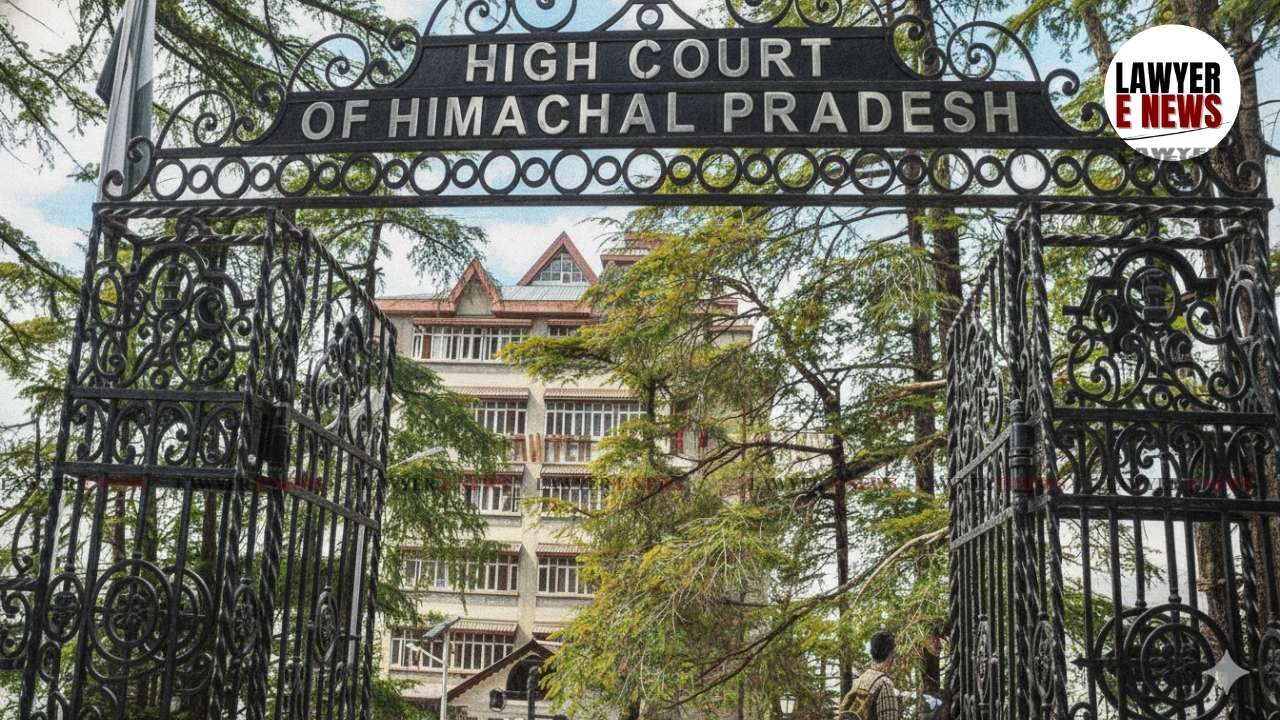
"High speed is a relative term. It was for the prosecution to bring on record material to establish as to what it meant by 'high speed' in the facts and circumstances of the case." In a significant ruling on the evidentiary standards required to establish rash and negligent driving under Section 279 IPC, the Himachal Pradesh High Court on March 2, 2026, dismissed a State appeal against acquittal in a road accident case, holding that the mere use of the expression "high speed" by eyewitnesses — without mentioning the approximate speed of the vehicle — is wholly insufficient to fasten criminal liability on a driver for rash and negligent driving.
Justice Rakesh Kainthla, presiding over the Criminal Appellate jurisdiction, affirmed the acquittal of the respondent-accused Rajneesh Kumar, who had been charged under Sections 279 (rash and negligent driving), 337 (causing hurt by act endangering life) and 201 (destruction of evidence) of the Indian Penal Code arising out of a road accident on May 12, 2008 in Kangra, Himachal Pradesh.
Background of the Case
The prosecution alleged that on May 12, 2008, the accused drove a truck at high speed and struck an auto bearing registration No. HP40A-4037 from the rear, causing it to fall into a gorge and injuring a passenger, Dhani Ram. The informant Praveen Kumar (PW6) and another person were riding a motorcycle behind the auto when the incident allegedly occurred. The truck driver stopped the truck at some distance and fled the scene. The Trial Court acquitted the accused, finding material contradictions in the prosecution evidence and non-establishment of the driver's identity. Aggrieved, the State of Himachal Pradesh filed the present appeal.
Legal Issues
The case raised three critical legal questions: first, whether the use of the term "high speed" without quantification suffices to prove rash and negligent driving under Section 279 IPC; second, whether a witness's opinion that an accident occurred due to the negligence of the driver constitutes relevant evidence; and third, whether the High Court, sitting in appeal against acquittal, was justified in interfering with the Trial Court's findings.
Court's Observations and Judgment
"To one man, the speed of even 10 or 20 miles per hour may appear to be high, while to another, even a speed of 25 or 30 miles per hour may appear to be a reasonable speed"
Justice Kainthla opened his analysis by reiterating the settled parameters governing appellate interference with acquittals. Placing reliance on the Supreme Court's recent pronouncements in Surendra Singh v. State of Uttarakhand (2025) 5 SCC 433 and P. Somaraju v. State of A.P., 2025 SCC OnLine SC 2291, the Court held that interference with a judgment of acquittal is warranted only where the judgment is patently perverse, based on misreading or omission to consider material evidence, and no two reasonable views are possible. Critically, the Court underscored that after acquittal, the accused becomes entitled to a "reinforced or double presumption of innocence," making the threshold for appellate interference even more exacting.
"Due to the reinforced or 'double' presumption of innocence after acquittal, interference must be limited. If two reasonable views are possible on the basis of the record, the acquittal should not be disturbed."
Turning to the eyewitness testimony, the Court dissected the statements of each prosecution witness with surgical precision. The informant PW6 Praveen Kumar, critically, did not state that the truck had hit the auto; he merely stated that he heard the noise of the auto falling into the gorge. In cross-examination, he admitted he could not say whether any accident had occurred or whether the auto driver had negligently fallen into the gorge. The Court found that this testimony, far from supporting the prosecution's version, actively undermined it.
Raju (PW1), the auto driver, stated that the truck had hit the auto from behind at high speed. However, the Court found this testimony directly contradicted by objective documentary evidence — the mechanical inspection report of the auto (Ext.PW8/A) made no mention of any damage to the rear of the auto, and the photographs (Ext.PW5/A to Ext.PW5/C) equally revealed no damage to the rear of the auto or to the front of the truck. The Court, accordingly, found the prosecution's version of a rear collision rendered doubtful by the very evidence produced on its behalf.
"The statement of Raju (PW1) that the truck had hit the auto from the rear is not corroborated by the mechanical report."
The Court also noted a damning entry in the site plan (Ext.PW10/C) prepared by the Investigating Officer on the very date of the accident: it recorded that the front tyres of the truck were punctured at the spot. The Court observed that there was no explanation forthcoming for this entry, and it cast serious doubt on whether the truck was in motion at all at the time of the alleged incident.
On the central legal question of "high speed," the Court delivered a definitive ruling that mere invocation of the phrase by a witness carries no evidentiary weight without quantification. Relying on the Supreme Court's landmark ruling in Mohanta Lal v. State of West Bengal, 1968 ACJ 124, the Court noted that what one person understands by "high speed" may be entirely different from what another person understands by it, and no inference of negligence or rashness can be drawn without the prosecution placing on record material to establish what "high speed" meant in the specific facts and circumstances of the case.
"Merely because the truck was being driven at a 'high speed' does not bespeak of either 'negligence' or 'rashness' by itself."
The Court further fortified this position by relying on the Supreme Court's ruling in State of Karnataka v. Satish, (1998) 8 SCC 493, which had categorically held that criminality cannot be presumed, and in the absence of any material on record regarding speed, no presumption of rashness or negligence could be drawn even by invoking the maxim res ipsa loquitur. The Himachal Pradesh High Court's own coordinate bench decisions in State of H.P. v. Madan Lal and State of H.P. v. Parmodh Singh were also cited to reinforce that "speed alone is not a criterion for judging rashness or negligence — the deciding factor is the situation in which the accident occurs."
"A witness may inform the court of everything he saw, but he may not express any opinion on whether either or both of the parties were negligent. His opinion is not relevant."
The Court then addressed the prosecution's argument that witnesses had categorically attributed the accident to the negligence of the accused. On this issue, the Court drew upon the celebrated English decision in Hollington v. Hawthorn, 1943 KB 507, holding that a witness is entitled to depose only about facts which occurred in his presence and cannot draw inferences or express opinions therefrom. The determination of whether a vehicle was driven rashly and negligently is a legal conclusion to be drawn by the Court on the basis of evidence, not a factual statement that a witness can make. The witnesses' opinion that the accident occurred due to the negligence of the accused was, accordingly, held to be irrelevant evidence and incapable of advancing the prosecution's case.
"The issue whether the vehicle was being driven in a rash and negligent manner is a conclusion to be drawn on the basis of evidence led before the Court."
Having found that the Trial Court's view was reasonable — grounded in material contradictions among prosecution witnesses, lack of corroboration by the mechanical report and photographs, the absence of damage to the relevant parts of both vehicles, the puzzling puncture of the truck's front tyres, and the legally insufficient use of the term "high speed" without quantification — the High Court held that this was not a case warranting any appellate interference whatsoever. The appeal was dismissed and the acquittal upheld.
The Himachal Pradesh High Court's ruling reinforces a rigorous evidentiary standard for prosecutions under Section 279 IPC, making clear that testimony couched in vague terms such as "high speed" cannot substitute for proof of actual speed and situational context. The judgment simultaneously affirms the double presumption of innocence available to an accused after acquittal, reminding appellate courts that where two reasonable views are possible on the record, the one favourable to the accused must prevail. Advocates appearing in road accident criminal matters would do well to note that eyewitness opinions on negligence carry no independent evidentiary value — that determination remains, as it must, the exclusive province of the Court.
Date of Decision: March 2, 2026





