-
by sayum
26 August 2026 12:18 PM







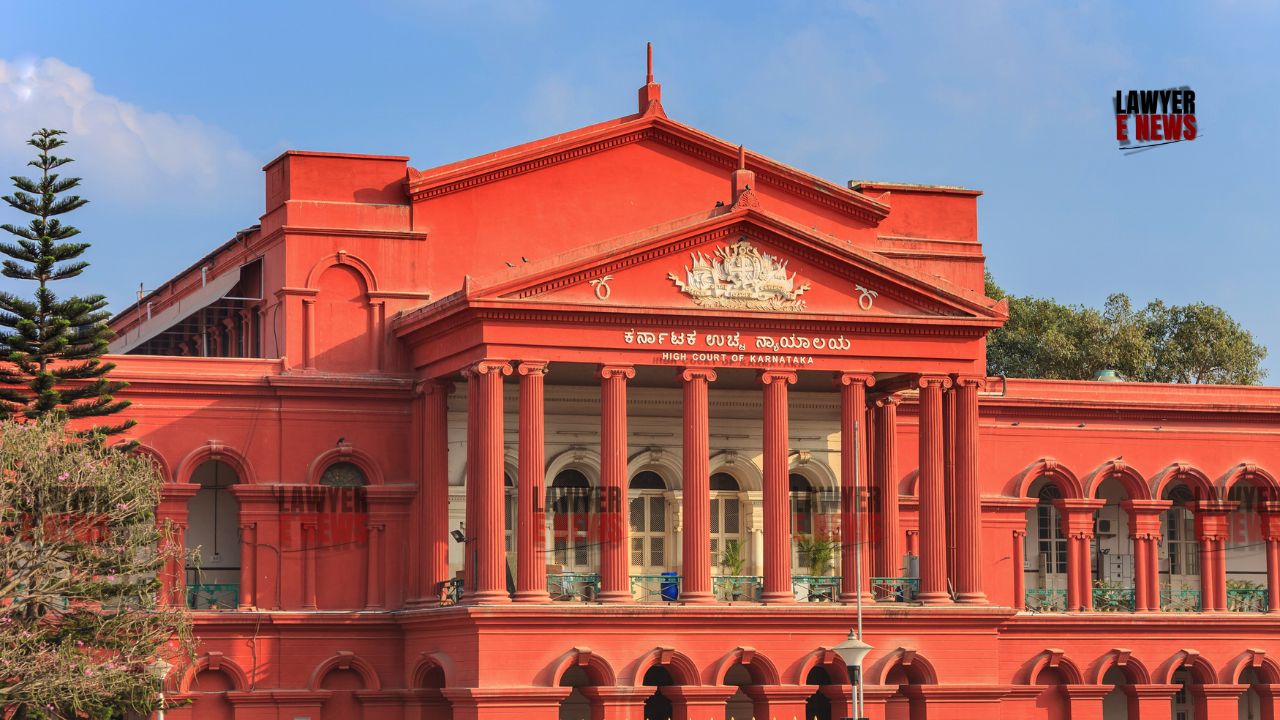
“A Gift Without Title Is No Gift at All”, High Court of Karnataka at Bengaluru, in a reportable judgment authored by Justice H.P. Sandesh, decisively reaffirmed that a donor cannot convey better title than what he himself possesses, particularly when an earlier oral family partition has been admitted and acted upon.
High Court allowed the second appeal, set aside the judgment of the First Appellate Court, and restored the Trial Court’s decree dismissing the suit for declaration, recovery of possession and mandatory injunction, holding that the registered gift deed dated 19.03.1992 was executed by a person who had no exclusive title.
“Revenue Records Cannot Override Categorical Admissions”
The plaintiff sought declaration of title, recovery of possession and mandatory injunction in respect of land in Sy.No.11, claiming ownership under a registered gift deed dated 19.03.1992 executed by Narasimhaiah, her senior uncle.
Her case rested heavily on RTCs, mutation entries, conversion orders and katha records, asserting that after the gift, the property stood in her name and that defendants had later encroached upon portions of the land.
The defendants, however, set up a consistent and specific defence that the entire Sy.No.11 had already been divided through a family Palupatti (oral partition) on 29.04.1958, wherein the northern and southern portions were separately allotted to the respective branches, divided by a bund that existed from time immemorial. According to them, Narasimhaiah’s name continued in revenue records merely as a senior family member, without any exclusive ownership.
The Trial Court dismissed the suit, holding that the donor had no title to gift the property. The First Appellate Court reversed this finding, relying primarily on revenue records and the registered gift deed.
“A Registered Gift Deed Fails If the Donor Lacks Absolute Title”
Core Legal Issue Before the High Court
Justice H.P. Sandesh framed the controversy squarely within the scope of Section 100 CPC, focusing on whether the First Appellate Court had ignored material admissions and acted perversely while upholding the gift deed.
The Court noted that the crucial question was not the formality of the gift deed, but the competence of the donor. The judgment records:
“Mere continuance of revenue entries does not confer exclusive title.”
The Court emphasised that if an earlier partition had already divested the donor of exclusive rights, any subsequent gift would be legally ineffective, notwithstanding its registration under Sections 122 and 123 of the Transfer of Property Act, 1882.
“Admissions Are the Best Evidence Against the Maker”
Oral Partition of 1958 Held Proved
A decisive factor in the case was the categorical admissions made by the plaintiff herself (P.W.1) and her witness (P.W.2). The High Court recorded that:
“P.W.1 categorically admits that there was a partition among the members of the family on 24.09.1958.”
The plaintiff further admitted that after the partition, revenue records continued in the name of Narasimhaiah, and that even the share allotted to her father stood in the senior uncle’s name. P.W.2 went further and admitted that:
“Northern portion was given to the plaintiff’s father and southern portion was given to the defendants… both of them have put bund and cultivating the same.”
Justice Sandesh held that these admissions conclusively established an earlier partition that had been acted upon, making the absence of a registered partition deed or mutation legally irrelevant.
“Admissions Override the Presumptive Value of Revenue Records”
Error of the First Appellate Court
The High Court found that the First Appellate Court committed a serious error of law by treating RTCs and mutation entries as conclusive proof of title, while ignoring binding admissions on record.
The judgment clearly states that:
“Admissions on the part of P.W.1 and P.W.2 take away the case of the plaintiff.”
Justice Sandesh observed that the Appellate Court’s reasoning — that since the property stood in the donor’s name, he had the right to gift it — was fundamentally flawed, as revenue records cannot resurrect a title already lost by partition.
“Consequential Relief Cannot Survive When Title Fails”
Declaration, Possession and Injunction Rejected
Since the plaintiff failed to establish valid title under the gift deed, the Court held that the reliefs of recovery of possession and mandatory injunction automatically collapse. The direction issued by the First Appellate Court to hand over ‘B’ schedule properties was therefore held unsustainable.
The High Court concluded that the Trial Court, despite a brief discussion, had reached the correct legal conclusion, while the First Appellate Court’s reversal amounted to perversity warranting interference under Section 100 CPC.
The Karnataka High Court’s ruling is a sharp reminder that title flows from substantive rights, not from the mere appearance of names in revenue records. By restoring the Trial Court’s judgment, the Court reaffirmed that admissions of an earlier family partition — once acted upon — decisively negate the donor’s authority to execute a gift deed, regardless of its registration.
Second Appeal allowed. Judgment and decree of the First Appellate Court dated 21.03.2023 in R.A.No.4/2015 set aside. Judgment and decree of the Trial Court dated 28.11.2014 in O.S.No.37/2008 restored.
Date of Decision: 19 December 2025