-
by sayum
05 August 2026 3:07 PM







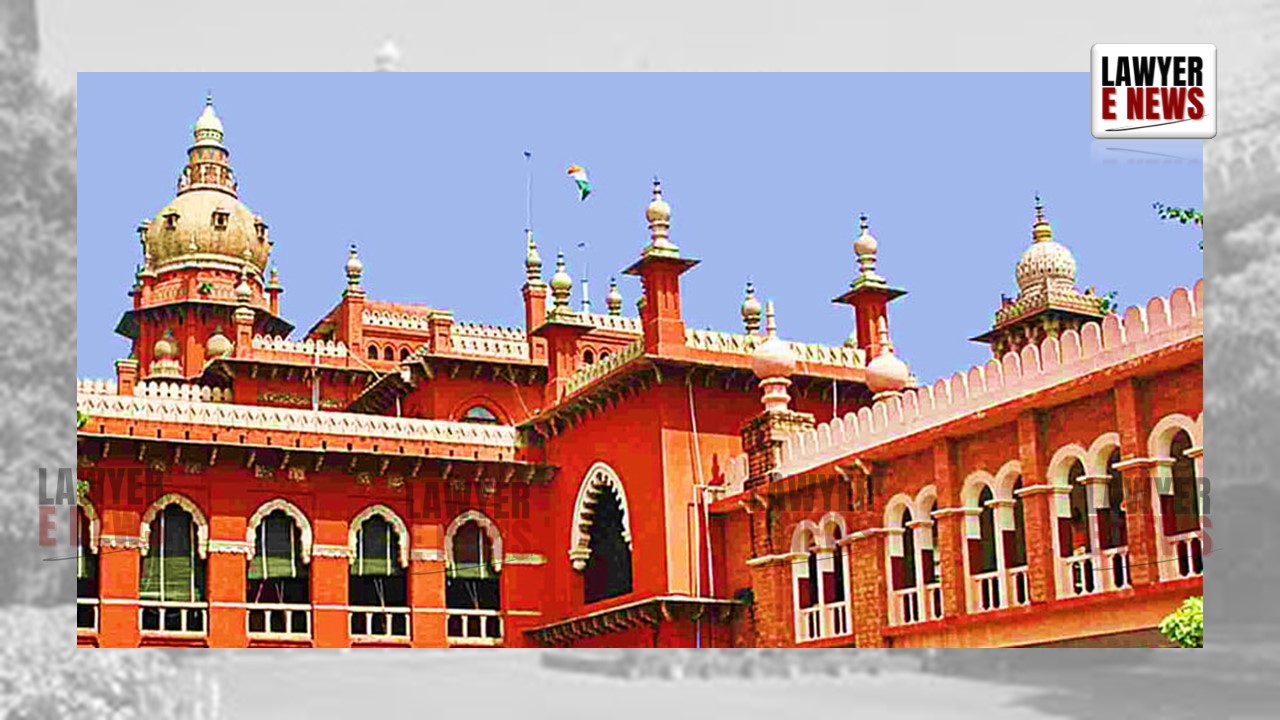
“Enjoyment Without Proof Grants No Title”: Delivering a landmark ruling Madras High Court firmly refused to interfere with the concurrent judgments of the lower courts, which rejected a contested Will and two settlement deeds for want of legal proof. Justice C.V. Karthikeyan, in a meticulously reasoned verdict, upheld the decree granting equal partition among the heirs, ruling that "the mandatory legal formalities under the Indian Succession Act and the Evidence Act are not ornamental but fundamental." The Court emphasized that unproven documents, even if acted upon, cannot extinguish the rightful inheritance claims of lawful heirs.
The legal battle revolved around ancestral and self-acquired properties situated in Coimbatore. Rajammal, the original plaintiff, initiated proceedings seeking partition and separate possession after the death of her mother, Pattiammal @ Ammassiammal, who allegedly died intestate. The defendants, Nagaraj and Saraswathi, her brother and sister, resisted partition on the ground of a Will bequeathing the mother’s share to Nagaraj and two settlement deeds favouring Saraswathi. The plaintiff disputed these documents as forgeries and maintained that she, along with her siblings, was entitled to an equal share.
The Trial Court decreed partition with respect to A and C schedule properties while dismissing claims over the B schedule property. The First Appellate Court confirmed this finding. The defendants approached the High Court under Section 100 CPC alleging improper application of legal provisions governing proof of testamentary documents.
Justice Karthikeyan zeroed in on the crux of the dispute: the failure of the defendants to prove the Will and the settlement deeds in accordance with Section 63(c) of the Indian Succession Act and Section 68 of the Indian Evidence Act (now Section 67 of the Bharatiya Sakshya Adhiniyam, 2023). The Court unequivocally stated, “The law is emphatic that if a Will is to be accepted as valid, at least one attesting witness must be examined in court. This requirement is not optional, it is absolute.”
The Court further observed that in the instant case, "the defendants, despite having ample opportunity, failed to bring any attesting witness to the stand." The judge declared, “A Will unproven by attesting witnesses remains no more than a piece of paper in the eyes of law.”
A pivotal blow to the Will's credibility came from its contents. The testatrix, a mother, had described her son as a minor when he was factually a major at the time of the Will’s execution. The Court highlighted this glaring inaccuracy as a "serious misdescription which strikes at the very foundation of the Will’s credibility." Justice Karthikeyan remarked, “It is unconceivable for a mother to mistakenly identify the age of her own son. Such a mistake is not trivial; it is symptomatic of suspicious circumstances tainting the execution.”
Turning to the settlement deeds, the High Court ruled that no legal sanctity could be attached to documents merely acted upon, if not properly proved. The Court cited the well-established principle, “Enjoyment or possession under an unproven document does not create title. Legal proof is the bedrock of ownership, not mere use.”
In a comprehensive analysis, the High Court reaffirmed the concurrent factual findings of the Trial and First Appellate Courts. It underscored that the absence of attesting witnesses, coupled with misdescription and procedural irregularities, left no room for judicial interference. The judgment observed, “Concurrent findings of fact, when based on correct application of law and evaluation of evidence, are sacrosanct under Section 100 CPC and cannot be unsettled in second appeal.”
Justice Karthikeyan concluded that the plaintiff Rajammal was rightly held entitled to an undivided one-third share in A and C schedule properties. The dismissal of her claim over the B schedule property was also correctly affirmed. The Court stated, “This Court finds no error, no perversity, and no substantial question of law warranting interference. The appeal is devoid of merit.”
This judgment sends an unequivocal message that claims to property based on Wills or settlement deeds must be backed by unimpeachable legal proof. As Justice Karthikeyan aptly stated, “Courts cannot condone casualness in proving testamentary instruments, especially when they aim to exclude rightful heirs.” The ruling not only safeguards inheritance rights but also reinforces the legal principle that the burden to establish the validity of testamentary and inter vivos transfers lies squarely on those who benefit from them.
The Court summed up its position firmly: “In a court of law, possession without proof, and documents without attestation, can neither confer title nor defeat inheritance rights.”
Date of Decision: 18th July 2025