-
by sayum
29 August 2026 3:15 PM







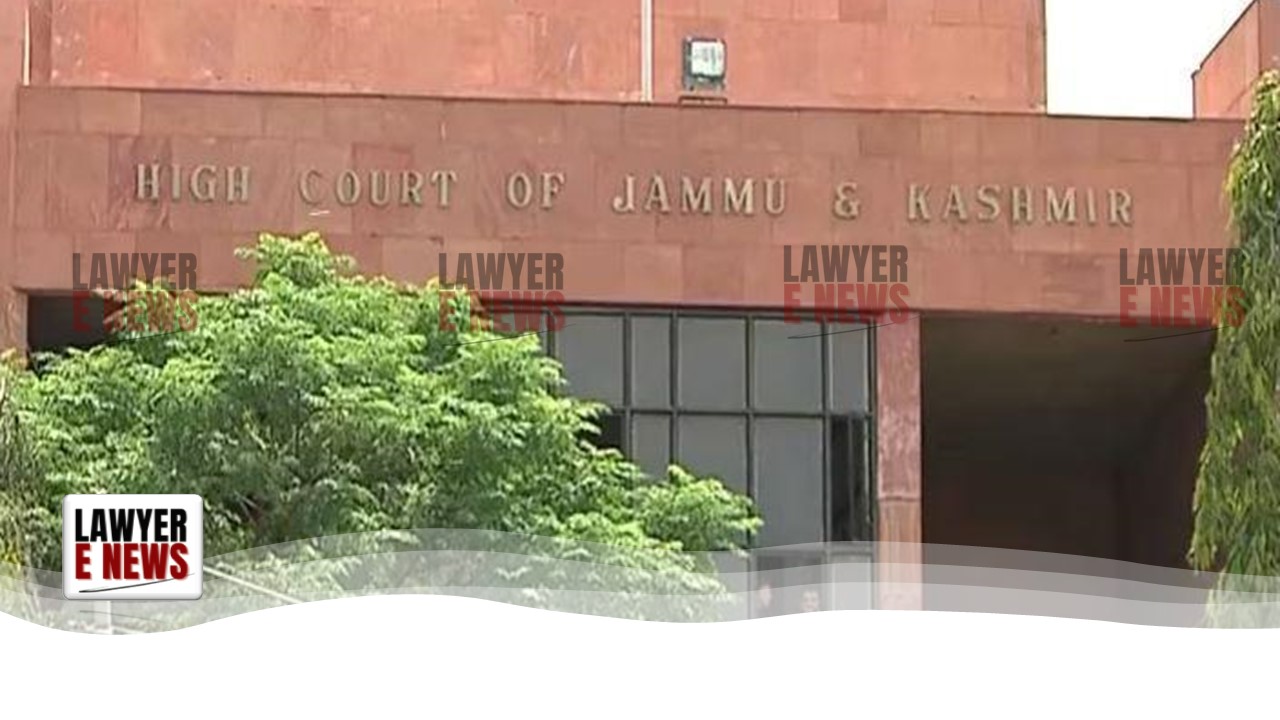
"Once a litigant chooses to accept an order and participate in proceedings, he cannot later re-agitate the matter by suppressing that very conduct" – High Court of Jammu & Kashmir and Ladakh at Jammu, presided over by Justice Wasim Sadiq Nargal, delivered a significant ruling in Mohd. Yousaf v. Union Territory of J&K and Others, wherein a writ petition filed under Articles 226 and 227 of the Constitution of India was dismissed with exemplary costs of ₹20,000 for deliberate suppression of material facts. The Court rejected the petitioner’s challenge to the condonation of a delay of over 24 years in an appeal against a land mutation order, holding that the petitioner, having voluntarily participated in the appellate proceedings, could not later turn around and challenge the very same orders.
This judgment reinforces the principle that writ jurisdiction is an equitable and discretionary remedy, available only to those who come to court with clean hands, and cannot be invoked to aid dishonest litigants.
The petitioner, Mohd. Yousaf, approached the High Court assailing two orders. The first was the order dated 25 November 2021 passed by the Additional Commissioner (with powers of Divisional Commissioner), Jammu, whereby a delay of over 24 years in filing an appeal against Mutation Order No. 742 dated 20 June 1996 was condoned. The second was the revisional order dated 10 August 2022 passed by the Financial Commissioner (Revenue), J&K, dismissing the revision petition filed under Section 15 of the J&K Land Revenue Act, 1996.
The land in question, situated at Maitra Govindpura, District Ramban, measuring approximately 13 kanals, had been mutated in favour of the petitioner in 1996. The private respondents filed an appeal challenging the mutation decades later, and the Additional Commissioner, exercising appellate powers, condoned the delay and admitted the appeal. After his revision was dismissed, the petitioner filed the present writ petition, alleging that the delay was condoned arbitrarily and that the orders were passed mechanically without proper reasoning.
The petitioner also sought directions to protect his possession over the land, alleging multiple attempts by the respondents to forcibly dispossess him, including registered FIRs involving violent incidents.
The core issue before the Court was whether the petitioner was entitled to relief under Article 226 when he had participated in the proceedings before the Appellate Authority after the dismissal of his revision petition, without disclosing this fact in his writ petition. The Court was also required to consider whether the delay of over two decades in filing the appeal could have been lawfully condoned.
The High Court noted that although the petitioner had challenged the delay condonation before the Financial Commissioner and lost, he subsequently continued to participate in the appellate proceedings before the Additional Commissioner between 18 August 2022 and 4 November 2023. Despite being an active party in the appeal, the petitioner suppressed this vital fact from the Court when filing the present writ petition. The Court found this concealment to be deliberate and calculated.
Justice Nargal categorically held that a litigant who voluntarily participates in proceedings arising out of a challenged order and then approaches the writ court suppressing this fact is guilty of forum shopping and abuse of judicial process. Once the petitioner accepted the revisional order and acted upon it by appearing before the appellate authority, he could not seek to challenge the same without disclosing his participation.
The Court held that suppression of material facts, especially facts which go to the root of the maintainability of the writ petition, disentitles the petitioner to any discretionary relief. The petitioner’s conduct in pursuing two parallel remedies – one before the High Court and one before the lower appellate authority – on the same cause of action, while concealing his appearance before the latter, amounted to misuse of the court's process.
The Court found that the petitioner, through his conduct, had abused the constitutional remedy under Article 226. It noted that he had filed an application to set aside ex parte proceedings before the Appellate Court and participated through his counsel even as late as 4 November 2023. None of these facts were disclosed in the writ petition filed on 8 November 2023, just days later. The Court observed that the petitioner deliberately misled the Court and chose to remain silent on facts that would reveal his inconsistent conduct.
Referring to a catena of decisions from the Supreme Court including Dalip Singh v. State of U.P., Prestige Lights Ltd. v. SBI, and K. Jayaram v. BDA, the Court reiterated that writ jurisdiction is not to be exercised in favour of litigants who approach the Court with unclean hands. The Court also relied on its own earlier decision in Satpal Sharma v. State of J&K, where it had lamented the rising trend of dishonest litigants misusing equitable remedies by suppressing facts.
The judgment specifically noted that the petitioner’s plea of having suffered prejudice due to the condonation of delay was overshadowed by his own conduct, which disentitled him from any equitable relief. The Court further clarified that it was not inclined to examine the legality of the delay condonation itself, as the challenge stood vitiated by the petitioner’s conduct and suppression of facts.
The High Court concluded that the petitioner’s deliberate concealment of participation in the appellate proceedings constituted a fraud on the Court and a clear abuse of the extraordinary writ jurisdiction. Not only was the writ petition dismissed, but the Court also imposed exemplary costs of ₹20,000, to be deposited in the Advocate’s Welfare Fund, as a deterrent against such dishonest practices.
Justice Wasim Sadiq Nargal stressed that the integrity of the judicial system cannot be compromised by allowing unscrupulous litigants to exploit the court’s discretion through misrepresentation. The Court thus sent a strong message that writ jurisdiction under Article 226 is meant to serve justice, not to be misused by those who engage in forum shopping and deliberate deception.
Date of Decision: 5 August 2025