-
by sayum
29 August 2026 3:15 PM







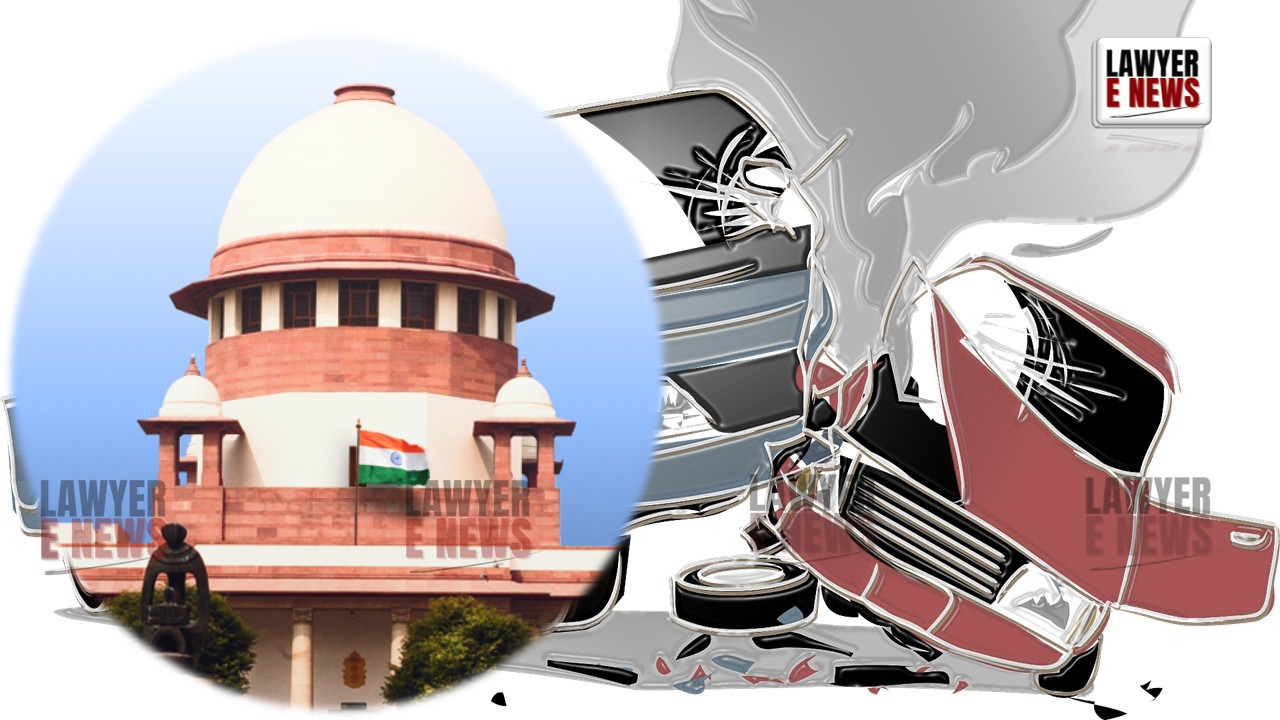
"Where control is assumed by the State, the legal consequences arising from that control cannot, in fairness, be shifted back to a private insurer whose contractual engagement was premised on a wholly different footing", In a significant ruling on the law of motor accident liability, the Supreme Court of India held that when a privately owned vehicle is requisitioned by a State authority for election duty and causes a fatal accident during that period, the liability to pay compensation rests squarely with the requisitioning authority — not with the vehicle's insurer.
A bench of Justice Sanjay Karol and Justice Nongmeikapam Kotiswar Singh dismissed the appeal of the District Magistrate and District Election Officer, Gwalior, who had challenged the Madhya Pradesh High Court's order shifting accident liability from the National Insurance Company to the State authority.
On January 23, 2010, a bus belonging to Kidzee Corner School, Gwalior, which had been requisitioned by the District Election Officer for Gram Panchayat elections, collided with a motorcycle, killing its rider. The Motor Accident Claims Tribunal, Gwalior, awarded compensation of Rs. 5,13,500 with interest, fastening liability on the insurer. On appeal, the Madhya Pradesh High Court enhanced the compensation to Rs. 27,01,556 and shifted liability from the National Insurance Company to the requisitioning authority — the District Magistrate. The District Magistrate then approached the Supreme Court, contending that since the vehicle was insured at the time of the accident and was being used for a public purpose, liability ought not to be cast on a State authority that had neither ownership of the vehicle nor any insurable interest in it.
The core question before the Court was whether the definition of "owner" under Section 2(30) of the Motor Vehicles Act, 1988, which extends to any person in possession or control of a vehicle, covers a requisitioning State authority — and whether that authority, rather than the private insurer, must bear the liability for accidents occurring during the period of statutory requisition.
Requisition Transfers Control — And With It, Liability
The Court relied extensively on two binding precedents to resolve the question. In National Insurance Co. Ltd. v. Deepa Devi, (2008) 1 SCC 414, the Supreme Court had held that while a vehicle is under requisition, "the owner does not exercise any control thereover" and "save and except for legal ownership, for all intent and purport, the registered owner of the vehicle loses entire control thereover." In Purnya Kala Devi v. State of Assam, (2014) 14 SCC 142, a three-judge bench held that the requisitioning State must be treated as the "owner" within the meaning of Section 2(30) of the Motor Vehicles Act, which covers any person in possession and control of the vehicle — not merely the registered owner.
Applying these authorities, the Court found no error in the High Court's conclusion and dismissed the appeal.
Why the Insurance Policy Does Not Cover This Risk
The Court went further to articulate a principled basis for why the insurer cannot be made liable in cases of statutory requisition. The insurance policy obtained by the school contemplated the vehicle's "regular and lawful use in the ordinary course." The Court held that compelled deployment under a statutory requisition order is fundamentally different from voluntary commercial or private use.
"To fasten liability upon the insurer in these circumstances would be to extend the contract beyond the risk that was agreed to be covered," the Court stated, adding that requiring the insurer to answer for consequences arising from a use "neither authorised nor controlled by the insured would be unfair."
The Court held that when the State steps in, assumes control, and deploys a vehicle for its own governmental functions, "it assumes with that control the corresponding responsibility." The owner, who is compelled to surrender the vehicle under statutory authority, has no say over its deployment, the roads it travels, the hours it operates, or the manner in which it is driven. It would be inequitable, the Court held, to impose on a private insurer the burden of risks generated "exclusively by governmental action."
Requisition Is a Command, Not a Contract
The Court decisively rejected the appellant's reliance on U.P. SRTC v. National Insurance Co. Ltd., (2021 SCC OnLine SC 3278) and U.P. SRTC v. Kulsum, (2011) 8 SCC 142, where insurers were held liable despite State operation of vehicles. The Court drew a critical distinction: in those cases, the vehicles were operated under a contractual agreement between the authority and the owner. Here, the vehicle was taken under statutory requisition — a compulsory takeover, not a voluntary arrangement. "A requisition is not a voluntary arrangement, instead it is a command issued under statutory authority," the Court held. The owner does not consent; he is compelled. Cases of contractual operation, accordingly, stand on entirely different footing from statutory requisition.
On the Driver: Implicit Acceptance Means Implicit Responsibility
The Court also addressed a subsidiary but important question about the status of the driver. Section 160 of the Representation of the People Act, 1950, which authorises the State to requisition vehicles for elections, does not expressly authorise requisition of manpower such as a driver. Yet, in practice, vehicles are placed at the disposal of election authorities along with their drivers.
The Court held that by accepting and utilizing the services of the driver, the election authority "implicitly recognized such a driver's competence, capacity and ability to operate the vehicle." The authority had consciously requisitioned the vehicle with its driver rather than arranging its own staff from institutions listed under Section 159(2) of the Act. This implicit acceptance of the driver's services further reinforced the conclusion that operational control — and thus liability — vested with the requisitioning authority.
Rejection of the "Bad Message" Argument
The appellant had submitted that fastening liability on civic authorities would send a "bad message" and discourage requisitioning for public purposes. The Court rejected this framing. It held that when statutory power is exercised to requisition private property in the public interest, "that power carries with it an obligation to answer for the consequences flowing from such compelled use." Responsibility cannot be avoided simply because the requisition serves a public purpose. The State must answer for what happens when it exercises its coercive powers over private property.
Date of Decision: March 23, 2026