-
by sayum
27 August 2026 3:32 PM







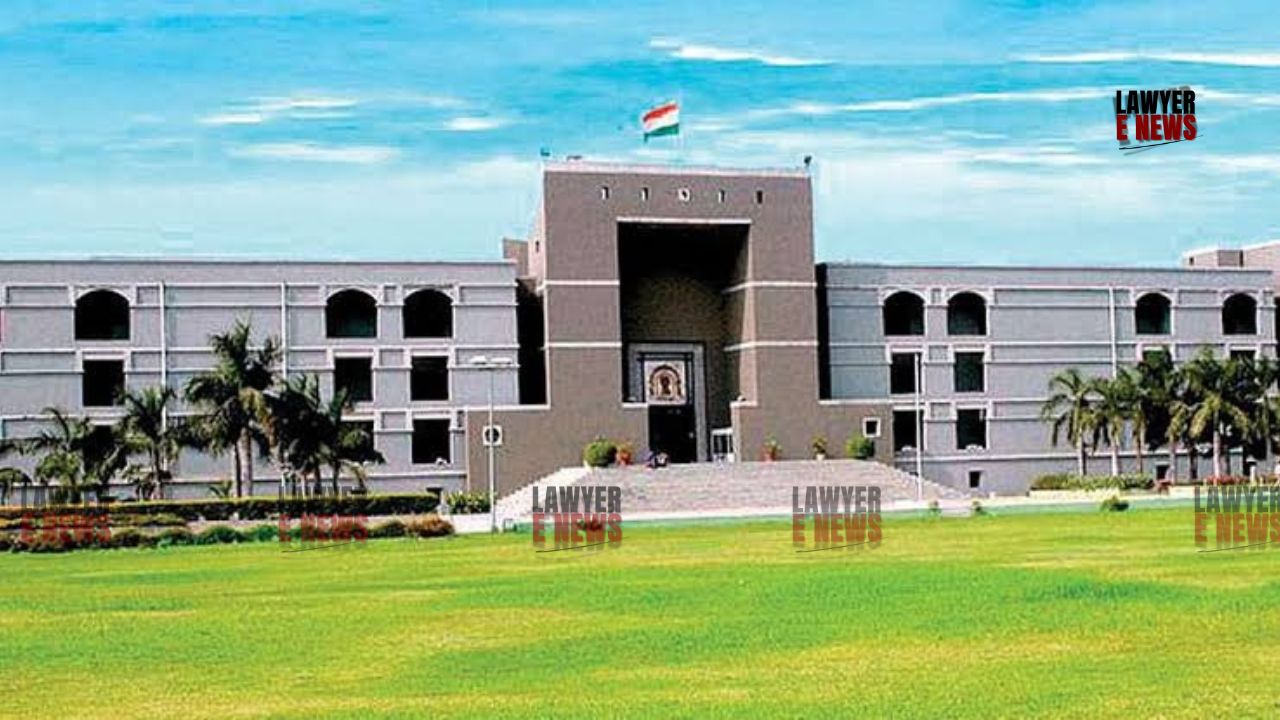
"In absence of the certificate under Section 65B(4) of the Evidence Act or Section 63(4) of the BSA, the Court cannot take decision in regards to admissibility of electronic evidence, the tape record in the present case," Gujarat High Court, in a significant ruling, held that a trial court cannot direct defendants to provide voice samples or order a Forensic Science Laboratory (FSL) examination of a tape recording without first determining its admissibility as evidence.
A bench of Justice J.C. Doshi observed that the mandatory requirements for proving electronic records, specifically the production of a certificate under Section 65B(4) of the Indian Evidence Act or Section 63(4) of the Bharatiya Sakshya Adhiniyam (BSA), must be satisfied before such directions are issued.
The dispute arose from a suit for specific performance filed by the respondents (plaintiffs) regarding an alleged oral agreement for the sale of a bungalow. The plaintiffs claimed to have recorded telephonic conversations with the defendants to prove the existence of a concluded contract. The trial court, acting on an application by the plaintiffs, had directed the FSL to examine the audio tape for tampering and ordered the defendants to provide their voice samples for comparison.
The primary question before the court was whether the trial court could direct the defendants to provide voice samples for an electronic record whose admissibility had not yet been established. The court was also called upon to determine whether a certificate under Section 65B(4) of the Evidence Act or Section 63(4) of the BSA is a mandatory prerequisite for admitting a tape recording that is a copy of an original conversation.
Distinction Between Primary And Secondary Electronic Evidence
The court noted that the plaintiffs had not produced the original telephone instrument used to record the conversation but instead provided a tape record which was a copy. The bench observed that such a recording falls within the definition of "secondary evidence" under the law. It emphasized that the trial court failed to distinguish between primary and secondary evidence before passing the impugned directions.
Section 65B Certificate Is A Mandatory Prerequisite
The High Court reiterated the settled legal position that the production and proof of a certificate under Section 65B(4) of the Evidence Act (now Section 63(4) of the BSA) is an essential condition for the admissibility of secondary electronic records. Referring to the Supreme Court's ruling in Arjun Panditrao Khotkar v. Kailash Kushanrao Gorantyal, the bench noted that this requirement is a "condition precedent" that cannot be bypassed.
"In absence of the certificate under Section 65B(4) of the Evidence Act or Section 63(4) of the BSA, the Court cannot take decision in regards to admissibility of electronic evidence, the tape record in the present case."
Stringent Standards For Tape-Recorded Evidence
Citing the Supreme Court's decisions in Tukaram S. Dighole v. Manikrao Shivaji Kokate and Nilesh Dinkar Paradkar v. State of Maharashtra, the court explained that tape recordings are more susceptible to tampering and excision. Consequently, the standard of proof for their authenticity must be more stringent than for other documentary evidence. The bench observed that the trial court had completely ignored these binding precedents.
"To rule out the possibility of any kind of tampering with the tape, the standard of proof about its authenticity and accuracy has to be more stringent as compared to other documentary evidence."
Voice Identification Evidence Is Suspect And Unreliable
The court expressed caution regarding voice identification, noting that accurate voice identification is far more difficult than visual identification. It observed that voice evidence is prone to sophisticated doctoring and editing. Therefore, courts must be extremely cautious and should generally treat tape-recorded conversations only as corroborative evidence rather than primary proof.
"In our opinion, the evidence of voice identification is at best suspect, if not, wholly unreliable. Accurate voice identification is much more difficult than visual identification. It is prone to such extensive and sophisticated tampering, doctoring and editing that the reality can be completely replaced by fiction."
Trial Court Exceeded Jurisdiction By Ordering Voice Samples
The High Court found that by directing the defendants to provide voice samples to the FSL, the trial court had effectively required the defendants to furnish evidence to prove the plaintiffs' case. The bench held that the question of directing defendants to give voice samples does not arise until the tape record is first proved and admitted as evidence in accordance with the law.
"The learned trial Court has exceeded its jurisdiction. Learned Senior Counsel submits that in reality, the defendants are directed to give the evidence to prove the case of the plaintiffs."
The Court concluded that the trial court's order was a patent illegality as it ignored statutory provisions and binding precedents regarding electronic evidence. The bench allowed the petition and quashed the order dated December 30, 2022. The matter was remanded to the trial court with instructions to decide the application afresh, strictly following the legal requirements for the admissibility of electronic evidence.
The ruling reinforces the mandatory nature of Section 65B certificates for secondary electronic evidence in civil proceedings. By setting aside the order for voice samples, the High Court has clarified that the burden of proving the admissibility of electronic records remains firmly with the party relying on them, and the court cannot compel the opposing party to facilitate this proof until the legal prerequisites are met.
Date of Decision: 08 May 2026