-
by sayum
28 August 2026 2:11 PM







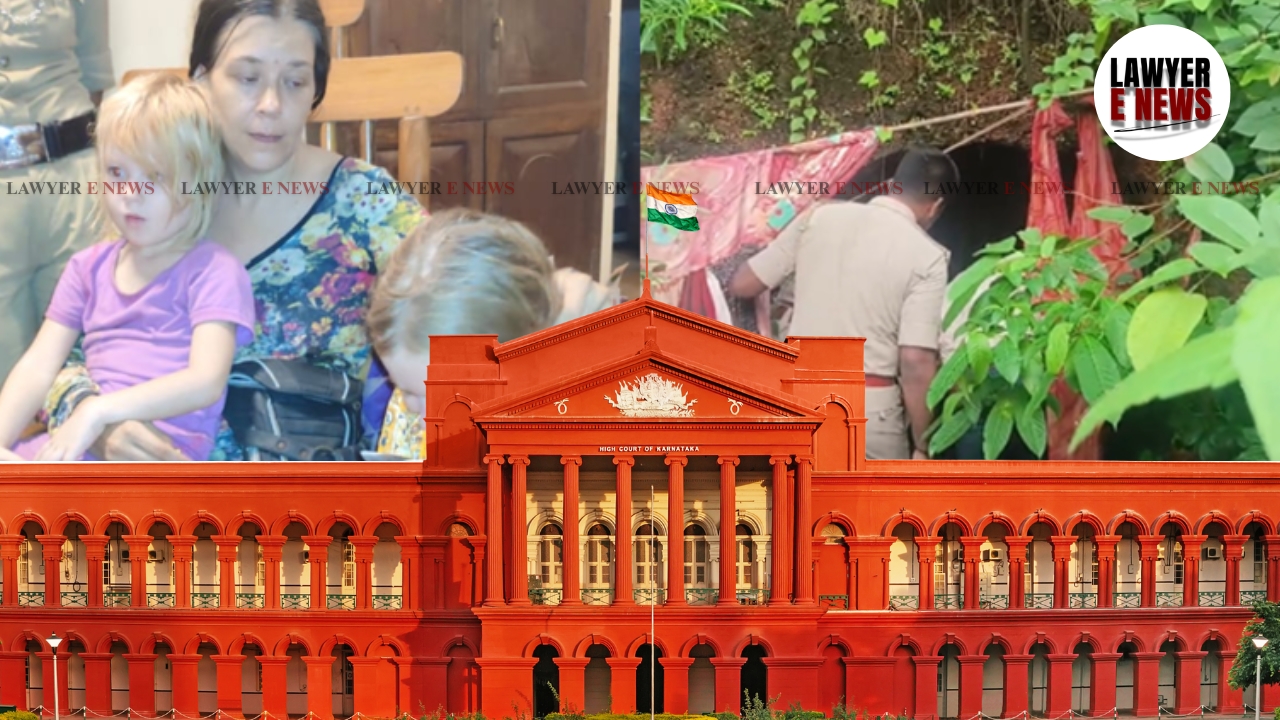
"The Test of Best Interest Cannot Be Applied in Abstraction, Detached from the Facts of the Case" — In a striking case involving international custody, immigration law, and child rights, the Karnataka High Court dismissed a writ petition filed by Dror Shlomo Goldstein, an Israeli national, who sought to restrain the Union of India from issuing Exit Permits enabling the return of his alleged minor daughters and their Russian mother to Russia. The judgment, delivered by Justice B.M. Shyam Prasad, emphatically held that the proposed return, based on the mother's voluntary consent and Emergency Travel Documents (ETDs) issued by the Russian Consulate, did not amount to forced deportation, and that no violation of child rights under the United Nations Convention on the Rights of the Child (UNCRC) or the Goa Children Act, 2003 was established.
The Court stated at the outset, “This Court must refer to the peculiarities of this case even before referring to the relief/s that the petitioner seeks,” underlining the exceptional facts: a Russian woman and her two minor children were discovered living in an isolated cave in the forests of Gokarna, Karnataka, on July 9, 2025, without any basic amenities. Upon their discovery, they were housed at the Foreigners Restriction Centre in Tumakuru, and proceedings were initiated by the FRRO due to the mother’s overstay in India beyond her permitted travel duration.
The Union of India, supported by the Russian Consulate in Chennai, facilitated the issuance of Emergency Travel Documents on September 25, 2025, enabling the repatriation of the woman and her two children. A crucial aspect of the case was the mother’s express request to return to Russia, made in writing to Indian authorities:
"That minor daughters and I are not used to the food which is being served to us and that we wish to just go back to Russia as soon as possible... I request you with folded hands to permit us to repatriate back to Russia since the emergency travel documents have been issued by the Russian Consulate in our favour."
This statement, along with the active involvement of the Russian Government, formed the bedrock of the Court’s finding that the action could not be equated with deportation.
“Repatriation With Consular Coordination and Parental Consent Cannot Be Labelled as Deportation” — Court Clarifies Scope of Executive Power in Immigration Matters
The petitioner, represented by Smt. Beena P.K., argued that the action of issuing Exit Permits violated the best interests of the children and that India, being a signatory to the UNCRC, was duty-bound to protect their welfare under Goa Children Act, 2003. It was also claimed that the second child was born in Goa, and that custody proceedings initiated by the petitioner were pending.
The Court, however, was unimpressed by these claims in the absence of any credible explanation from the petitioner as to why the mother and the children were found in a cave with no resources. It noted:
"This question is presented for consideration by the petitioner who cannot explain the reasons for the mother and the two children being in an isolated cave until they were found there and the authorities began action for their rehabilitation."
On the question of deportation, the Additional Solicitor General Sri Aravind Kamath, appearing for the Union of India, submitted that this was a case of voluntary repatriation based on the mother’s clear and unequivocal communication. The Court accepted this submission, holding:
"Sending back the mother and the children cannot be termed ‘deportation’... the permission to travel to Russia with the required Exit Permit would only be recognition of the mother's interest to travel back to her country with the children."
The Court further observed that repatriation under ETDs at the request of a parent, with diplomatic coordination, fell within the lawful domain of the executive, and did not require judicial interference unless there was illegality or arbitrariness, neither of which was found.
“The Best Interest of the Children Must Be Judged in the Context of Their Real-Life Circumstances, Not Abstract Legal Doctrines” — High Court Applies Welfare-Centric Lens
In rejecting the petitioner’s invocation of child rights under the UNCRC and Goa Children Act, the Court emphasized that legal safeguards must be grounded in actual circumstances. The Court placed significant weight on three factors: the manner in which the children were discovered, the expressed wish of the mother to return, and the Russian government's active engagement through consular channels.
It stated: "It would only be just and reasonable to examine the question of the children’s best interest in the backdrop of this apart from the other circumstances that are peculiar to this case."
The Court also noted that the Emergency Travel Documents were only valid until October 9, 2025, creating an urgency to act promptly in order to avoid further detainment of the children in the Foreigners Restriction Centre, where the mother had stated they were struggling with conditions.
The judgment concluded with the following observation:
"These circumstances overweigh every other assertion... it would be within the Union of India’s domain to issue necessary documents to enable the mother and the children to travel to Russia."
No Violation of Law or Rights — Voluntary Return Upheld as Lawful and in Children's Best Interest
The Karnataka High Court ultimately refused to interfere under Article 226 of the Constitution, holding that the petitioner’s challenge lacked legal merit and failed to demonstrate how the voluntary return facilitated by diplomatic coordination was contrary to law. It underscored that judicial intervention is unwarranted when the executive acts within legal bounds and with regard to humanitarian and diplomatic sensitivities.
The writ petition was accordingly disposed of, with the Union of India permitted to issue necessary Exit Permits and facilitate the repatriation of the mother and children to Russia.
"The petition stands disposed of observing that it would be within the Union of India’s domain to issue necessary documents to enable the mother and the children to travel to Russia."
Date of Decision: September 26, 2025