-
by sayum
01 August 2026 8:24 AM







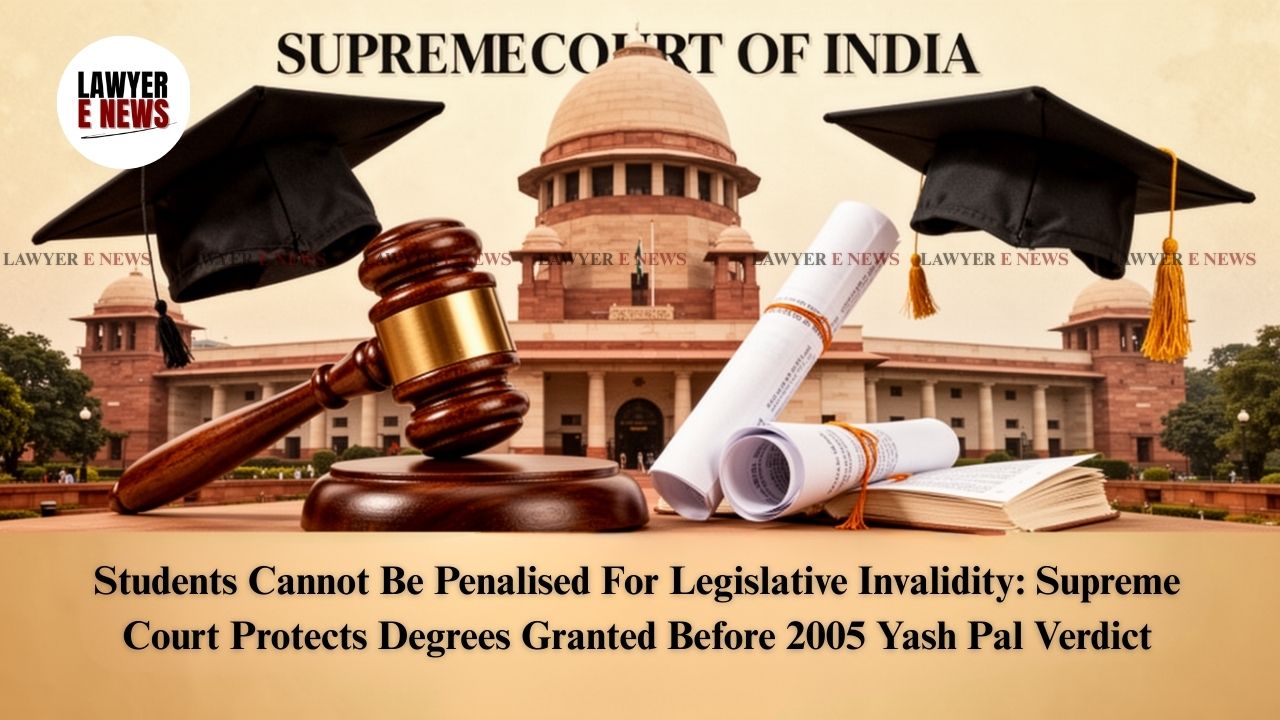
“Appellants Cannot Be Said To Be At Fault… They Should Not Be Deprived Of The Benefits Of The Degree Obtained By Them”, In a significant ruling safeguarding the careers of students affected by the striking down of a statute, the Supreme Court of India on 18 February 2026 held that degrees obtained from a private university prior to the declaration of the parent Act as ultra vires cannot be invalidated retrospectively to the detriment of innocent students.
A Bench comprising Justice Rajesh Bindal and Justice Vijay Bishnoi, in Priyanka Kumari and Ors. v. State of Bihar and Ors., allowed three connected civil appeals and set aside the termination of librarians appointed in Bihar on the basis of degrees obtained from a Chhattisgarh private university established under the Chhattisgarh Niji Kshetra Vishwavidyalaya Act, 2002. While directing reinstatement with continuity of service, the Court denied back wages for the intervening period.
The judgment marks a crucial extension of the protective principle earlier recognized in Prof. Yash Pal v. State of Chhattisgarh (2005) 5 SCC 420, emphasizing that “innocent students should not suffer” for legislative invalidity.
Degrees From A University That Ceased To Exist
The appellants had obtained Bachelor of Library Science (B.Lib.) degrees in 2004 from the University of Technology and Science, Raipur, established under the Chhattisgarh Niji Kshetra Vishwavidyalaya Act, 2002. The University had been duly recognized by the State Government and its courses acknowledged by the Ministry of Human Resource Development through a communication dated 26.01.2004.
However, in Prof. Yash Pal, the Supreme Court declared Sections 5 and 6 of the 2002 Act ultra vires for lack of legislative competence. As a consequence, the notifications establishing private universities under the Act were quashed and “such universities shall cease to exist.”
The appellants were appointed as librarians by the State of Bihar in 2010 and served for over five years. A Public Interest Litigation later questioned appointments made on the basis of degrees from the said University. Though the PIL was dismissed for lack of foundational facts, the State terminated the appellants’ services in 2015 on the ground that their degrees were invalid.
The High Court upheld the termination in writ and intra-court appeals, prompting the present challenge before the Supreme Court.
Are Degrees Obtained Before Declaration Of Ultra Vires Protected?
The central legal question was whether students who had completed their courses prior to the 2005 judgment striking down the 2002 Act could be deprived of the benefit of their degrees on the ground that the parent statute was later declared unconstitutional.
The appellants argued that in Prof. Yash Pal, the Supreme Court had protected students who were studying at the time of the judgment and that the same principle must extend to those who had already passed out when the Act was still operative.
The State contended that once the Act was struck down for legislative incompetence, the degrees granted under it stood invalidated, and that protection in Yash Pal was confined only to students then pursuing studies.
Protection Must Extend To Those Who Had Already Passed Out
The Bench carefully examined paragraphs 64 and 65 of the Prof. Yash Pal judgment, where this Court had directed affiliation of institutions “in order to protect the interests of the students who may be actually studying.”
However, the Court held that the present case involved students who had passed out in 2004, prior to the declaration of unconstitutionality in 2005. Importantly, there was no material to suggest that the University was bogus or non-existent.
Justice Bindal, speaking for the Bench, observed:
“It is not the case of the State that the University in which the appellants studied was bogus or no study was actually imparted.”
The Court emphasized that the appellants had studied in a University validly established under a State enactment that remained operative until struck down. Hence, they could not be faulted for legislative incompetence subsequently declared.
The Bench categorically held:
“Considering the aforesaid fact and also that in the factual situation in hand, the appellants cannot be said to be at fault as they had studied in the University, which has been set up under the 2002 Act enacted by the State Legislature. Hence, they should not be deprived of the benefits of the degree obtained by them while studying in the University.”
The Court also noted that despite the Yash Pal judgment being in the public domain, the State of Bihar had appointed the appellants in 2010 and allowed them to serve for more than five years without objection. Even a PIL filed immediately after appointments had been dismissed.
This conduct further weighed with the Court in concluding that termination solely on the ground of invalidity of the parent Act was unsustainable.
Constitutional Dimensions: Effect Of Declaration Of Ultra Vires
Though the Court did not explicitly invoke the doctrine of prospective overruling, it effectively applied the principle that past transactions undertaken while a statute was operative cannot be automatically nullified to the prejudice of third parties who acted bona fide.
The ruling reinforces the broader constitutional principle that a declaration of unconstitutionality does not necessarily obliterate all past actions taken under the statute, particularly where innocent parties would suffer.
By harmonizing Articles 14 and 226 concerns with equitable considerations, the Court ensured that the burden of legislative invalidity does not fall upon students who neither engineered nor benefited from any illegality.
Relief: Reinstatement With Continuity, But No Back Wages
Having found the termination illegal, the Court set aside the High Court’s judgment and quashed the termination orders.
The Bench held:
“The services of the appellants were terminated only for the reason that the institution in which they had studied was declared to be unrecognised. Accordingly, the orders vide which the services of the appellants were terminated have to be declared as illegal.”
However, on the question of back wages, the Court balanced equities. It observed that the appellants had not actually worked during the intervening period and that the matter could not be attributed solely to fault on the part of the State.
Therefore, while directing reinstatement with continuity of service, the Court denied back wages.
A Significant Extension Of Student Protection Jurisprudence
The judgment in Priyanka Kumari represents a vital clarification in education and service jurisprudence. It extends the protective umbrella first recognized in Prof. Yash Pal to students who had completed their courses prior to the declaration of statutory invalidity.
By holding that “students cannot be said to be at fault” and must not be deprived of the benefit of degrees obtained when the University was functioning under a validly enacted statute, the Supreme Court has reaffirmed the principle that constitutional adjudication must not operate harshly against innocent individuals.
The ruling is likely to have far-reaching implications in cases where statutory schemes are invalidated after educational qualifications have already been awarded and acted upon.
Date of Decision: 18 February 2026