
-
by sayum
28 August 2026 2:11 PM







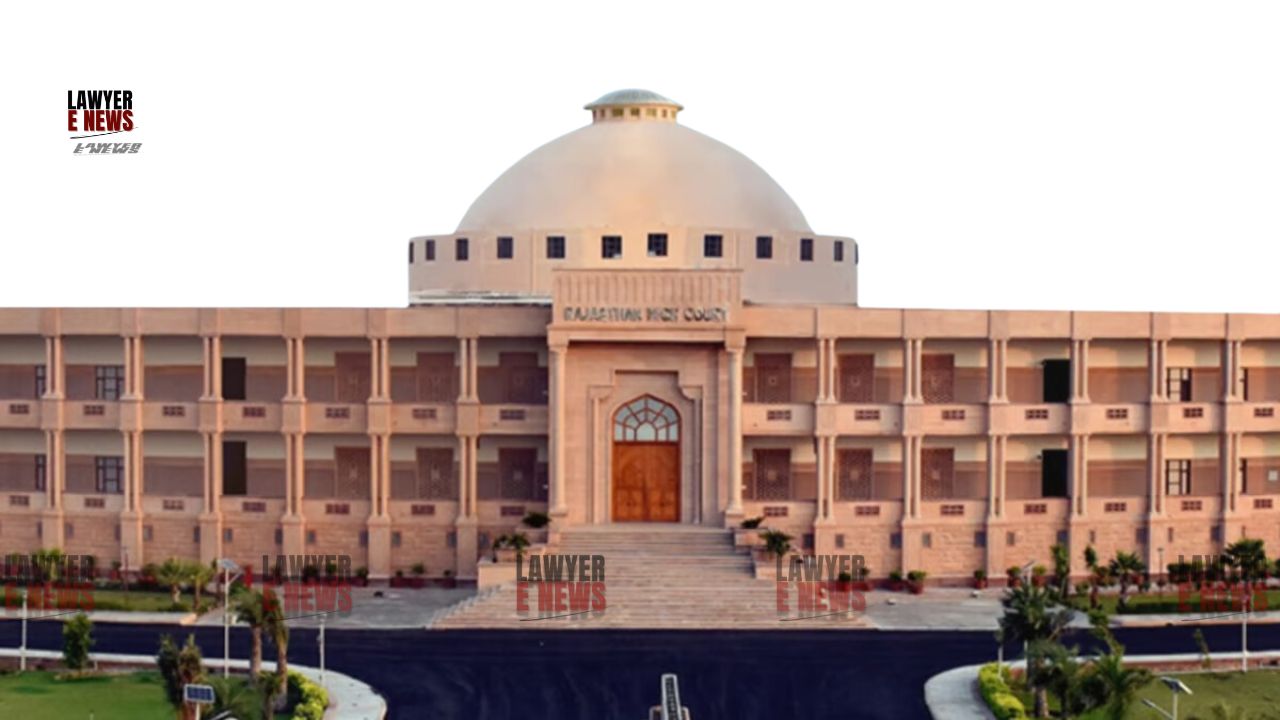
“The creation of new revenue villages is an administrative act, not legislative in nature, and cannot be struck down merely for non-adherence to executive circulars which lack statutory force,” observed the Rajasthan High Court in its significant judgment delivered. The Court upheld a series of government notifications, dismissing over a dozen writ petitions challenging the creation and naming of new revenue villages across the State.
“Fairness Must Govern Executive Action, But Circulars Are Not Law”: Court Clarifies Legal Status of Panchayati Raj Guidelines in Revenue Reorganisation
In a detailed judgment delivered by Justice Kuldeep Mathur, the High Court examined whether the State Government’s notifications—creating new revenue villages such as Harkanada, Chouhan Nagar, Somesar Kalla, Kishandasot Nagar, Phusa Nagar and others—violated the mandatory legal process. The primary contention of the petitioners was that the government failed to convene Gram Sabha meetings, violated minimum population and distance requirements, and named villages after living persons, castes, or political affiliates, thereby breaching a set of administrative circulars issued between 2009 and 2025.
The Court rejected the notion that these circulars were binding. In para 55, it ruled:
“These circulars have not been issued in the official gazette… the guidelines and parameters laid down… are found not to have any statutory force although it is expected from the authorities to adhere to the said guidelines… to avoid any element of arbitrariness.”
“Revenue Village Creation Under Section 16 Is Administrative, Not Legislative”: Landmark Clarification by Rajasthan High Court
Rejecting the State’s argument that the creation of villages under Section 16 of the Rajasthan Land Revenue Act, 1956 amounted to a legislative act, the Court ruled decisively:
“The exercise of creation of new Revenue Villages under Section 16… is an administrative act which is based on the administrative/policy decision of the Government.” [Para 50]
Relying on the landmark precedents of Union of India v. Cynamide India Ltd. and State of Punjab v. Tehal Singh, the Court explained that the decision to reorganize revenue villages is taken on the basis of area-specific needs and aimed at ensuring better delivery of public services, rather than making law of general applicability.
The Court noted:
“Though it is a settled position of law that administrative decisions are a prerogative of the executive… they can still be interfered with if taken arbitrarily, with mala fide intent or without proper application of mind.” [Para 51]
But in the present batch of petitions, no such illegality was proven.
“Naming of Villages After Individuals or Castes Is Impermissible—But Only If Motivated by Mala Fides”: Court Narrows Grounds for Challenge
A major grievance of the petitioners was that the new villages were named after living persons, political figures, or castes, in violation of Clause 4 of the circular dated 20.08.2009, and its subsequent amendments through circulars dated 17.02.2025 and 18.02.2025.
The Court acknowledged that a coordinate bench in Joga Ram v. State of Rajasthan had already declared the deletion of naming restrictions via circulars dated 28.02.2025 and 06.03.2025 as illegal, thus reviving the bar on naming villages after persons, castes, or religious identifiers. However, the Court held that mere deviation from the guideline is not enough to vitiate the administrative decision:
“Unless it is established on record beyond doubt that the Revenue Village has been named after a particular person, deity or caste to appease a particular religious or political group… no challenge in that regard can be entertained.” [Para 66]
On examining the individual facts of each case, the Court noted:
“This Court, prima facie does not find any intentional and deliberate departure from the guidelines… thus, the arguments raised by petitioners qua deviation from the circulars to name new revenue villages is hereby turned down.” [Para 67]
“No Legal Requirement for Gram Sabha Consent After Circular Amendments”: Court Upholds Alternate Mechanism for Revenue Village Proposals
Another key issue was the alleged absence of Gram Sabha meetings or resolutions endorsing the proposals for creation of new villages. Petitioners argued that the absence of such consent violated Sections 8-A, 8-B, and 8-D of the Panchayati Raj Act, 1994, and earlier circulars requiring Gram Sabha No Objection Certificates (NOC).
However, the Court held that amended circulars dated 28.02.2025 and 06.03.2025 introduced an alternative mechanism allowing Gram Vikas Adhikari and Patwari to assess and forward proposals, particularly when Gram Sabhas fail to reach consensus:
“The circulars… nowhere bind the respondent authorities to convene a meeting of Gram Sabha… before floating the proposal.” [Para 68]
According to the Court, this procedural flexibility was essential:
“The alternative mechanism was prescribed… looking to the difficulties faced in creation of new Revenue Villages for want of general consensus… which was creating hindrance to development at grass root level.” [Para 68]
“Factual Disputes on Population and Distance Cannot Be Decided Under Article 226”: High Court Leaves Door Open for Representations
On the question of whether minimum population (250 in general areas, 200 in tribal/desert areas) and distance requirements (1 km) were met, the Court refused to adjudicate contested facts in a writ petition:
“In a case which involves disputed question of facts, the High Court cannot go into the same in exercise of its extra-ordinary jurisdiction under Article 226.” [Para 70]
However, the Court allowed the petitioners to file representations within 30 days before the competent authority, directing that such representations must be considered expeditiously.
“Revenue Administration Is Best Judge of Reorganisation Needs—Judicial Review Limited to Clear Illegality”: High Court Applies Restraint
Reiterating the principle from Rama Ram v. State of Rajasthan, the Court concluded that unless the petitioners furnish unimpeachable evidence of mala fides or arbitrariness, courts must defer to administrative discretion:
“In the absence of any unimpeachable proof of any violation of prescribed norms… such disputes cannot be gone into by this Court.” [Para 52]
Consequently, the High Court dismissed all 13 writ petitions and associated stay applications, finding no illegality, arbitrariness or mala fide intent in the notifications issued by the State Government.
No Interference Warranted in Policy Decisions Absent Proof of Bias or Malice
This judgment lays down a clear demarcation between procedural irregularities and unlawful executive action, reaffirming that guidelines without statutory force, even if wise and desirable, cannot bind the State. While encouraging procedural discipline, the Rajasthan High Court has also sent a strong message of judicial restraint in matters of policy and administration, unless malice or manifest illegality is proven.
“This Court finds no merit in the present batch of writ petitions. The writ petitions are accordingly dismissed.” [Para 71]
Date of Decision: 23/09/2025





