-
by sayum
04 August 2026 1:39 PM







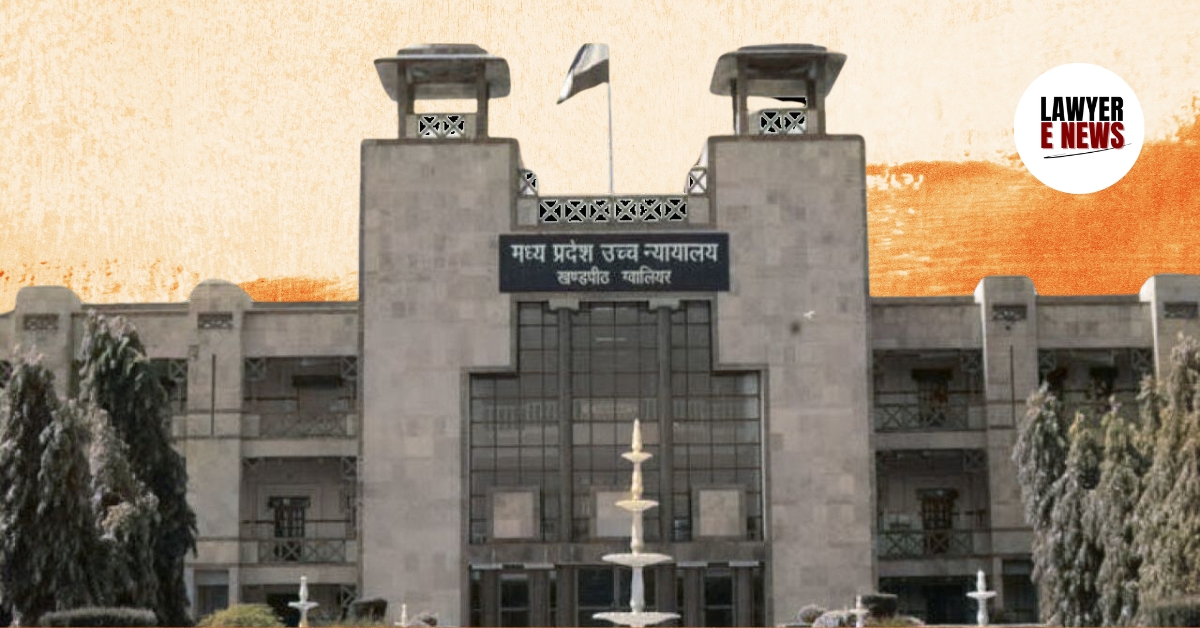
“In statutory arbitration, the place chosen by the Arbitrator for convenience cannot be treated as the juridical seat, especially where no arbitration agreement exists” — Madhya Pradesh High Court at Gwalior upholding the jurisdiction of the 4th Additional District Judge, Shivpuri, to entertain a challenge under Section 34 of the Arbitration and Conciliation Act, 1996 against an arbitral award passed by the Commissioner, Gwalior Division. The Court ruled that the venue fixed by a statutory arbitrator cannot override territorial jurisdiction based on cause of action, especially in the absence of any arbitration agreement designating the seat.
Justice Milind Ramesh Phadke clarified that “Gwalior was merely a convenient venue selected by the appointed Arbitrator; it did not amount to a juridical seat binding the parties.”
“Statutory Appointment Does Not Create Contractual Seat”: Court Refuses to Oust Shivpuri Court’s Jurisdiction
Rejecting the argument raised by NHAI that only the courts at Gwalior had jurisdiction since the arbitration took place there, the High Court held that the concept of “seat” in arbitration is only applicable when the arbitration arises out of a mutual agreement. Justice Phadke observed: “Commissioner, Gwalior Division, was appointed as Arbitrator under Section 3G(5) of the National Highways Act, 1956. The place where the Arbitrator holds sittings cannot be treated as the ‘seat of arbitration’ in the absence of agreement.”
He further held: “The arbitration in this case is statutory in nature and not by virtue of an agreement… thus, the general rule that the ‘seat’ confers exclusive jurisdiction is inapplicable here.”
Relying on the Supreme Court’s judgment in BGS SGS Soma JV v. NHPC Ltd., the Court emphasized that: “The designation of a venue by the Arbitrator for convenience cannot oust the jurisdiction of a court where the land is situated and cause of action arose.”
Justice Phadke clarified that the landowners had first filed objections under Section 34 before the Shivpuri court, and therefore: “In view of Section 42 of the Arbitration Act, the Shivpuri court, being the first to be approached under Part I of the Act, shall retain exclusive jurisdiction.”
“Failure to Apply the 2013 Land Acquisition Act Renders Award Liable to Be Set Aside”: Court Upholds Tribunal’s Finding of Legal Error
Addressing NHAI’s argument that the application of the Right to Fair Compensation and Transparency in Land Acquisition, Rehabilitation and Resettlement Act, 2013 (RFCTLARR Act) was erroneous, the High Court dismissed the challenge.
Citing Sunita Mehra v. Union of India and P. Nagaraju v. NHAI, Justice Phadke ruled:
“Any arbitral award passed without considering the provisions of Sections 26 to 28 of the 2013 Act is perverse and against public policy.”
He further stated: “Determination of just compensation in land acquisition must reflect constitutional values of fairness… an award that disregards binding statutory law cannot be sustained under Section 34.”
Thus, the Court upheld the lower court’s decision to set aside the award passed by the Commissioner, Gwalior Division, for failing to consider the RFCTLARR Act while determining compensation.
“Though a Section 34 Court Cannot Remand, a Section 37 Appellate Court Can”: High Court Sends Matter Back to Arbitrator
The National Highways Authority of India also raised the issue that the lower court erred by setting aside the award without remanding the case, thereby leaving the matter in a legal vacuum. The High Court acknowledged this concern and, exercising powers under Section 37(1)(c), ordered remand.
Justice Phadke held: “Though the court under Section 34 cannot remand the matter to the Arbitrator, an appellate court under Section 37 has discretion to do so in appropriate cases.”
He cited Bombay Slum Redevelopment Corp. Ltd. v. Samir Bhojwani and emphasized:
“This Court is duty-bound to ensure that neither party is rendered remediless. Interests of justice require that the matter be sent back to the Arbitrator for fresh adjudication.”
The Court thus remanded the case for reconsideration, directing the Arbitrator to conduct the proceedings afresh in accordance with law.
The judgment reaffirms that territorial jurisdiction in statutory arbitrations must be guided by where the cause of action arises, not by the Arbitrator’s chosen venue. It underscores that the mandatory application of the 2013 Land Acquisition Act in determining compensation cannot be bypassed. Moreover, it clarifies that remand is permissible under appellate jurisdiction, ensuring that affected parties are not left without remedy.
Justice Phadke concluded:
“Neither the land loser nor the exchequer should suffer in the matter of just and fair compensation. The law must ensure fairness at every stage — from acquisition to adjudication.”
Date of Decision: 07 May 2025