-
by kapil
27 October 2026 6:21 AM







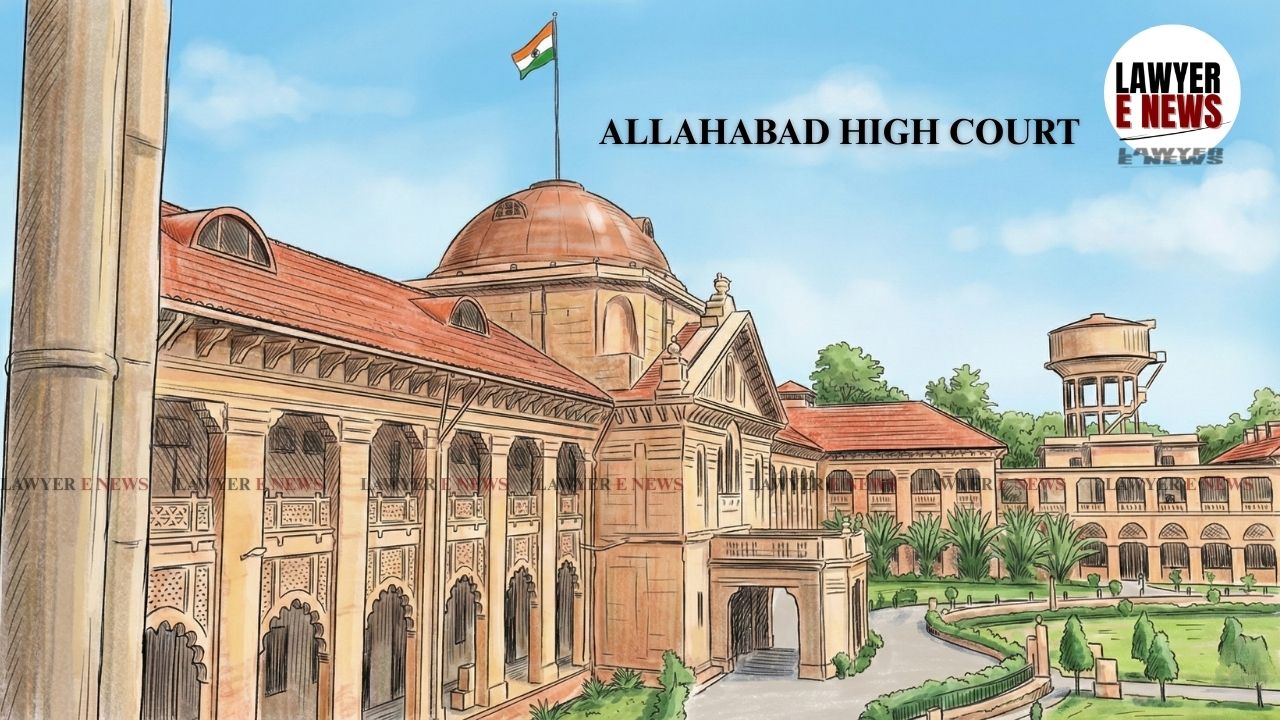
"The Trial Court has full power to summon any person as a witness for doing the full and complete justice... the Trial Court has also not drawn an adverse inference against the prosecution in the light of Illustration (g) of Section 114 of the Indian Evidence Act, by not adducing injured witnesses." Allahabad High Court, in a significant judgment dated July 15, 2026, has set aside the conviction of two men in a murder case, emphasizing that the failure of the prosecution to examine injured eyewitnesses creates a fatal gap in the case.
A bench of Hon’ble Siddharth, J. and Hon’ble Vinai Kumar Dwivedi, J. observed that under Section 311 of the CrPC (now Section 348 of BNSS), the Trial Court is duty-bound to summon essential witnesses to ensure a fair trial and arrive at the truth, rather than acting as a "mere umpire."
The case originated from an incident in 2008 where the prosecution alleged that the accused persons, driving a Bolero vehicle, intentionally hit a motorcycle to kill Ved Prakash Singh over a monetary dispute. The Trial Court had convicted Dhanushdhari Singh and Yashwant Singh under Sections 302/34, 307/34, 504, 506, and 427 of the IPC, sentencing them to life imprisonment. The appellants challenged this conviction before the High Court, primarily arguing that the incident was accidental and the prosecution had withheld the most crucial injured witnesses.
The primary question before the court was whether the non-examination of injured eyewitnesses by the prosecution warrants an adverse inference under Section 114(g) of the Indian Evidence Act. The court also examined the extent of the Trial Court's duty under Section 311 CrPC to summon witnesses whose testimony is essential for a just decision of the case.
Duty Of Court To Secure Best Available Evidence
The Court highlighted that it is a cardinal rule of evidence that the best available evidence must be brought before the court. It noted that in the present case, three persons—Mayank Kumar Singh, Rahul Gupta, and Chandan Gupta—had sustained injuries in the alleged attack but were never produced in the witness box by the prosecution. The bench observed that these individuals were the "best witnesses" to support the prosecution's narrative of intentional collision.
Adverse Inference For Withholding Material Witnesses
Invoking Illustration (g) of Section 114 of the Indian Evidence Act, the Court held that if evidence which could be produced is withheld, it is presumed to be unfavourable to the party withholding it. The bench remarked that the prosecution, with a "plan and purpose," withheld valuable evidence from the court. It noted that the prosecution instead relied on "projected" eyewitnesses whose presence at the crime scene was highly doubtful and whose testimony appeared concocted.
Trial Court Not A Mere Umpire In Criminal Proceedings
The High Court expressed strong disapproval of the Trial Court’s passive role. Citing the Supreme Court’s precedent in Mohanlal Shamji Soni Vs. Union of India, the bench emphasized that a presiding officer should not simply sit as an umpire in a contest between two parties. The Court held that the Trial Court committed a manifest error by failing to exercise its discretionary power under Section 311 CrPC to summon the injured witnesses to find the truth.
"The Trial Court has full power to summon any person as a witness for doing the full and complete justice. On the other side, the Trial Court has not performed its legal duty by summoning as witness the injured persons... and has also not drawn an adverse inference against the prosecution."
Conflict Between Ocular And Medical Evidence
The Court further identified a stark contradiction between the eyewitness accounts and the medical evidence. While the witnesses claimed that the accused ran the Bolero vehicle over the deceased's body repeatedly to crush him, the postmortem report by Dr. Jameel Ahmad (PW-9) explicitly stated there were no tire marks or signs of "grouting" on the body. The bench observed that this contradiction "threw a cloud of shadow on the truthfulness of the prosecution story," rendering the testimony of the alleged eyewitnesses unreliable.
Conviction On Doubtful Evidence Is Bad In Law
Reiterating the settled principles of criminal jurisprudence, the Court noted that the more heinous the crime, the heavier the burden of proof on the prosecution. It found that the prosecution had completely failed to prove its case beyond reasonable doubt through either direct or circumstantial evidence. The High Court concluded that the Trial Court had appreciated the evidence in a "cursory and casual manner," leading to a perverse finding of guilt.
"For conviction in a criminal case like murder, prosecution in every circumstances, is liable and bound to prove its case behind all reasonable doubts. In the light of the above observations, prosecution story also becomes suspicious and thereby unbelievable."
The High Court allowed the appeals, setting aside the judgment and order of conviction dated June 4, 2010. The appellants, Dhanushdhari Singh and Yashwant Singh, were acquitted of all charges, and their bail bonds were ordered to be cancelled. The Court reaffirmed that a conviction cannot be sustained when material witnesses are withheld and the ocular version is refuted by medical science.
Date of Decision: July 15, 2026