-
by sayum
15 August 2026 10:03 AM







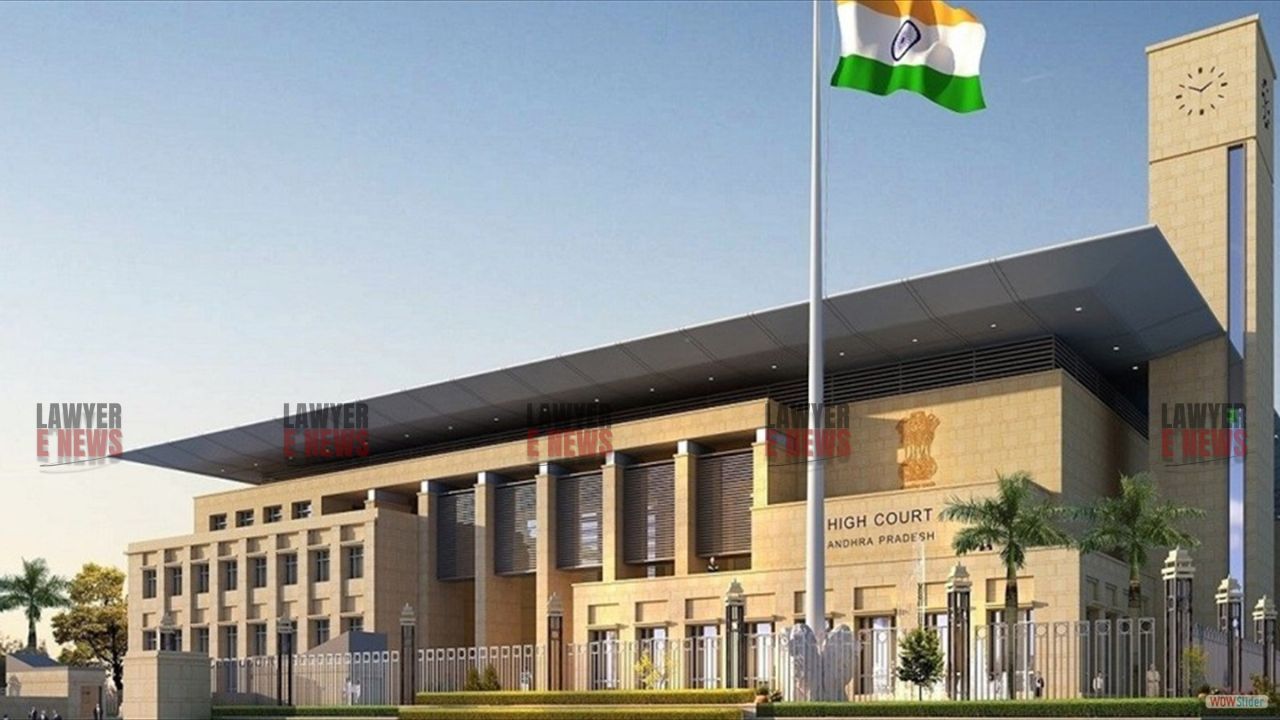
"The interest of justice requires that the matter has to be remanded back to the trial court with a direction to the trial court to frame the relevant issue and to give opportunity to both the parties to submit the arguments... and dispose of the same on merits." Andhra Pradesh High Court, in a judgment dated July 13, 2026, held that a trial court cannot ignore the testimony of a witness produced to prove a Will when the original attesting witnesses and the scribe are deceased.
A bench of Justice V. Gopala Krishna Rao observed that failing to discuss such evidence or even failing to mention the witness's name in the appendix of the judgment constitutes a significant procedural lapse. The Court noted that such an oversight necessitates a remand to ensure the core issue of the document's validity is decided on merits.
The dispute originated from a partition suit (O.S.No.9 of 2013) filed by the sons of late Gundumogula Venkateswara Rao. The plaintiffs claimed the suit properties were joint family assets and sought their respective shares. Conversely, the defendants, including the mother (Defendant No. 1) and a subsequent purchaser (Defendant No. 5/Appellant), contended that the properties were self-acquired. They further asserted that the deceased had bequeathed the properties to his wife via a registered Will (Ex.B-10) in 1988, who subsequently alienated them to the Appellant in 2012.
The primary question before the court was whether the decree and judgment passed by the trial court required interference due to the non-consideration of evidence regarding the proof of the Will. The court was also called upon to determine whether the matter should be remanded to frame a specific additional issue regarding the execution and proof of the Will (Ex.B-10) in accordance with the Indian Evidence Act.
Trial Court Erroneously Held Will As Unproved Without Evaluating Record
The High Court observed that in Paragraph No. 21 of the original judgment, the trial court had summarily dismissed the Will (Ex.B-10), stating that since none of the attesting witnesses were examined, the document remained unproved. The Bench found this observation factually incomplete given the specific circumstances of the case. The Appellant contended that by the time the trial commenced, both the attesting witnesses and the scribe of the 1988 Will had passed away.
Obligation To Consider Evidence Of Secondary Witnesses Under Section 69 Evidence Act
The Bench noted that to prove the Will in the absence of the original attestors, the defendants had examined the son of the second attesting witness as D.W.4. The Court pointed out that D.W.4 had been cross-examined by the plaintiffs' counsel, yet the trial court failed to refer to his evidence or even mention his name in the appendix of evidence. This omission led to the trial court's incorrect finding that no steps were taken to prove the document.
"The trial Court did not even refer to the evidence of D.W.4 in its judgment and also did not mention the name of D.W.4 in the appendix of the judgment. Unfortunately, the trial Court has not at all touched the evidence of D.W.4 and also did not discuss the evidence of D.W.4 in its judgment."
Failure To Discuss Relevant Evidence Requires De Novo Consideration Of Issue
Justice Rao emphasized that when a trial court ignores a witness whose testimony is central to the proof of a title-conferring document, the interest of justice demands a remand. The Court observed that the respondents/plaintiffs also conceded that the trial court had indeed failed to refer to D.W.4's evidence. Consequently, the High Court determined that the trial court must specifically frame an issue regarding the proof of the Will to ensure a reasoned adjudication.
"The interest of justice requires that the matter has to be remanded back to the trial Court with a direction to the trial Court to frame the relevant issue and to give opportunity to both the parties to submit the arguments... and dispose of the same on merits."
Remand With Directions For Time-Bound Disposal
The High Court set aside the decree and judgment dated March 11, 2026, passed by the IX Additional District Judge, West Godavari. It remanded the matter with a specific direction to frame an additional issue: "Whether Ex.B-10 Will is proved in accordance with law?" The trial court was instructed to hear arguments from both sides on this issue and pass a fresh judgment on merits without being influenced by its previous findings.
The Court allowed the appeal suit and mandated that the entire exercise of re-hearing and deciding the matter on the additional issue be completed within a period of two months. The Bench clarified that while the trial court must re-evaluate the evidence of D.W.4 and the validity of the Will, there was no necessity to conduct an entirely new trial or record additional evidence unless legally required.
Date of Decision: 13 July 2026