-
by sayum
04 August 2026 1:39 PM







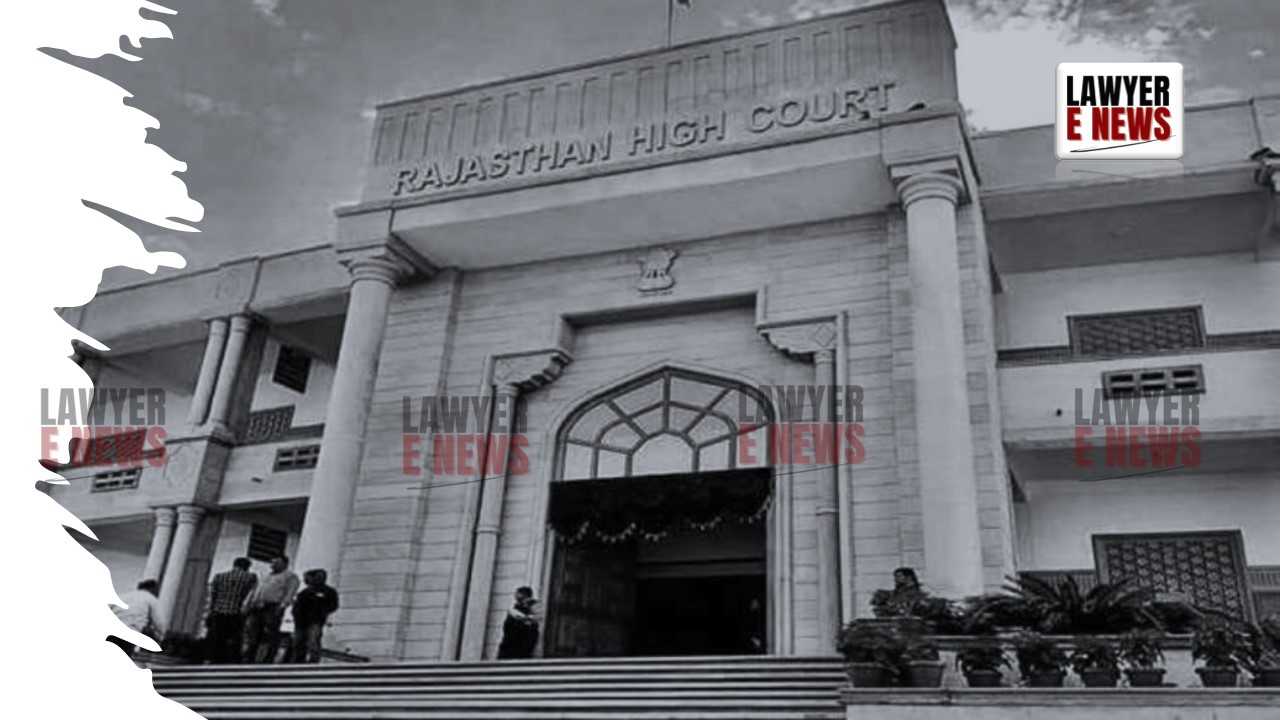
“Two views are possible — one must favour the accused. A mere possibility of guilt cannot replace proof beyond reasonable doubt”, - In a judgment Rajasthan High Court dismissed a State appeal against the acquittal of four accused in a custodial death and murder case from 1996, where the deceased, a notorious undertrial prisoner, was found dead near Bikaner's Suraj Talkies. The Division Bench comprising Dr. Justice Pushpendra Singh Bhati and Justice Sandeep Shah upheld the findings of the Additional Sessions Judge No.1, Bikaner, observing that the prosecution’s case was riddled with contradictions, unsupported by credible forensic evidence, and tainted by unreliable eyewitness testimony.
Reiterating the settled legal principle, the Court held that “if two views are possible on the same evidence, the appellate court must adopt the one that favours the accused”.
“An Eyewitness Under Intoxication And A Brother Who Didn’t Recognise The Victim — No Case For Conviction”
The prosecution alleged that the deceased, Babura—a known history-sheeter involved in over 70 criminal cases—was murdered on 15 May 1996 by a group that included a serving police constable. Two eyewitnesses, Shankarlal (PW-12) and Madanlal (PW-23), were presented as direct observers of the murder. However, the Court found their testimonies unreliable, inconsistent, and unworthy of belief.
Shankarlal admitted in open court that he was “under the influence of alcohol” not only during the incident but also while deposing. Notably, despite allegedly witnessing the brutal attack, he did not inform anyone for 10–12 days, and when he finally did, it was during a casual conversation while drinking.
The High Court commented, “A witness who admits to intoxication and delays disclosure by nearly two weeks cannot be considered trustworthy, especially when his statements are riddled with inconsistencies and unsupported by independent corroboration.”
Madanlal’s testimony was no better. Though he claimed to have seen the accused assault someone on the day of the incident, he confessed he “could not recognise the victim”, who turned out to be his own brother. He then contradicted himself about when he came to know of the death — first saying two months later, then claiming within two days.
“Such contradictions,” the Court observed, “erode the very foundation of his claim as an eyewitness.”
“Forensics Cannot Be Ignored — Recovered Weapons Did Not Even Contain Human Blood”
The prosecution highlighted the recovery of blood-stained weapons — a sword and an iron rod — allegedly used in the murder. These items were recovered 12 to 13 days after the incident, and in the presence only of interested witnesses — relatives of the deceased. No independent witness from the public, though the incident occurred in an open public space, was presented.
Crucially, the Forensic Science Laboratory (FSL) report confirmed that no human blood was detected on the recovered weapons, a detail the Trial Court had already noted.
The High Court emphasized, “In absence of independent witnesses and with FSL results negating the prosecution’s claims, the recovery cannot be said to inspire confidence.”
“No Motive, And Too Many Enemies — Why These Accused?”
The deceased was a habitual offender, convicted in at least one case and implicated in dozens more. The prosecution failed to establish why these particular accused, including a police constable, would want to eliminate him.
“Where the deceased is shown to have had a long list of criminal adversaries, any allegation of conspiracy must be supported by stronger material,” the Court said. “In this case, there is no motive proven, nor is there a link between the accused and the death beyond conjecture.”
“A Plausible Acquittal Needs No Interference” – High Court Reiterates Appellate Restraint
The Court cited landmark decisions of the Supreme Court, including Naresh @ Nehru v. State of Haryana (2023) and Babu Sahebagouda Rudragoudar v. State of Karnataka (2024), reiterating that interference in acquittal appeals is permissible only where the findings of the Trial Court are perverse, illegal, or against the weight of evidence.
Referring to the principles laid down in Mallappa v. State of Karnataka (2024), the Court said: “An appellate court may disagree with the trial court, but unless it finds perversity or misreading of evidence, the acquittal cannot be overturned. The presumption of innocence stands reinforced post-acquittal.”
The Trial Court had examined 26 prosecution witnesses, of whom many turned hostile, and scrutinised both documentary and oral evidence in detail. The High Court found no error of law or appreciation of fact.
Dismissing the appeal, the High Court concluded: “This is not a case that warrants reversal of acquittal. The trial court’s findings are supported by evidence, and its judgment suffers from no legal or factual infirmity. Hence, no interference is called for.”
The Court directed the surviving accused to furnish bonds under Section 437-A CrPC, valid for six months, to secure their appearance before the Supreme Court in case of further appeal.
Date of Decision: 15 May 2025