
-
by sayum
26 August 2026 1:49 PM







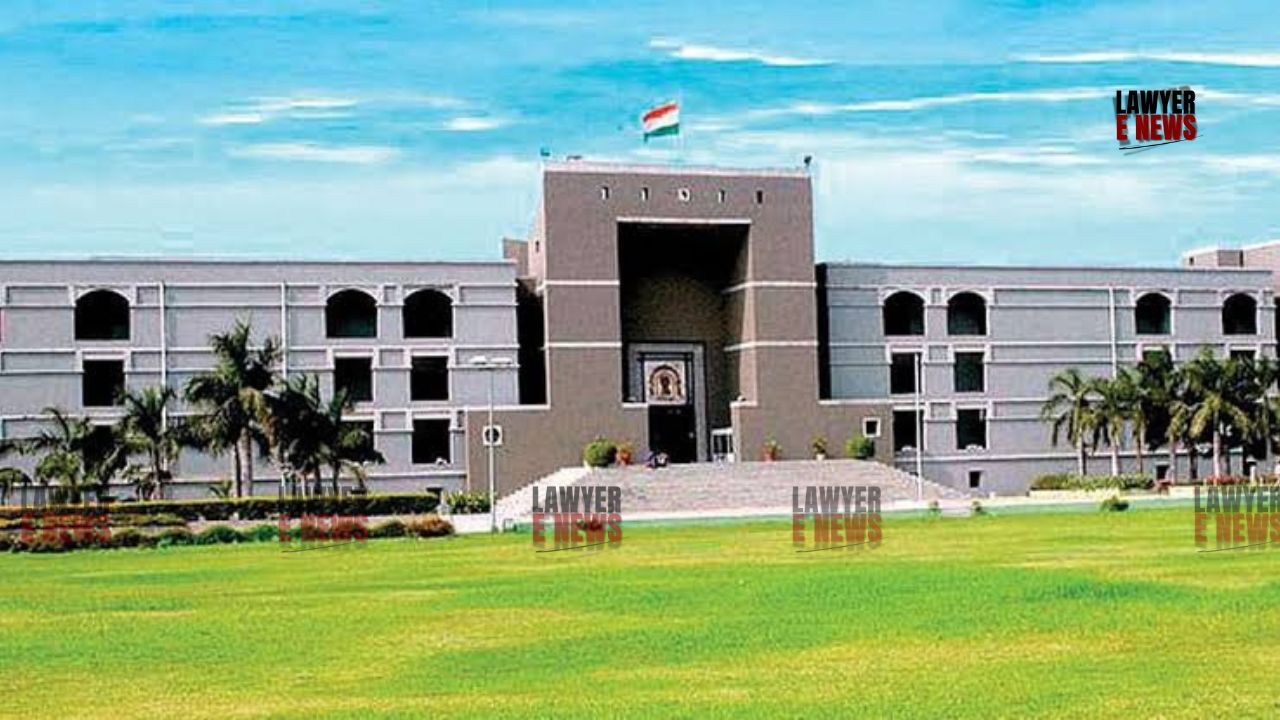
“Plaintiff cannot achieve through clever pleading what law denies directly — No injunction on basis of unregistered Banachitthi without registration or specific performance claim,” rules Gujarat High Court
In a significant ruling reinforcing the statutory mandate on the registration of immovable property transactions, the Gujarat High Court on 6th October 2025 held that no injunction can be granted solely on the basis of an unregistered agreement to sell, especially where the plaintiff has not sought specific performance. The Court dismissed Second Appeal No. 479 of 2022 at the admission stage, upholding the concurrent findings of the trial and appellate courts.
The case, titled Devuben Mansingbhai Gadhavi v. Jantibhai Bhagvanbhai, involved a dispute over an alleged Banachitthi (agreement to sell) dated 18.09.2008, under which the plaintiff claimed the defendant had accepted ₹50,000 as earnest money. However, the plaintiff sought only a permanent injunction restraining the defendant from transferring the property — without seeking specific performance of the alleged agreement.
“No Registration, No Relief — Unregistered Document Can Neither Confer Right Nor Protect Possession”
Justice Sanjeev J. Thaker, in a well-reasoned judgment, rejected the plaintiff's plea, holding that an unregistered agreement to sell which was also unproved in original form cannot form the basis of a legal claim, particularly for injunction.
“The suit that has been filed is not for specific performance but only seeking permanent injunction and not for specific performance. Therefore, no right will arise to the plaintiff to rely on the said unregistered Banachitthi, which is not proved in accordance with law,” the Court held.
Further, the Court observed that Section 17(1)(b) of the Registration Act, 1908 makes it mandatory to register any document that purports to create rights in immovable property. The alleged Banachitthi, being an agreement to sell, falls squarely within this requirement. As the original document was not produced, and its execution denied by the defendant, no evidentiary value could be attached.
“An unregistered agreement to sell cannot confer any right, title or interest in immovable property,” said the Court, affirming that the document was inadmissible and the suit was misconceived.
“No Injunction Without Seeking Specific Performance”: Court Applies Supreme Court Precedents
Citing the Supreme Court’s authoritative ruling in Balram Singh v. Kelo Devi, MANU/SC/1241/2022, the High Court reiterated:
“The plaintiff cannot get the relief even for permanent injunction on the basis of such an unregistered document/agreement to sell, more particularly when the defendant has specifically denied execution, and no claim for specific performance has been made.”
The Court held that the plaintiff’s attempt to claim possession and prevent alienation of the property amounted to claiming benefit under Section 53-A of the Transfer of Property Act, 1882, which is barred where the agreement is not registered, in terms of Section 17(1A) of the Registration Act, 1908.
Relying on Ameer Minhaj v. Dierdre Elizabeth (Wright) Issar, (2018) 7 SCC 639, the High Court noted:
“An unregistered agreement has no effect for the purposes of Section 53-A of the 1882 Act… and thus cannot be relied upon to protect possession or assert rights under the doctrine of part performance.”
“Equally Efficacious Remedy Was Available — Injunction Barred Under Section 41(h) of Specific Relief Act”
The Court invoked Section 41(h) of the Specific Relief Act, 1963, to hold that where an equally efficacious remedy like specific performance exists, a plaintiff cannot maintain a mere injunction suit. By not pursuing that remedy, the plaintiff's suit was statutorily barred.
“The plaintiff cannot be permitted to achieve indirectly what she cannot achieve directly… the suit for mere injunction, without a prayer for specific performance, is not maintainable,” the Court ruled.
It also referred to the Gujarat High Court’s own decision in Devesh Metcast Pvt. Ltd. v. Girish Nagjibhai Savaliya, R/CRA/288/2022, decided on 03.07.2025, reinforcing that no decree for permanent injunction can be passed based on an unregistered agreement to sell unless the suit is one for specific performance.
“Second Appeal Must Be Founded on Substantial Question of Law — Reappreciation of Facts Is Not Permitted”
Upholding the concurrent findings of the Trial Court and Appellate Court, the High Court emphasized that no substantial question of law arose for consideration under Section 100 of CPC, and thus the second appeal had to be dismissed at the threshold.
Relying on Navaneethammal v. Arjuna Chetty, (1996) 6 SCC 177 and Jaichand (Dead) through LRs v. Sahnulal, 2024 SCC OnLine SC 3864, the Court reiterated:
“Under Section 100 CPC, the High Court cannot interfere with the findings of fact arrived at by the first appellate court unless such findings are perverse or based on no evidence.”
In this case, the plaintiff not only failed to produce the original document but also did not establish possession or title, and hence had no cause of action to seek injunction.
The Gujarat High Court dismissed the Second Appeal, holding that:
“No substantial question of law arises. Both the learned Trial Court and First Appellate Court have rightly decided the issue in accordance with settled law. The present Second Appeal is devoid of merit both on facts and law.”
The connected Civil Application for Stay was also disposed of accordingly.
Date of Decision: 06/10/2025





