-
by sayum
12 November 2026 8:14 PM







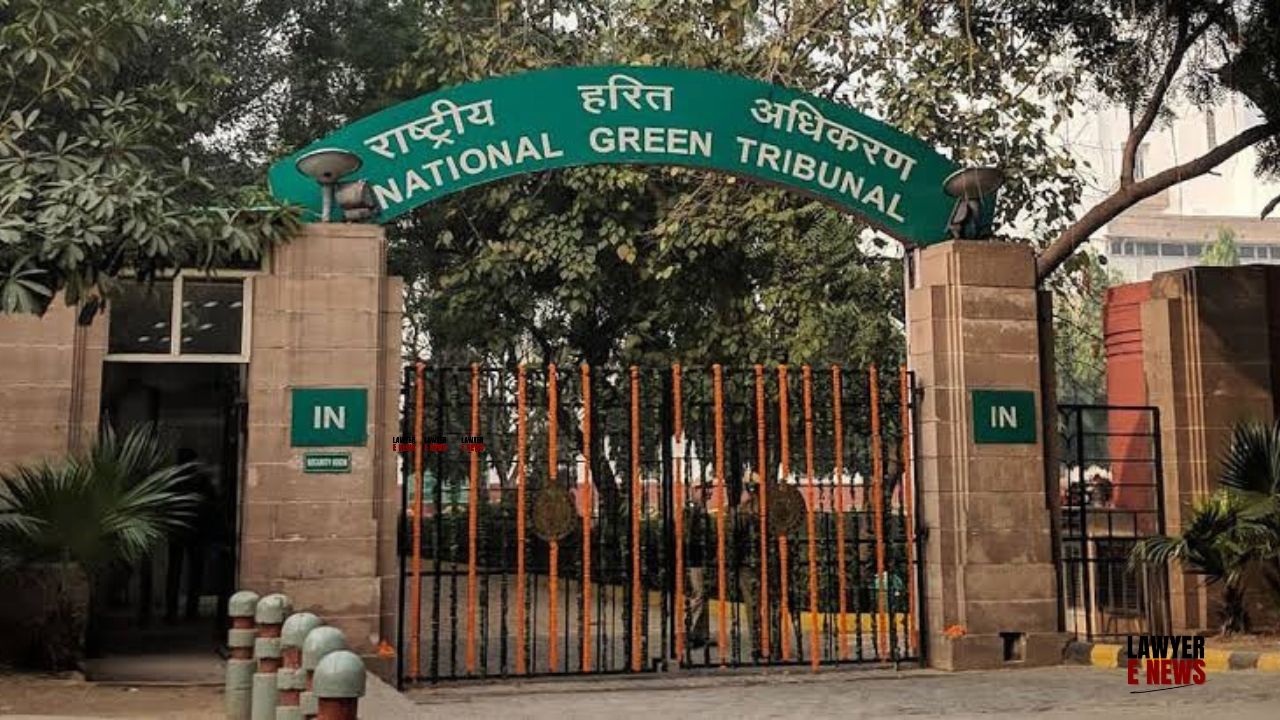
BHOPAL: Observing that the relocation of industrial operations from municipal residential zones falls squarely within executive urban planning rather than environmental adjudication, the National Green Tribunal, Central Zone Bench, Bhopal, on November 3, 2026, refused to order the eviction or closure of longstanding groundnut decorticating mills in Shivpuri, directing instead that they install necessary air pollution control equipment under the Air (Prevention and Control of Pollution) Act, 1981.
The original application was preferred by a local resident alleging that five grain and groundnut processing units were operating illegally on government land in the Old Anaaj Mandi area of Narwar, Shivpuri. The applicant contended that these units operated without statutory consent from the Madhya Pradesh Pollution Control Board, spewing heavy fugitive emissions, husk, and fine particulate matter into the ambient air adjacent to residential houses and a nearby school. The State authorities and project proponents opposed the plea, placing on record joint inspection findings that classified the micro-scale units under the environmental 'White Category' and established their lawful operation since decades.
Whether the National Green Tribunal has the jurisdiction to order the shifting of established micro and small enterprises from residential zones in the absence of a municipal or town planning policy?
Whether 'White Category' groundnut decorticating units emitting fugitive dust particles can be permitted to continue operations without installing prescribed air pollution control devices under the Air (Prevention and Control of Pollution) Act, 1981?
Addressing the jurisdictional ambit of the Tribunal regarding urban planning, a bench comprising Judicial Member Justice Sheo Kumar Singh and Expert Member Sudhir Kumar Chaturvedi held that land use zoning and industrial relocation fall within the administrative prerogatives of the State.
Relocation of industrial establishments is an executive policy decision within the exclusive remit of town planning authorities
The Tribunal underscored that the judicial forum cannot usurp the functions of urban planning departments to mandate the shifting of units that have operated with municipal sanction for decades. It noted that the residential habitat had mushroomed around the preexisting units rather than the reverse.
The bench reaffirmed settled administrative jurisprudence regarding judicial restraint, noting that courts do not sit in appeal over executive policy unless demonstrable illegality or unreasonableness is shown.
"It is within the domain of the Country and Town Planning Department and the State Policy to consider the matter and decide as a matter of policy. The administrative decisions which have been taken by the State Government should not be interfered with unless and until it is proved by cogent evidence and report of any Expert Committee that there is any violation of law and/or damage to the environment."
Judicial review over administrative policies is restricted to instances of manifest arbitrariness, ultra vires action, or constitutional breach
Invoking the Apex Court rulings in Bajaj Hindustan Limited v. Sir Shadi Lal Enterprises Limited and Ugar Sugar Works Ltd. v. Delhi Administration, the Tribunal held that administrative choices involving economic balance cannot be lightly disturbed.
The bench reiterated that executive discretion exercised bona fide and within legal confines must be respected, noting that the judiciary should avoid embarking upon an uncharted ocean of public policy when evaluating economic and developmental decisions.
"Unless a policy decision is demonstrably capricious or arbitrary and not informed by any reason or discriminatory or infringing any Statute or the Constitution, it cannot be a subject of judicial interference. However, if the policy cannot be touched on any of these grounds, the mere fact that it may affect business interests of a party does not justify invalidating the policy."
Precautionary principle and sustainable development govern environmental compliance under Article 21
The Tribunal analyzed the constitutional contours of environmental law under Articles 21, 47, 48-A, and 51-A(g), balancing the right to a hygienic environment with the right to development and livelihood as articulated in N.D. Jayal v. Union of India.
The bench stressed that sustainable development operates as a constitutional guarantee to reconcile ecological protection with socio-economic activities of micro-enterprises.
"The adherence of sustainable development principle is a sine qua non for the maintenance of the symbiotic balance between the rights to environment and development. Right to environment is a fundamental right. On the other hand right to development is also one. Here the right to 'sustainable development' cannot be singled out."
Mandatory installation of air pollution control devices enforced under Section 31A of the Air Act
Evaluating the joint committee report, the Tribunal observed that while groundnut decorticating (dry) falls under the White Category as per the MPPCB notification dated December 27, 2016, uncontrolled particulate discharge cannot be countenanced.
Noting that the State PCB had already issued statutory notices under Section 31A of the Air (Prevention and Control of Pollution) Act, 1981, the Tribunal ordered that no unit can function without fully operational air pollution control devices.
Disposing of the proceedings, the Tribunal directed the project proponents to install dust collectors, bag filters, cyclone separators, and proper enclosure systems to arrest fugitive dust emissions during unloading, cleaning, and destoning. The Madhya Pradesh Pollution Control Board was directed to periodically inspect the units, monitor ambient air quality, and initiate penal action under environmental laws if emissions surpass prescribed limits. The applicant was granted liberty to represent before the State Administration regarding industrial relocation under municipal master plans.
Date of Decision: November 3, 2026