-
by sayum
15 August 2026 2:23 PM







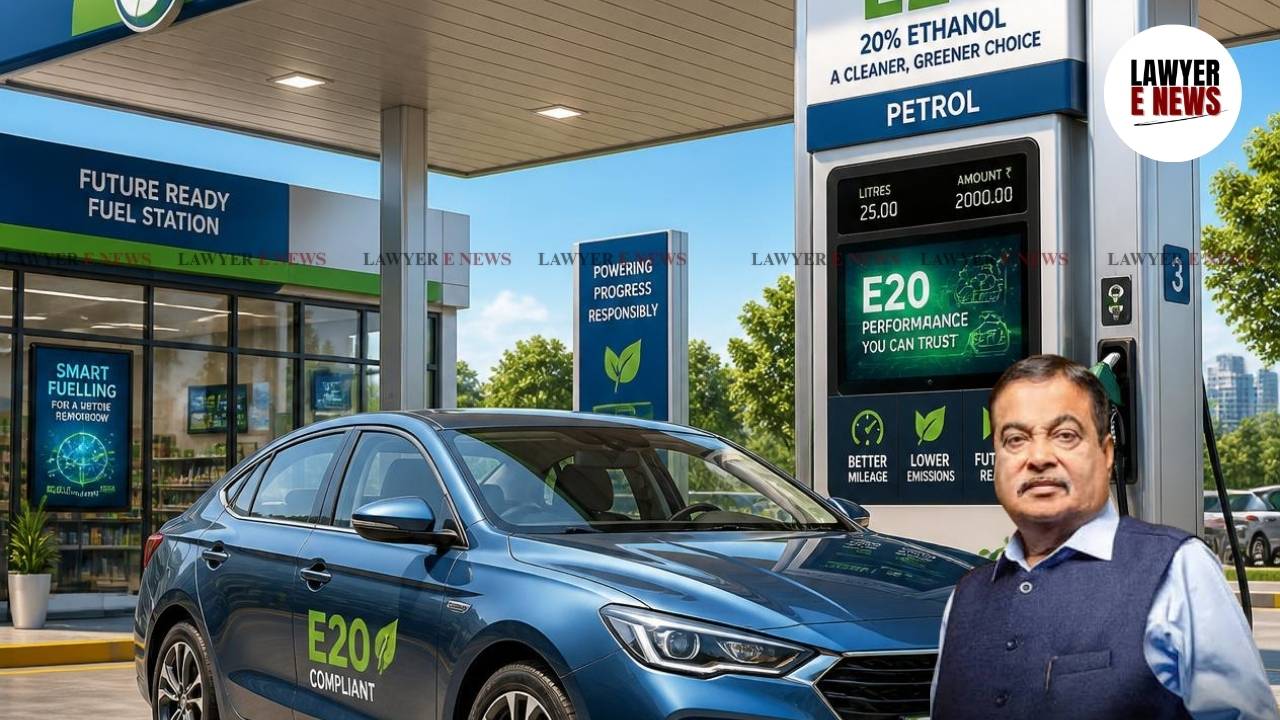
"Selling a vehicle that does not support E20 petrol without disclosing this fact, resulting in engine failure due to regular fuel, and subsequently refusing to replace it with an E20-compliant model amounts to an unfair trade practice and deficiency in service." District Consumer Disputes Redressal Commission, Raipur, in a significant ruling, held that selling a non-E20 (ethanol blend) compliant vehicle to a consumer without explicit disclosure constitutes an unfair trade practice and a clear deficiency in service.
A bench of President Prashant Kundu and Member Dr. Anand Varghese directed Maruti Suzuki India Ltd and its authorized dealer to either replace the complainant's defective Grand Vitara car with a new E20-compliant model or refund the entire purchase amount exceeding ₹20 lakhs.
The complainant, a medical practitioner, purchased a Maruti Grand Vitara Strong Hybrid in June 2024. After being driven for around 21,913 kilometers, the vehicle repeatedly broke down due to engine failure. The manufacturer and dealer denied warranty coverage, claiming the engine was damaged by adulterated fuel, prompting the complainant to approach the consumer forum seeking a replacement or refund.
The primary question before the Commission was whether the repeated engine failure was caused by external fuel adulteration or an inherent manufacturing defect due to fuel incompatibility. The Commission was also called upon to determine whether selling an older, non-E20 compliant model without informing the buyer amounted to a deficiency in service.
Rejection of Adulterated Fuel Defense
The Commission closely examined the defense raised by Maruti Suzuki and its dealer, who argued that the presence of a "white jelly-like substance" and water in the fuel tank indicated adulteration. The opposite parties relied on an independent lab report from SGS to assert that the fuel quality was subpar, thereby voiding the vehicle's warranty.
However, the Commission noted that the complainant had only used regular fuel available at standard petrol pumps. The court observed that the core issue was not deliberate fuel adulteration, but the vehicle's inherent inability to process standard ethanol-blended petrol mandated by the government across all fuel stations.
Failure To Provide E20-Compliant Engine
The Commission found that while the vehicle was sold to the complainant in June 2024, it was actually manufactured in January 2023. Crucially, the engine of this specific 2023 model did not support E20 petrol (a 20% ethanol blend), which is now the standard fuel available across Indian markets.
The court noted that because the engine was not designed to handle a 20% ethanol blend, regular use of standard petrol inevitably led to repeated engine failure. The Commission emphasized that the manufacturer and dealer failed to disclose this vital technical limitation to the consumer at the time of sale, leaving him severely prejudiced.
"The failure of the engine was caused by the fact that the vehicle did not support E20 petrol... The opposite parties failed to provide a vehicle with an E20-supported engine, which resulted in the engine failing upon using regular fuel."
Unfair Trade Practice By Dealer And Manufacturer
Addressing the liability of the dealer and manufacturer, the Commission held that passing off an older inventory model that lacked current fuel compatibility standards was a deceptive and unfair trade practice. The forum observed that the consumer was misled into purchasing a vehicle that was technically obsolete for current market fuel standards.
The bench firmly rejected the opposite parties' reliance on the warranty clause that excluded damage caused by external factors. The Commission reasoned that the incompatible fuel was not an "external factor" introduced negligently by the driver, but a systemic issue stemming from the manufacturer's failure to provide an E20-compliant engine while selling the car in 2024.
Concluding the proceedings, the Commission allowed the complaint and directed the opposite parties to either provide a new E20-compliant vehicle of the same model within 45 days or refund the total amount of ₹20,50,494. Furthermore, the Commission imposed a penalty of ₹1,00,000 for mental agony and ₹10,000 towards litigation costs, payable with 7% interest in case of default.
Date of Decision: 14 July 2026