-
by sayum
04 August 2026 1:39 PM







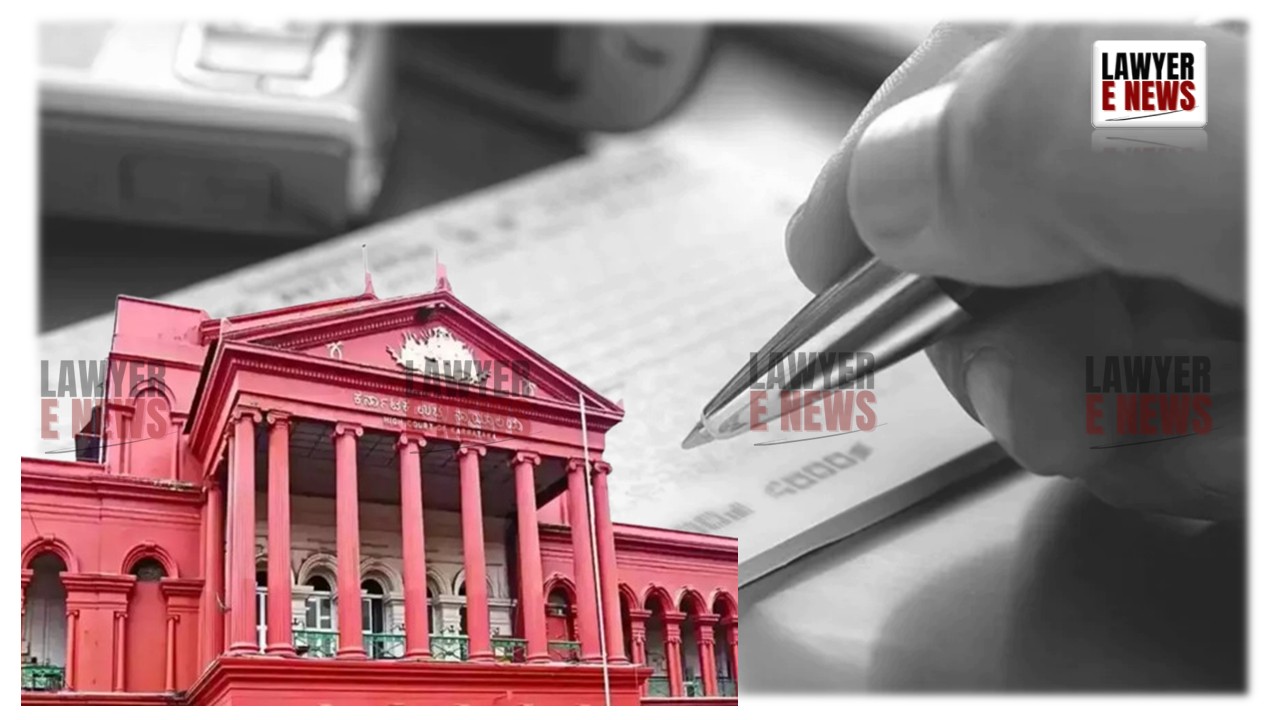
Signature of Accused on Corrected Cheque Amounts to Consent; Not a Material Alteration: In a significant ruling Karnataka High Court overturned a trial court's acquittal in a cheque dishonour case under Section 138 of the Negotiable Instruments Act, 1881, restoring conviction on grounds of improper appreciation of law on limitation and cheque alteration.
Justice H.P. Sandesh held that the statutory demand notice was issued within the prescribed time, and that the accused’s own signature on the altered cheque negated any claim of material alteration, stating emphatically: “When the correction was signed by the drawer herself, it validates the change; the finding of material alteration is wholly erroneous.”
The case arose from a personal loan transaction between two BESCOM employees. The appellant, B.R. Anand, alleged that he had loaned ₹11,70,000/- to the respondent, V.R. Gisha, in June 2014 for her sister’s wedding and house construction. Upon repeated requests for repayment, the respondent issued a post-dated cheque (dated 02.08.2017).
When the cheque was presented, it was returned unpaid with the remark “Funds Insufficient.” Anand promptly issued a statutory notice on 04.09.2017, but the accused neither replied nor repaid the sum. A complaint under Section 138 NI Act was filed, but the Trial Court acquitted the accused, citing two main grounds:
The demand notice was allegedly served after the 30-day limitation period.
There was a material alteration in the cheque amount.
Anand appealed the acquittal under Section 378(4) CrPC.
“The Trial Court Erred in Law — The Date of Bank Intimation Is to Be Excluded”: Justice H.P. Sandesh
The Trial Court had accepted the accused’s argument that the statutory notice was sent on the 31st day, making the complaint time-barred.
However, the High Court categorically held that the Trial Court’s computation was flawed: “Section 138(b) mandates that the notice must be issued within 30 days from the date of receipt of intimation — not from the date of dishonour.”
Relying on precedents such as Saketh India Ltd. v. India Securities Ltd., (1999) 3 SCC 1 and Econ Antri Ltd. v. Rom Industries Ltd., (2014) 11 SCC 769, the Court stated: “The date of receipt of information from the bank must be excluded while computing limitation. Once that is done, the notice dated 04.09.2017 following bank intimation dated 05.08.2017 is clearly within time.”
The Court found the Trial Court’s approach contrary to binding precedent, noting: “Even if there was an admission by the complainant regarding delay, the law does not permit such a technical misreading when settled law demands exclusion of the intimation date.”
“Correction Signed by Drawer Is Not Material Alteration — It Is Consent in Ink”: High Court
The Trial Court had also dismissed the complaint on the ground that the cheque bore a material alteration — specifically, the figure was “corrected” to reflect ₹11,70,000/-.
However, the High Court firmly disagreed, stating: “The signature of the accused at the site of correction proves that the alteration was with her consent — it ceases to be material alteration under Section 87 of the NI Act.”
Justice Sandesh noted that:
The cheque bore two signatures from the accused — one authenticating the instrument, and one confirming the correction.
The accused never denied the signature or issuance of the cheque.
No rebuttal evidence or explanation was provided in defense.
“When such counter-signature exists, the allegation of material alteration collapses. The Trial Court’s failure to appreciate this is a serious misapplication of law.”
“No Reply, No Defense, No Rebuttal — Presumption Under Section 139 NI Act Stands Unshaken”
Further, the High Court emphasised the presumptive burden under Section 139 NI Act, noting that: “The accused received the notice and yet did not reply. There was no attempt to dispute the liability, explain the issuance of cheque, or even to claim duress or mistake. This inaction strengthens the complainant’s case.”
Citing K. Subramani v. K. Damodara Naidu, (2015) 1 SCC 99 and M.S. Narayana Menon v. State of Kerala, (2006) 6 SCC 39, the Court observed:
“While an accused need not enter the witness box, the presumption under Section 139 is not rebutted by silence alone. Mere cross-examination of the complainant does not suffice.”
Finding the Trial Court’s judgment legally untenable, the High Court concluded: “The Trial Court’s conclusions on limitation and material alteration are perverse and unsupported by either law or facts. Material evidence was completely disregarded.”
Justice H.P. Sandesh allowed the appeal and passed the following operative order: “The judgment of acquittal dated 08.02.2019 in C.C.No.386/2018 is set aside. The respondent is convicted under Section 138 NI Act and is directed to pay a fine of ₹12,00,000/-. Of this, ₹11,70,000/- shall be paid to the complainant, and ₹30,000/- to the State. In default of payment within two months, the accused shall undergo simple imprisonment for one year.”
This decision stands out for its clear reaffirmation of statutory interpretation and judicial discipline, particularly in cheque dishonour cases. The Karnataka High Court has corrected a flawed acquittal, upholding both the letter and spirit of Section 138.
“Litigants must not be allowed to escape liability through hypertechnical misreadings when the facts, law, and equity support the complainant’s claim.”
Date of Decision: 09 April 2025