
-
by sayum
26 August 2026 1:49 PM







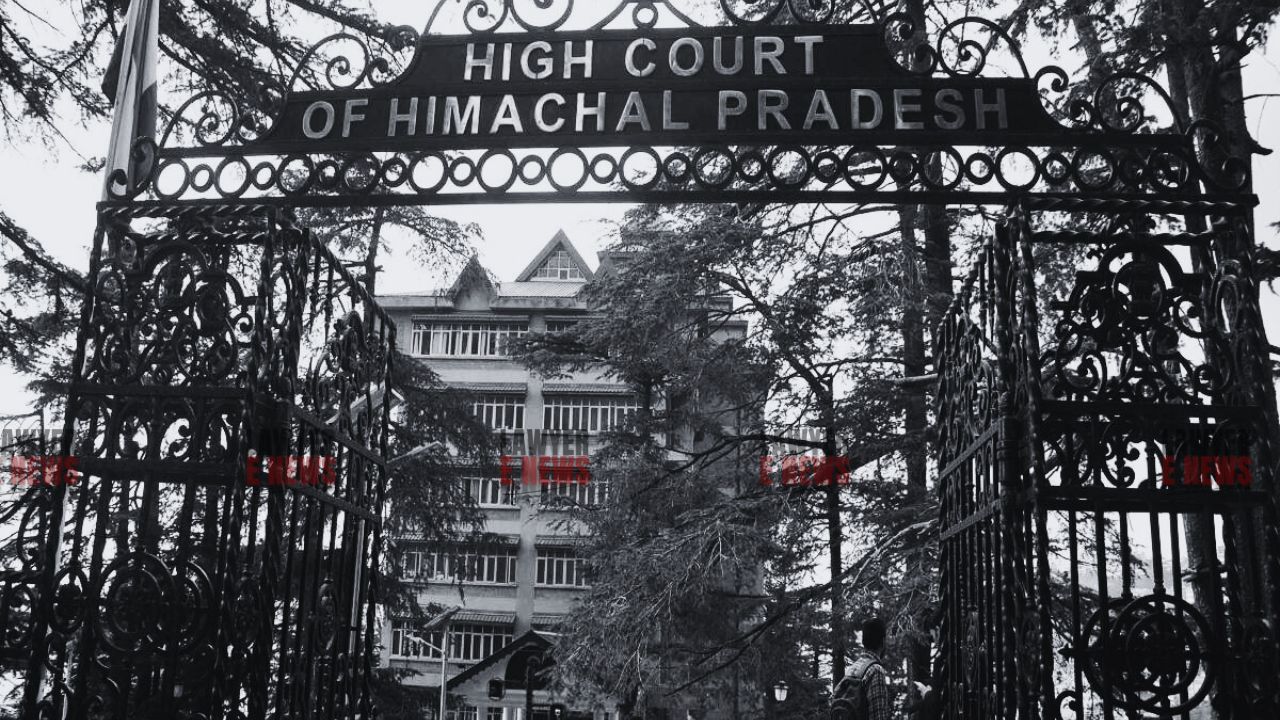
“Signatures Alone Don’t Prove Seizure – Witnesses Must Speak on Oath” - In a significant reaffirmation of constitutional safeguards during criminal investigation, the Himachal Pradesh High Court dismissed the State’s appeal against the acquittal of Vinod Kumar alias Ghungaru, accused under Section 61(1)(a) of the Punjab Excise Act, 1914. The court held that the search and seizure of country liquor from the accused’s premises was fundamentally flawed due to non-compliance with Sections 100 and 165 of the Code of Criminal Procedure, 1973.
Delivering the judgment in State of Himachal Pradesh vs. Vinod Kumar @ Ghungaru, Justice Rakesh Kainthla observed, “The liberty of a citizen cannot be curtailed by a procedure that violates statutory safeguards. When the law prescribes a manner in which a search is to be carried out, any deviation goes to the root of the prosecution's case.”
The Court reiterated the necessity of strict adherence to procedural prerequisites during warrantless searches and emphasized that the burden to establish lawful seizure rests heavily on the prosecution.
Acquittal of Accused in Liquor Case Was Justified: “Police Failed to Record or Communicate Information Before Search”
The case stemmed from a raid conducted on December 16, 2008, when police officials claimed to have recovered seven boxes of country liquor branded ‘Lal Killa’ from the house of the accused. ASI Balak Ram, who led the operation, allegedly received secret information about illegal liquor sale and acted immediately. However, as the Court noted, he neither reduced the information to writing nor forwarded it to a Magistrate — a mandatory requirement under Section 165 of CrPC.
Citing the Supreme Court’s decision in ITC Ltd. v. State of Karnataka, 2025 SCC OnLine SC 1971, the Court emphasized, “Section 165 CrPC is clear – in the absence of a search warrant, the reasons for conducting a warrantless search must be recorded in writing and communicated to a Magistrate. This requirement cannot be ignored.”
Justice Kainthla observed that SI Balak Ram “admittedly did not record the basis of his ‘belief’ nor sent any intimation to a Magistrate, making the entire search process invalid in the eyes of law.” The failure to comply with these statutory mandates, the Court held, rendered the recovery suspect and inadmissible.
“Hostile Independent Witnesses Cannot Be Brushed Aside”: Court Finds Lack of Credible Testimony on Recovery
Two independent witnesses — Muni Lal (PW-1) and Ram Prakash (PW-4), who were Panchayat members at the time — turned hostile during trial and denied witnessing the recovery or the raid. Though they admitted signing the seizure memo, both explicitly disowned its contents during deposition.
The Court firmly rejected the State’s argument that admission of signatures was enough. “The prosecution’s case cannot rest on signatures alone — the witnesses must prove the contents of seizure memos by credible statements on oath. Their denial shakes the very foundation of the recovery,” the Court ruled.
It further noted, “Where the independent witnesses are hostile, the court is bound to examine the official testimony with greater caution and not accept it uncritically.”
Bottles Produced in Court Were Half-Filled and Unsealed: Court Finds No Justification or Diary Entry Supporting Prosecution
A critical blow to the State’s case came from the condition of the alleged case property. Contrary to prosecution claims of seizing sealed bottles of liquor, the court found that bottles presented during trial were half-filled, unsealed, and lacked proper identification.
SI Balak Ram admitted during cross-examination that the bottles were “half-filled and empty” and “no FIR number was mentioned on them.” The claim that leakage occurred during transport was unsupported by any diary entry or testimony. HC Jogesh Kumar (PW-5), who was the Malkhana in-charge, confirmed that the case property was intact while under his custody, further contradicting the leakage theory.
The Court cited its earlier decision in Amandeep Singh & Ors. v. State of H.P., 2010 (3) Shim. LC 39, holding: “Where the case property is not produced in court, and its quantity and identity are not proven through documentation or testimony, conviction cannot be sustained.”
It also relied on Pawan Kumar v. State of H.P., (2019) 4 SCC 182, in which the Supreme Court held that non-production of seized material creates a fatal gap in the prosecution’s case.
Presumption of Innocence Reinforced After Acquittal: Appellate Court Should Not Interfere Unless View is Perverse
In declining to interfere with the Trial Court’s decision, the High Court relied on well-established principles laid down by the Supreme Court in Surendra Singh v. State of Uttarakhand, (2025) 5 SCC 433, Rajesh Prasad v. State of Bihar, (2022) 3 SCC 471, and H.D. Sundara v. State of Karnataka, (2023) 9 SCC 581.
Justice Kainthla remarked: “The presumption of innocence is a foundational principle of criminal law, further strengthened by an acquittal. Unless the trial court’s view is palpably perverse or unsupported by evidence, appellate interference is unwarranted.”
The Court held that the trial court had taken a plausible and reasoned view after assessing contradictions, hostile witnesses, and failure to comply with legal procedure. Therefore, the appeal failed to meet the threshold for reversal.
“Prosecution Must Not Only Prove Seizure But Also Prove It Was Done Lawfully”: High Court Declines Appeal
The Court summed up by stating that the prosecution not only failed to prove lawful seizure but also could not provide any coherent explanation for procedural lapses and evidentiary discrepancies.
Justice Kainthla concluded:
“The entire case rests on a search that is not legally sustainable, witnesses who do not support the seizure, and case property that does not inspire confidence. In such circumstances, the trial court’s acquittal is not only justified but necessary to uphold the rule of law.”
The appeal was accordingly dismissed.
The Court also directed the accused to furnish a bail bond of ₹50,000 under Section 437-A of CrPC (now Section 481 of the Bharatiya Nagarik Suraksha Sanhita, 2023), to ensure appearance in case of further challenge before the Supreme Court.
Date of Decision: 13 October 2025





