-
by sayum
28 August 2026 8:44 AM







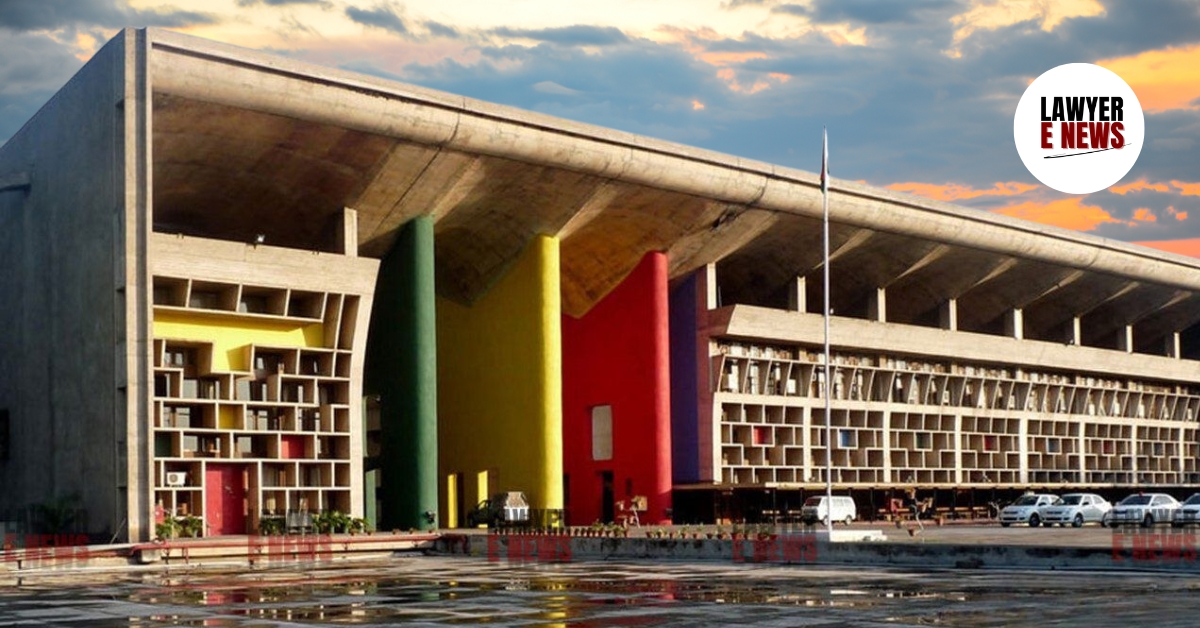
"Reformation is an Integral Part of Our Justice Delivery System" – Punjab and Haryana High Court delivered a significant judgment upholding an undertrial's right to travel abroad to pursue higher education, emphasizing that apprehension of evasion cannot override fundamental rights without strong justification. Justice Surya Partap Singh allowed the petitioner’s request to travel to Germany for a 3-year course, quashing a prior order of the Additional Sessions Judge, Hisar, which had denied him permission on grounds of risk of absconding.
The Court held that “denial of permission to go abroad merely on apprehension of fleeing from the course of law… is not based upon sound legal principles”, and recognized the right to travel abroad as a component of the personal liberty protected under Article 21 of the Constitution.
"Merely Being Accused Does Not Mean a Citizen Must Forfeit His Right to Study or Live with Dignity"
The case concerned a 21-year-old student facing trial under Sections 147, 149, 323, 324, 379, 379-B and 506 of IPC and Sections 3(2) and 3(2)(va) of the SC/ST (Prevention of Atrocities) Act, 1989. The petitioner, out on bail since 22.06.2023, sought permission to travel to Berlin to pursue a B.Sc. in Computer Science at the International University of Applied Sciences, Germany, for which he had cleared IELTS and submitted the university's offer letter.
However, the trial court had rejected the application on 13.08.2024, citing “apprehension that the accused may not return to face trial”. The High Court took exception to this reasoning, stating:
“In order to procure presence, the petitioner may be asked to furnish heavy surety… and may also be asked to furnish an undertaking that his appearance may be exempted and evidence may be recorded in his absence.”
The Court expressed concern that blanket denial based on unsubstantiated apprehension could result in irreparable harm to a young individual’s career and life prospects, observing:
“The petitioner is a 21-year-old young boy having a bright future… if the rights to pursue his study and build-up career are denied, it will certainly have an adverse impact on his future. In fact, it will be a travesty.”
"Right to Go Abroad Is a Human Right of Great Social Value": Court Cites Landmark Constitutional Precedents
The Court anchored its reasoning in established constitutional jurisprudence by referring to the Supreme Court’s judgments in Satwant Singh Sawhney v. D. Ramarathnam (AIR 1967 SC 1836) and Maneka Gandhi v. Union of India (AIR 1978 SC 97), affirming that: “Personal liberty guaranteed under Article 21 is of the widest amplitude and includes the right to go abroad.”
Quoting Satish Chandra Verma v. Union of India (2019), the Court noted: “The right to travel abroad is an important basic human right, for it nourishes independent and self-determining character of the individual… Freedom to go abroad has much social value and represents the basic human right of great significance.”
In addition, the Court cited Srichand P. Hinduja v. State (2002), where foreign nationals were allowed to go abroad during trial with strict conditions, as well as Jaspal Kaur Bhinder v. State of Punjab, wherein the same High Court upheld the right of an accused to travel internationally.
“Denial of Fundamental Rights Must Be Backed by Law, Not Fear”: Court Directs Conditional Permission for Foreign Travel
Setting aside the impugned order dated 13.08.2024 of the Sessions Judge, Hisar, the High Court allowed the petition and directed that the petitioner be granted permission to travel abroad, while empowering the trial court to impose strict conditions, including:
Furnishing heavy surety;
Written undertaking for exemption of appearance and permission to record evidence in his absence;
Any other stringent measures to ensure participation in the trial.
The Court concluded that: “Since the impugned order is not sustainable in the eyes of law, the same deserves to be set aside.”
By striking down the arbitrary denial and recognizing that accusation cannot equate to automatic forfeiture of rights, the judgment lays down an important precedent for balancing due process with constitutional freedoms.
“Education is a Path to Reform, Not Escape”: Court Reinforces Faith in Individual Rights and Justice
Justice Surya Partap Singh underscored the reformative spirit of criminal law, asserting: “Reformation is an integral part of our Justice Delivery System.”
The judgment powerfully reiterates that criminal proceedings must not become punitive in their procedure, especially for those accused but not yet convicted. Denying young citizens the chance to build a future — without clear legal basis — not only violates personal liberty, but also the constitutional vision of justice, dignity, and rehabilitation.
This decision adds to the evolving jurisprudence that right to education and mobility must be treated as fundamental rights, subject to judicial safeguards, and not blocked by presumptive fears.
Date of Decision: 09 September 2025