-
by sayum
19 August 2026 1:58 PM







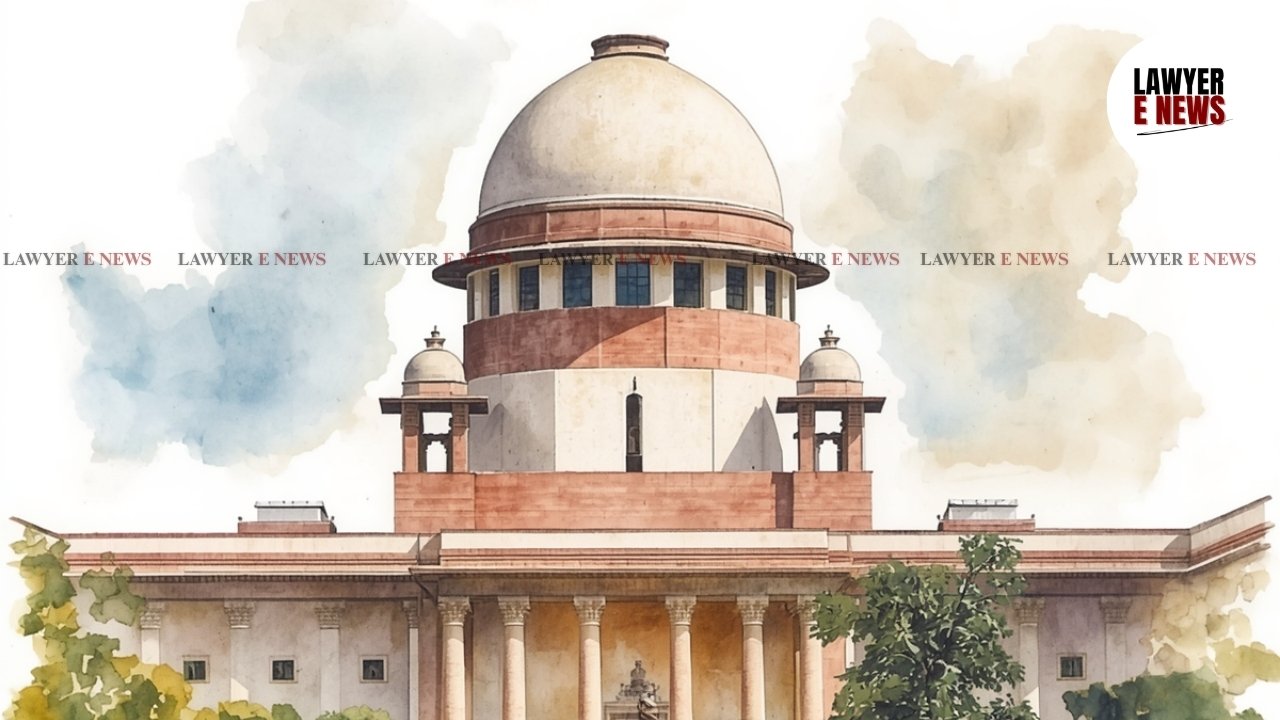
"A Revenue Record is not a document of title and does not confer any ownership or title upon the person whose name appears in it. Mutation does not create or extinguish title and has absolutely no presumptive value regarding title," Supreme Court, in a significant ruling dated May 6, 2026, held that entries in revenue records such as Faisal Patti, Vasool Baqi, and Pahanies serve only a fiscal purpose and cannot be treated as evidence of ownership or title to property.
A bench of Justice Pankaj Mithal and Justice S.V.N. Bhatti observed that "revenue record is not a document of title" and emphasized that mutation proceedings neither create nor extinguish title. The Court dismissed a challenge by claimants seeking to exclude 600 acres of land from a proposed reserve forest in Telangana, noting that the High Court’s writ jurisdiction cannot be used to resolve serious disputes regarding property title.
The appellants claimed ownership of 600 acres in Survey No. 81, Kalvalanagaram Village, based on alleged "pattas" granted by the Nizam of Hyderabad in 1931-32. They challenged a 2003 order of the Joint Collector which rejected their claim to exclude this land from a 1950 notification proposing the area as a reserve forest. While a Single Judge of the High Court originally declared the forest notification ultra vires and affirmed the appellants' title, the Division Bench subsequently reversed this decision, leading to the present appeal before the Supreme Court.
The primary question before the Court was whether entries in revenue records like Faisal Patti and Pahanies can establish legal title in the absence of original patta certificates. The Court was also called upon to determine whether a writ court exercising jurisdiction under Article 226 of the Constitution can adjudicate complex disputes of fact and title. Additionally, the bench examined if a notification issued under a repealed enactment is rendered invalid if its purpose remains consistent with the successor law.
Revenue Records Limited To Fiscal Purposes
The Supreme Court reiterated the settled legal position that entries in revenue records or Jamabandi are maintained primarily for fiscal purposes to enable the collection of land revenue. The bench noted that such records do not confer ownership and the mere appearance of a name in these documents does not constitute proof of title.
The Court emphasized that mutation is a technical process for revenue collection that carries no presumptive value regarding ownership. Referencing the precedent in Suraj Bhan v. Financial Commissioner, the bench observed that revenue entries are not documents of title.
Mutation Neither Creates Nor Extinguishes Title
The Court explained that the act of mutation does not have the legal strength to create a new title or extinguish an existing one. It was noted that even the payment of municipal taxes or the procurement of bank loans based on such records does not stop the State from challenging ownership.
The bench highlighted that revenue records are often prone to being "tinkered with" at the local level. Consequently, stray or solitary entries for a single year cannot be relied upon against a consistent course of revenue entries that favor another party or the State.
"Revenue Record is not a document of title and does not confer any ownership or title upon the person whose name appears in it."
Writ Jurisdiction Unsuitable For Title Disputes
The Supreme Court found that the Single Judge had erred by expanding the scope of judicial review under Article 226 to effectively declare the appellants' title. The bench held that a Writ of Certiorari lies only on limited grounds such as want of jurisdiction or an error of law apparent on the face of the record.
The Court relied on Sohan Lal v. Union of India, asserting that proceedings under Article 226 are not the appropriate forum for resolving serious disputes concerning questions of fact and title. Such investigations are the "proper function of a civil court in a regularly constituted suit" rather than a court exercising prerogative writ jurisdiction.
Wrong Statutory Reference Does Not Vitiate Notification
Regarding the 1950 Gazette Notification, the Court rejected the argument that it was void because it referenced the Hyderabad Forest Act of 1326 Fasli instead of the 1355 Fasli Act. The bench held that a notification is not invalidated merely by citing a repealed enactment if it is not inconsistent with the new Act.
The bench observed that the purpose of the notification—declaring the land as a reserve forest—was apparent and legally sustainable. Therefore, the technical error in referencing the old Act did not render the entire forest reservation proceeding ultra vires.
"A Notification is not invalidated merely because it was issued under the wrong enactment, provided it is not inconsistent with the provisions of the new Act."
Appellants Failed To Produce Foundational Documents
The Court noted that the appellants failed to produce the "foundational document of title," namely the original patta certificate allegedly issued in the 1930s. The revenue extracts they provided were found to be truncated, contradictory, and in some instances, identified the land as "Jungle."
The bench concluded that the Joint Collector was correct in rejecting the claim as the appellants could not prove their proprietary interest. It further remarked that extending the life of this 75-year-old litigation by remanding it would be futile given the lack of primary evidence.
The Supreme Court dismissed the civil appeal and upheld the Division Bench judgment, confirming that the appellants had no established title over the forest land. The ruling reinforces the principle that revenue entries cannot substitute registered title deeds and that writ courts must refrain from adjudicating property ownership.
Date of Decision: 06 May 2026