-
by sayum
19 August 2026 1:58 PM







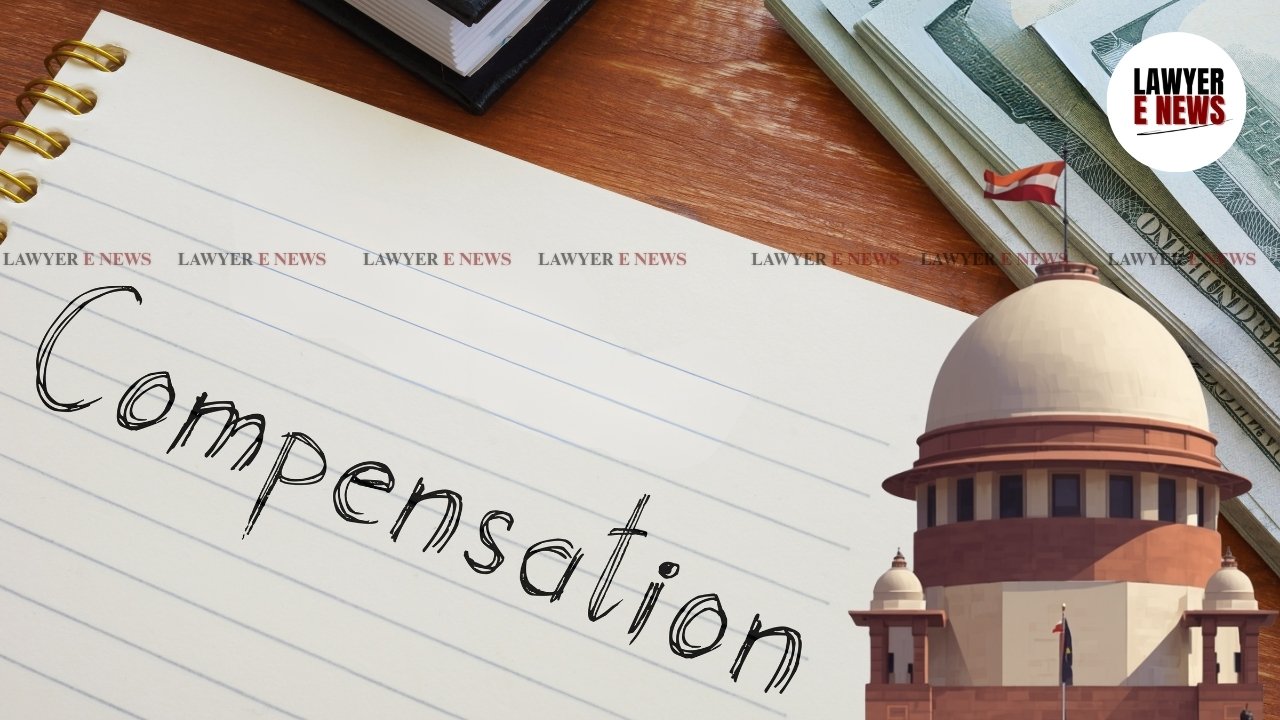
"Notional income would have to be determined on the basis of the minimum wages admissible for a skilled workman in the State... The appellant having suffered permanent disability, he would require the assistance of two attendants round the clock," Supreme Court, in a significant ruling dated May 6, 2026, held that the notional income for a minor victim of a motor accident must be determined based on the prevailing minimum wages of a skilled workman in the state where the accident occurred.
A bench of Justice J.K. Maheshwari and Justice Atul S. Chandurkar observed that for a victim suffering 100% permanent disability, the court must ensure "just compensation" that includes the costs for lifelong assistance by two round-the-clock attendants.
The appellant, Hansraj, was a 14-year-old pillion rider who suffered 100% permanent disability following a motorcycle accident in 2016. While the Motor Accident Claims Tribunal (MACT) awarded ₹7.76 lakhs, the Rajasthan High Court enhanced this to ₹12.17 lakhs by taking a notional annual income of only ₹30,000. The appellant approached the Apex Court seeking a further enhancement of the quantum, contending that the High Court's assessment was on the lower side.
The primary question before the court was whether the High Court erred in its determination of notional income and attendant charges for a minor with 100% permanent disability. The court was also called upon to determine the adequacy of compensation under non-pecuniary heads such as loss of marriage prospects and mental agony.
Court Rejects Lower Notional Income For Minors
The Supreme Court noted that the High Court’s consideration of notional annual income at ₹30,000 was significantly low given the economic realities of 2016. The bench emphasized that the starting point for calculating loss of income for a minor should be the minimum wages of a skilled workman.
The bench observed that such minimum wages in the State of Rajasthan in 2016 were ₹5,746 per month. Rounding this off to ₹5,800, the Court calculated the annual income at ₹69,600 and added 40% towards future prospects, bringing the total loss of income to ₹17,53,920 after applying the multiplier of 18.
Entitlement To Two Attendants For 100% Disability
Regarding the head of attendant charges, the Court found the High Court's award of ₹1.21 lakhs to be grossly inadequate. Relying on its earlier precedent in Kajal v. Jagdish Chand, the Court held that a victim with 100% permanent disability, especially one suffering injuries to the neck and backbone, requires constant care.
"The appellant having suffered permanent disability, he would require the assistance of two attendants round the clock. Applying the multiplier of 18, this figure would come to ₹21,60,000/-."
The Court determined that the monthly wages for a semi-skilled workman (₹5,000) should be taken as the base for one attendant. Since two attendants are required for life, the monthly cost was set at ₹10,000, totaling ₹21.60 lakhs over the multiplier period.
Significant Enhancement In Non-Pecuniary Damages
The Court further observed that the compensation for mental pain, suffering, and loss of amenities needed to be substantial given the age of the victim and the nature of the injuries. It enhanced the amount under this head from ₹1 lakh to ₹10 lakhs.
"Insofar as mental pain and suffering alongwith loss of amenities is concerned, the amount ₹10,00,000/- can be awarded. Towards future medical expenses, the amount deserves to be enhanced to ₹3,00,000/-."
The bench also awarded ₹3,00,000 for loss of marriage prospects and ₹1,00,000 for special diet and transportation. The Court noted that such enhancements are necessary to restore the victim, as far as money can, to the position he would have been in had the accident not occurred.
Directives For Investment Of Compensation
To ensure the long-term welfare of the appellant, the Court directed that 75% of the attendant charges (₹21.60 lakhs) must be kept in a fixed deposit. This arrangement is intended to allow the appellant to meet future caregiving expenses through the interest earned.
The Court ordered that an amount of ₹1,50,000 be released annually from the deposit to the appellant. The total compensation was enhanced to ₹56,83,663, carrying an interest rate of 6% per annum from the date of filing the claim petition.
In conclusion, the Supreme Court modified the High Court's judgment, significantly increasing the award to ensure it meets the standard of "just compensation" under the Motor Vehicles Act. The ruling reinforces that the calculation of notional income for minors cannot be arbitrary and must be anchored to statutory minimum wage standards.
Date of Decision: May 6, 2026