-
by sayum
27 August 2026 3:32 PM







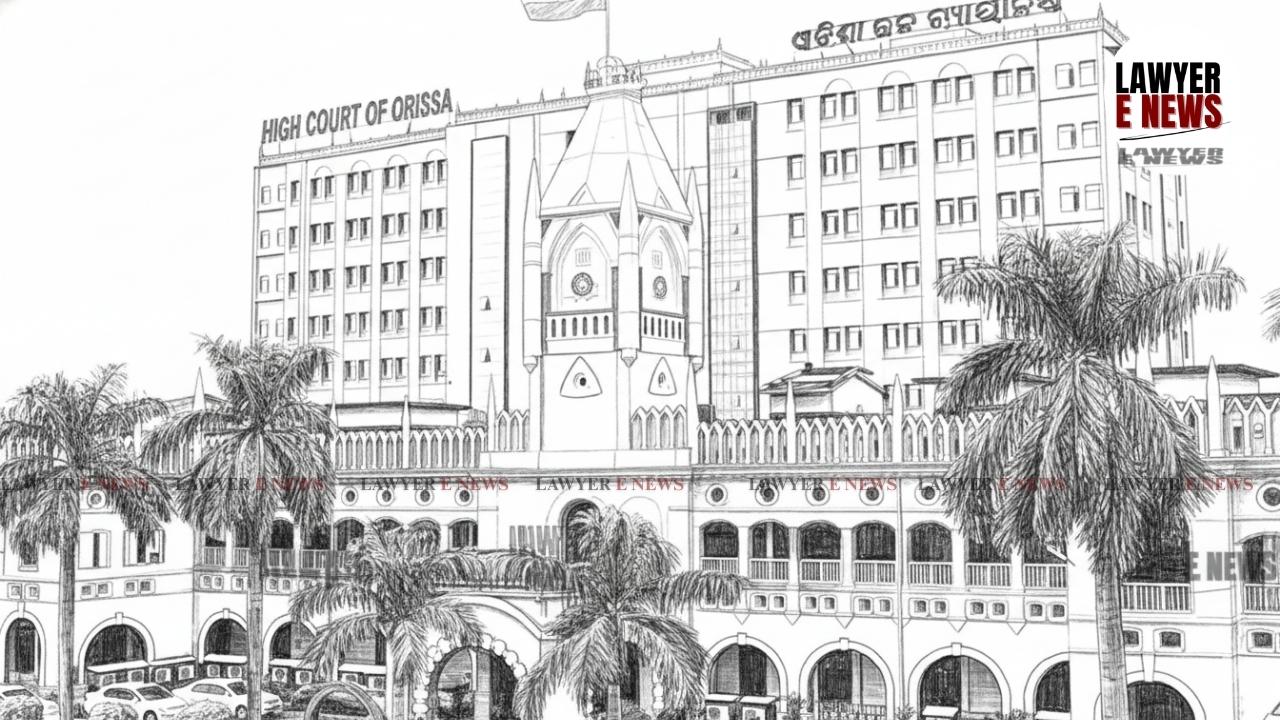
"Member, Board of Revenue went off on a tangent to decide a non-issue... Such approach cannot be countenanced in law nor is contemplated under the provisions of Section 32", Orissa High Court, in a significant ruling, held that the Board of Revenue cannot exceed its revisional jurisdiction under Section 32 of the OSS Act to quash orders that were never specifically challenged before it.
A Single Judge Bench of Justice Sashikanta Mishra observed that the Board is duty-bound to examine the correctness of the specific order impugned in the revision rather than foraying into the validity of previous, settled proceedings.
The court further clarified that a direction by a Commissioner to a Tahsildar to conduct a field inquiry does not amount to an illegal delegation of revisional power, but is rather a liberty granted to a party to approach the competent authority.
The dispute pertained to a patch of land in Cuttack, originally owned by one Banshidhar Mohanty, which the petitioners claimed was wrongly recorded in favor of the Cuttack Municipality (Opposite Party No. 5) during settlement operations. Following a revision in 1996, the Commissioner of Land Records directed a field inquiry, leading the Tahsildar to correct the Record of Rights (ROR) in 1997. After a delay of over four years, the Municipality challenged the Tahsildar’s order, but the appeal was dismissed by the Sub-Collector on grounds of limitation, a decision which the Board of Revenue subsequently overturned while also quashing the original 1996 and 1997 orders.
The primary question before the court was whether the Member, Board of Revenue, while exercising jurisdiction under Section 32 of the OSS Act, could legally quash the Commissioner’s 1996 order and the Tahsildar’s 1997 order which were not under challenge. The court was also called upon to determine if the Commissioner had illegally delegated his revisional powers to the Tahsildar.
Direction For Field Inquiry Is Not Delegation Of Power
The Court first addressed the Board of Revenue's finding that the Commissioner had illegally delegated his authority under Section 15(b) of the OSS Act to the Tahsildar. Justice Mishra noted that the Commissioner had merely observed that the revisional court lacked an independent agency for field inquiries since settlement camps were closed. By directing the Tahsildar to take up the matter under the Mutation Manual, the Commissioner was recognizing the Tahsildar’s statutory competence.
"The directions to the Tahasildar to take up the case under paragraph 17(1) of the Mutation Manual and cause field inquiry can, by no stretch of imagination, be treated as delegation of authority. It is rather to be construed as liberty granted to the petitioners to approach the competent authority for effecting corrections in the ROR."
Board Of Revenue Cannot Decide Non-Issues Under Section 32
The High Court expressed surprise at the Board of Revenue's approach, noting that the revision before the Board was specifically against the Sub-Collector’s refusal to condone delay in the mutation appeal. Instead of deciding whether the Sub-Collector was justified in dismissing the appeal on technical grounds, the Member of the Board of Revenue quashed the underlying substantive orders from a decade prior.
"It was therefore, incumbent upon the learned Member to examine the correctness or otherwise of the order of dismissal of the appeal. Surprisingly, however, nothing whatsoever has been decided in this regard. On the contrary, learned Member has forayed into the correctness of an order not in challenge before him."
The Court emphasized that Section 32 of the OSS Act, which empowers the Board to call for and revise proceedings, does not permit the authority to ignore the specific order under challenge to reopen settled issues that were never appealed by the aggrieved party at the relevant time.
"In other words, instead of deciding whether the Sub-Collector was legally justified in dismissing the mutation appeal, the Member went off on a tangent to decide a non-issue."
Adverse Remarks Against Subordinate Officers Must Be Avoided
The High Court took strong exception to the Board Member’s remarks describing the Sub-Collector’s decision as "judicial misconduct." The Bench clarified that dismissing an appeal on the ground of limitation is a standard legal procedure and cannot be termed misconduct. Justice Mishra reminded senior revenue officials to maintain decorum and exercise restraint in their language when reviewing orders of subordinate authorities.
"There is no way by which the action of the Sub-Collector in dismissing the appeal on the ground of limitation could be termed as ‘judicial misconduct’. This Court can only observe that senior officers must exercise restraint in the use of language while dealing with orders passed by the subordinate authorities."
The High Court concluded that the Board of Revenue’s order was legally unsustainable as it transcended the scope of the revision. The Court allowed the writ petition and set aside the Board's order, thereby restoring the 1996 order of the Commissioner, the 1997 mutation order of the Tahsildar, and the 2002 appellate order of the Sub-Collector.
Date of Decision: 23 April 2026