
-
by sayum
28 August 2026 2:11 PM







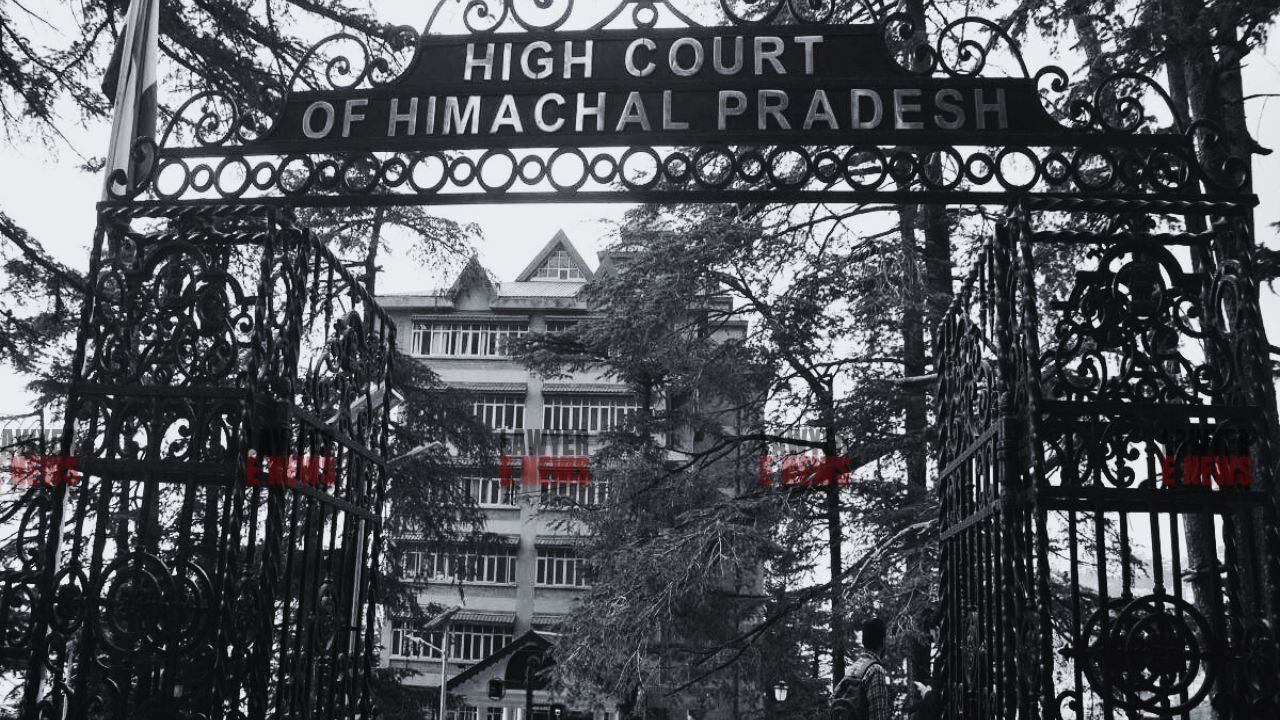
Himachal Pradesh High Court dismissed a petition seeking regular bail under Sections 20, 25 and 29 of the Narcotic Drugs and Psychotropic Substances Act, 1985, reiterating that the stringent twin conditions of Section 37 NDPS Act must be met before bail is granted in cases involving commercial quantities of narcotics.
Justice Rakesh Kainthal held that the presence of 1.056 kilograms of charas in a private vehicle, along with call detail records linking the petitioner to the co-accused, constituted prima facie conscious possession and hence, the petitioner failed to meet the mandatory statutory bar for bail under Section 37 NDPS Act.
“Once Possession Is Established, Burden Shifts to Accused to Prove Lack of Conscious Possession”: Citing Madan Lal, Court Rejects Passenger’s Innocence Plea
The case arose from FIR No. 83 of 2023, registered at Police Station Panchrukhi, District Kangra, following a midnight interception of a private car and scooter, acting on specific secret information received by the police. Upon search, a light pink bag containing 1.056 kg of charas was recovered from the dashboard of the car, in which the petitioner Shagun was seated as a passenger. Shagun and his co-accused were arrested on the spot.
The petitioner claimed that he was merely a passenger, had no knowledge of the contraband, and was falsely implicated. He further submitted that he is the sole earning member of his family and undertook to abide by any condition imposed by the Court.
The State opposed the bail, invoking Section 37 NDPS, highlighting that the quantity recovered was commercial, and that CDR analysis showed Shagun had pre-existing contact with the driver of the vehicle, thereby undermining his claim of innocence.
Interception and Recovery
The police, while patrolling near Andreta Machiyal Chowk on the night of 25.09.2023, received reliable information that narcotic substances were being transported in a vehicle bearing registration number HP37F-7813 and a scooter. After intercepting the vehicle, a dashboard search led to the seizure of 1.056 kg of charas, later confirmed by SFSL Junga to contain 26.46% w/w of resin.
During investigation, call detail records revealed that Shagun (petitioner) was in frequent contact with co-accused Avikash Manhas, and their location data placed them near the house of another alleged supplier, Khem Singh. The accused confessed to having procured the drugs for ₹90,000, leading to Khem Singh's subsequent arrest.
Applicability of Section 37 NDPS Act
The key legal issue was whether the petitioner could be granted bail despite the recovery being of a commercial quantity, triggering the stringent bar under Section 37(1)(b) of the NDPS Act. The Court was required to determine whether there existed “reasonable grounds” to believe that the accused was not guilty and unlikely to reoffend, as mandated under Section 37 NDPS.
Referring to Union of India v. Niyazuddin, (2018) 13 SCC 738, and State of Kerala v. Rajesh, AIR 2020 SC 721, the Court reiterated:
"The expression 'reasonable grounds' means something more than prima facie grounds. It contemplates substantial probable causes for believing that the accused is not guilty of the alleged offence... This reasonable belief requires the existence of such facts and circumstances as are sufficient in themselves to justify satisfaction that the accused is not guilty."
The Court also cited Narcotics Control Bureau v. Mohit Aggarwal, 2022 SCC OnLine SC 891, to hold that:
"The conditions imposed under Section 37 are cumulative, not alternative. Unless the court is satisfied that both (i) the accused is not guilty, and (ii) is unlikely to re-offend, bail cannot be granted."
“All Occupants of Non-Public Vehicle Must Be Presumed in Conscious Possession” — Madan Lal Applied
Applying the precedent of Madan Lal v. State of H.P., (2003) 7 SCC 465, the Court held that:
"All the accused persons were travelling in a vehicle... they were known to each other... it has not been explained or shown how they travelled together in a vehicle which was not a public vehicle."
Further quoting from Madan Lal:
"Once possession is established, the person who claims it was not conscious possession has to establish it because how he came to be in possession is within his special knowledge. Section 35 gives statutory recognition to this position."
Justice Kainthal observed that the petitioner’s mere denial of knowledge of the contraband was not sufficient, especially when:
The contraband was kept in the dashboard, not a concealed compartment;
The petitioner was not a stranger to the co-accused;
CDRs and location data connected him with the alleged supplier;
No material was placed on record to rebut the presumption of conscious possession.
Bail Jurisprudence Reiterated: NDPS Demands Stricter Threshold
The Court relied extensively on bail jurisprudence, including Pinki v. State of U.P., (2025) 7 SCC 314, where it was observed:
"The expression 'reasonable grounds' used in Section 37 means credible, plausible and substantial reasons for the Court to believe that the accused is not guilty of the alleged offence."
Further, in Mohd. Nawaz Khan, (2021) 10 SCC 100, the Court noted that:
"At the stage of considering bail under NDPS, the Court is not required to record a finding of not guilty — it is a limited inquiry whether there exists credible material to believe so."
In the present case, the High Court held that no such credible material was placed before it, and the petitioner failed to rebut either the presumption of conscious possession under Sections 35 and 54 NDPS Act or demonstrate that he would not re-offend if released.
Petitioner Failed to Satisfy Twin Conditions of Section 37 NDPS Act
The Court, after evaluating the record, observed:
"In the present case, the petitioner was, prima facie, found in possession of 1.056 kilograms of charas. There is nothing to indicate that he is not likely to commit a similar offence in the event of his release on bail. Therefore, the petitioner has failed to satisfy the twin conditions laid down under Section 37 of the NDPS Act."
Consequently, the petition was dismissed. The Court made it clear that bail in NDPS commercial quantity cases must not be granted casually, and societal interest in curbing the drug menace must override liberal bail principles.
Date of Decision: 22 September 2025





