-
by sayum
15 August 2026 2:23 PM







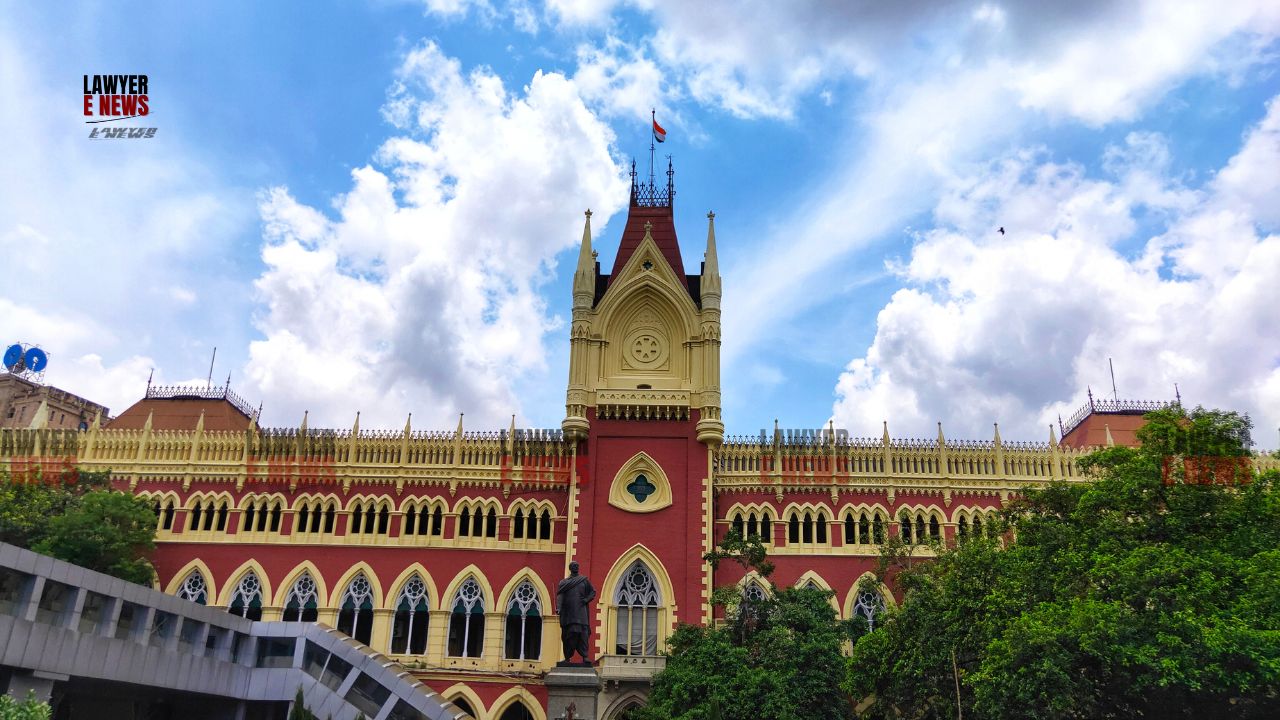
"The learned Trial Judge adopted a hyper technical approach which eventually led to the acquittal of the opposite party. This could clearly be described as a grave miscarriage of justice." Calcutta High Court, in a significant ruling, held that the production of a marriage certificate is sufficient proof of a prior marriage in bigamy cases, setting aside an order of acquittal passed nearly three decades ago.
A bench of Justice Rajasekhar Mantha and Justice Ananya Bandyopadhyay observed that trial courts should not adopt a "hyper-technical approach" regarding the proof of marriage ceremonies or the examination of registry officials when the existence of a prior marriage is evident from other records.
The appellant and respondent were married under Hindu rites in August 1984. The appellant later discovered that the respondent, a police officer, was already married to one Manabi Roy under the Special Marriage Act since 1983 and was living with her in government quarters. Following a complaint, the respondent was dismissed from service after a departmental inquiry, and the appellant filed a criminal complaint under Section 495 of the IPC in 1990. The Trial Court acquitted the husband in 1996, citing a lack of formal proof of the first marriage and delay in filing the complaint.
The primary question before the court was whether the production of a marriage certificate and departmental findings of guilt are sufficient to prove a prior marriage under Section 495 IPC. The court was also called upon to determine if the delay in filing a complaint for bigamy would extinguish the offence and whether every specific ritual of a Hindu marriage must be proved by examining priests from both sides.
Trial Court's Requirement For Official Records Of Marriage 'Hyper-Technical'
The Court noted that the Trial Judge erred by insisting that the appellant produce officials from the marriage registry or original registers to prove the respondent’s first marriage. The bench observed that the Trial Judge laid "unnecessary and excessive emphasis" on the requirement of proof of the first marriage, especially when a certified copy of the marriage certificate was already marked as an exhibit.
Court Explains Sufficiency Of Secondary Evidence Under Evidence Act
While acknowledging that primary evidence is the standard, the bench held that the circumstances of the case justified the acceptance of the marriage certificate. The Court stated that the "production of even a copy of the Certificate of Marriage under the Special Marriage Act is sufficient prove of a previous marriage by a person accused thereunder." It further noted that the defense failed to cross-examine prosecution witnesses on the absence of the first marriage.
Section 495 IPC Proceedings Not Barred By Limitation Under Section 468 CrPC
Addressing the Trial Court’s finding that a four-year delay in filing the complaint was fatal, the High Court clarified the statutory position. The bench held that the Trial Judge should have noticed that "a proceeding under Section 495 does not have any prescribed period of limitation under Section 468 of the Cr.P.C." The Court emphasized that while the appellant should have approached the court earlier, the delay does not "extinguish or dilute the offence committed."
Presumption Of Validity For Hindu Marriage Ceremonies
The High Court took strong exception to the Trial Court's finding that the second marriage was not proved because the priest from the groom’s side was not examined. The bench termed this finding "ludicrous," stating that there is a presumption of validity once several witnesses depose to having attended the Hindu marriage ceremony.
"To insist on the production of the priest... is to stretch the decree of proof beyond rational, logical and legal limits."
Scope Of Evidence In Complaint Cases Under Section 200 CrPC
The Court rejected the Trial Court's observation that the witnesses' depositions went beyond the original complaint. It held that the object of examining witnesses pre and post-charge is to enable them to depose as "freely and widely as possible." The bench noted that there is always scope for bringing in new facts during the examination of witnesses to ensure the purpose of cross-examination is not defeated.
Deceit Of Two Women Justifies Imprisonment Despite Accused's Advanced Age
In determining the sentence, the Court considered the "emotional and mental turmoil" caused to both the appellant and the first wife. The bench observed that the respondent had deceived two women, and such turmoil "cannot be compensated in money or in any form whatsoever." While the respondent's counsel pleaded for leniency citing his age (above 75 years), the Court found that the gravity of the deceit warranted a term of imprisonment.
Court Sets Aside Acquittal and Convicts Respondent
The High Court concluded that both vital ingredients of Section 495 IPC—a second marriage during the subsistence of the first and the active concealment of the former marriage—were proved beyond reasonable doubt. Consequently, the Court set aside the 1996 acquittal and convicted Jibananda Chatterjee, sentencing him to three years of simple imprisonment.
The High Court allowed the appeal, emphasizing that technical omissions in proving marriage rituals cannot override glaring evidence of bigamy and concealment. By imposing a fine of ₹1 lakh to be paid to the appellant, the Court aimed to address the prejudice suffered by the victim, while noting that the respondent's age was the only factor preventing the imposition of the maximum ten-year sentence.
Date of Decision: July 10, 2026