
-
by sayum
28 August 2026 2:11 PM







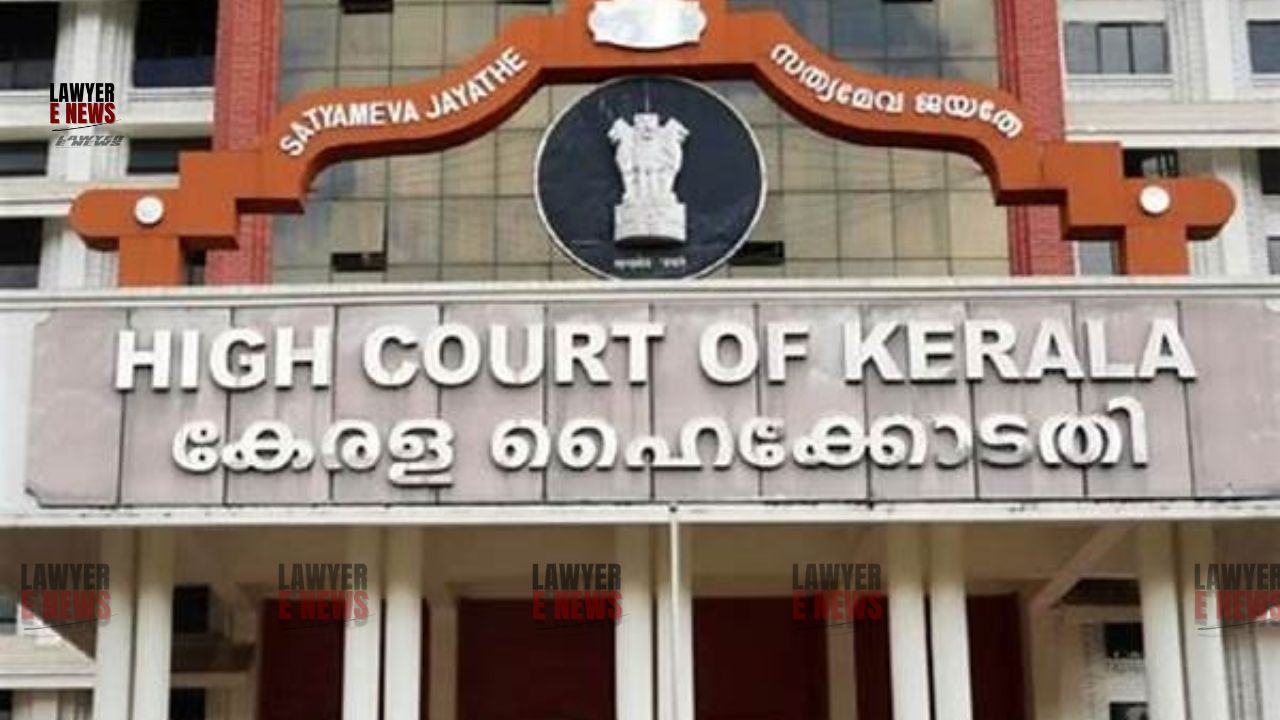
"Demand and Acceptance of Illegal Gratification is a Sine Qua Non for Conviction Under Sections 7 and 13(1)(d) of the PC Act" - High Court of Kerala addressing the crucial requirement of proving demand and acceptance in corruption prosecutions under the Prevention of Corruption Act, 1988. While affirming the guilt of the accused—a former Senior Civil Police Officer who had allegedly demanded and accepted a bribe for processing a passport verification—the Court reduced the sentence, citing proportionality and the nature of evidence.
The judgment reiterates a vital principle: “Mere recovery of money, divorced from the circumstances of the demand and acceptance, cannot sustain a conviction under Sections 7 and 13(1)(d) of the PC Act.”
“Recovery Alone Does Not Prove Guilt”: Court Emphasises Evidentiary Burden in Corruption Cases
The case originated from a complaint filed by PW1 Ratheesh, who had applied for a Tatkal passport. The accused, S. Navas, then a Senior Civil Police Officer at Thumba Police Station, was alleged to have demanded ₹1,000 from Ratheesh for submitting a favourable re-verification report—this, despite the initial passport already being issued.
The Vigilance and Anti-Corruption Bureau (VACB) laid a trap on 23.11.2012, wherein the tainted currency notes, pre-treated with phenolphthalein, were recovered from the accused’s possession. The Special Judge (Vigilance) convicted him under Sections 7 and 13(1)(d) r/w 13(2) of the PC Act and sentenced him to 3 years’ simple imprisonment, which was under challenge in this appeal.
"Suspicion, However Strong, Cannot Replace Proof"—Defence Invokes Gaps in Verification Procedure
The defence, arguing for acquittal, highlighted that the Manual of Office Procedure (MOP) was not strictly followed, and the official passport verification file (Ext. P2 series) was not convincingly proved to have been in lawful custody of the accused. It was argued that no credible entrustment of duty was shown, nor was the tapal register conclusive.
“Conviction based on mere assumptions and surmises is illegal,” submitted the counsel, citing A. Subair v. State of Kerala (2009) 6 SCC 587, and Safia Beevi v. State of Kerala, 2014 KHC 354.
The defence further claimed that if the complainant (PW1) had any money to give to another person (DW1), he might have mistakenly handed it over to the accused, who was allegedly not present during the transaction—an argument the Court termed “unconvincing and contrary to human prudence.”
"Demand, Acceptance, and Recovery Clearly Proven Through Consistent Witness Testimony"
Rejecting the defence, the Court found the demand and acceptance of ₹1,000 by the accused to be established through direct, corroborated evidence of PW1 (complainant), PW2 (Home Guard), PW3 (Vigilance Officer), and PW4 (Independent Witness). The tainted currency was recovered from the accused’s personal purse and from Home Guard PW2, both of which tested positive for phenolphthalein.
Justice A. Badharudeen observed: “Recovery of Ext.P2 series from the possession of the accused is a strong piece of evidence to negate the defence canvassed... The story canvassed by the accused, that he was in the toilet and had no contact with the complainant at the time of trap, is not acceptable.”
Importantly, call records (Ext. P20) and Section 65B certificate (Ext. P21) further corroborated the telephonic contact between the accused and PW1 just before the bribe was paid.
"Presumption Under Section 20 Must Be Raised When Foundational Facts Are Established"
In reaffirming the conviction, the Court relied heavily on the Constitution Bench ruling in Neeraj Dutta v. State (AIR 2023 SC 330). Citing paragraph 68 of that judgment, it reiterated:
"Proof of demand and acceptance of illegal gratification by a public servant as a fact in issue is a sine qua non in order to establish guilt under Sections 7 and 13(1)(d)(i) and (ii) of the Act."
The Court noted that once foundational facts were proven through oral and documentary evidence, Section 20 of the PC Act compels the court to raise a presumption that the gratification was received as illegal reward or motive. This presumption, the Court noted, remained unrebutted by the defence.
"Sentence Should Match the Crime, but Also Be Proportionate to the Circumstances"
While confirming the conviction, the Court found merit in reducing the sentence: "Taking note of the facts of the case involved and the plea raised by the learned counsel for the accused to reduce the sentence, I am inclined to modify the sentence."
Accordingly, the Court altered the punishment as follows:
For the offence under Section 7: 6 months’ simple imprisonment and a fine of ₹10,000, with 1-month default sentence.
For the offence under Section 13(1)(d) r/w 13(2): 1 year’s simple imprisonment and a fine of ₹15,000, with 45 days default sentence.
The substantive sentences were directed to run concurrently.
“Accused Shall Appear Before the Trial Court Forthwith to Undergo Modified Sentence”
The Kerala High Court vacated the interim bail and directed the accused to surrender immediately. It authorized the Special Court to ensure execution of the sentence.
This judgment reinforces the essential legal standard that proof of both demand and acceptance of a bribe is indispensable for conviction under the Prevention of Corruption Act. The presence of tainted currency alone is insufficient.
Justice Badharudeen’s verdict balances legal rigor with judicial restraint, reducing the sentence but affirming guilt based on well-corroborated evidence and settled principles.
Date of Decision: 26 September 2025





