-
by sayum
28 August 2026 2:11 PM







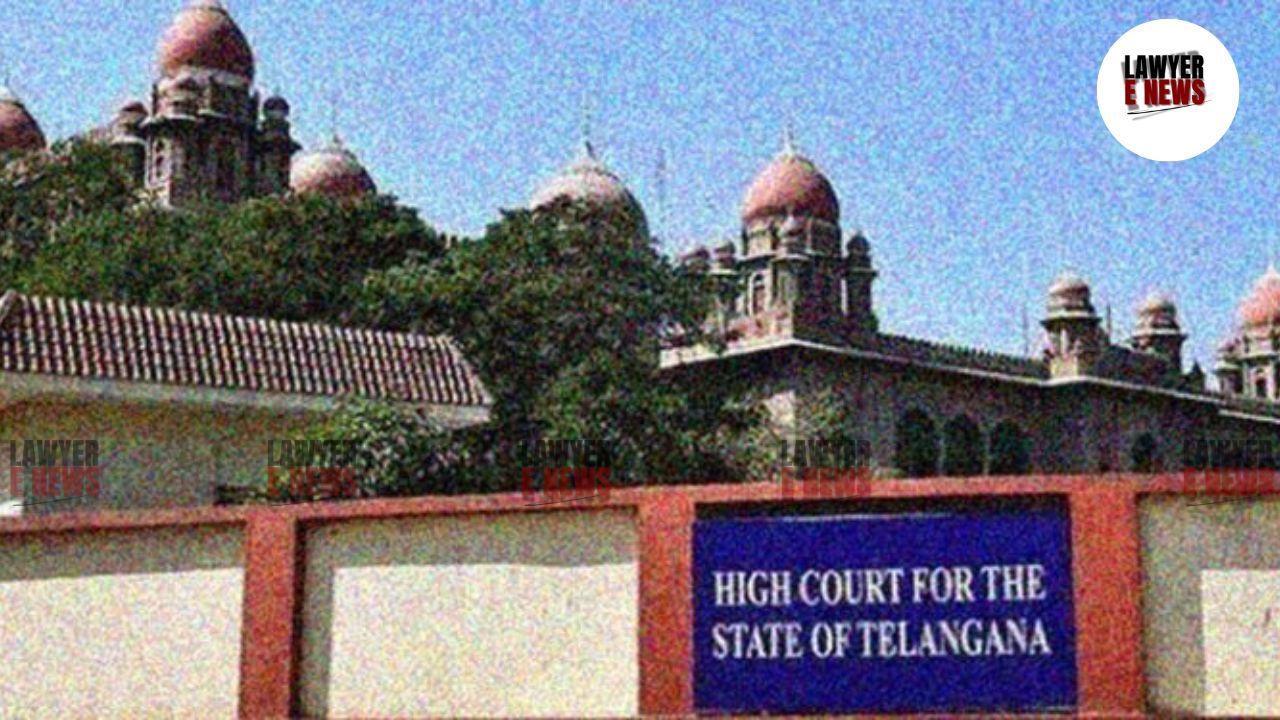
“Courts Must Nip Bogus Litigation in the Bud to Prevent Abuse of Judicial Process” – High Court for the State of Telangana holding that clever drafting of a plaint which creates an illusion of cause of action will not revive stale, time-barred claims. The Court, in its revisional jurisdiction under Article 227 of the Constitution, allowed the civil revision petition and rejected the plaint under Order VII Rule 11 CPC, branding the suit as "hopelessly barred by limitation", "based on an invalid oral Hiba", and "lacking real cause of action".
“A Right That Slept for 50 Years Cannot Be Resurrected by Artful Pleading” – High Court Rejects the Plaint as Time-Barred and Legally Unsustainable
The plaintiffs in the suit filed in 2020 claimed ownership over ancestral properties through a purported oral Hiba (gift) made in 2020 by their mother and aunts—legal heirs of one Mohd. Gouse Ali Khan, who had died in 1959. The suit sought cancellation of sale deeds executed in 2013, 2014, and 2017, and possession of four separate parcels of land. However, as the High Court noted, the properties had already been alienated through registered sale deeds as early as 1967 and 1971.
Justice Alishetty emphasized: “The cause of action shown in the suit is not comprehensive and cleverly avoids referring to the parent transactions of 1967 and 1971. The suit is nothing but a clever attempt to revive a dead claim through selective pleading.”
The Court held that the right to sue had first accrued more than five decades ago, and thus the suit was barred under Articles 59, 64, 65 and 113 of the Limitation Act, 1963.
“When Plaintiffs Failed to Assert Their Title or Challenge Parent Documents of 1967 and 1971, They Cannot Now Attack Sale Deeds of 2013–2017” – Court Calls Suit a Tactical Evasion of Limitation
Observing that the plaintiffs had not sought to cancel the original sale deeds of 1967 and 1971, the Court said:
“By selectively targeting only recent transactions while letting the foundational documents go unchallenged, the plaintiffs have sought to create a legally unsustainable suit based on illusions.”
The Court pointed to the principle laid down in Khatri Hotels Pvt. Ltd. v. Union of India (2011) 9 SCC 126, stating that:
“Successive violations do not give rise to a fresh cause of action. Limitation begins to run from the date the right to sue first accrues.”
It held that the plaint was liable to be rejected outright, as the limitation period had clearly expired decades ago, and plaintiffs were attempting to “circumvent the statute by clever pleading.”
“Invalid Hiba Without Delivery of Possession Cannot Confer Title – No Locus Standi to Sue” – Oral Gift Rejected as Legally Defective Under Mahomedan Law
One of the main pillars of the plaintiffs' claim was a 2020 oral Hiba (gift) from the daughters of Hameed Khatoon, wife of the original owner. The Court rejected the validity of this Hiba, observing that:
“Declaration and acceptance alone do not constitute a valid Hiba under Mohammadan Law. The most essential element—delivery of possession—is absent.”
Referring to Rasheeda Khatoon v. Ashiq Ali and Mahboob Sahab v. Syed Ismail, the Court reiterated: “The donee must take possession—actual or constructive. In its absence, the gift remains incomplete, invalid, and legally ineffective.”
Because none of the alleged donors were in possession, and the plaintiffs themselves were seeking recovery of possession, the Court concluded:
“The plaintiffs had no valid title. Their predecessors could not have gifted what they did not own or possess. Consequently, the plaintiffs have no locus standi to challenge any sale deed.”
“Clever Drafting of Plaint Will Not Rescue a Time-Barred and Legally Deficient Claim” – Courts Must End Sham Litigation at the Threshold
In strong terms, the High Court held that the suit was designed to mislead the Court:
“The plaint is a textbook case of clever drafting designed to create an illusion of cause of action, when in truth, there is none. Such litigation must be stopped at the earliest stage.”
Citing I.T.C. Ltd. v. DRAT, Dahiben v. Arvindbhai, and Rajendra Bajoria v. Hemant Kumar Jalan, the Court held:
“The duty is cast upon the Court to filter out bogus claims. When a plaint does not disclose any cause of action and is barred by law, it must be rejected under Order VII Rule 11 CPC.”
It concluded that: “This Court has no hesitation in holding that this is sham litigation, bereft of merit, and deserves to be dismissed at the threshold.”
“Decades of Silence Speak Loudly – Doctrine of Acquiescence Bars Plaintiffs From Challenging Possession and Title”
The Court also applied the Doctrine of Acquiescence, stating that the plaintiffs and their predecessors had remained silent spectators while multiple registered transactions occurred between 1967 and 2017.
Referring to Chairman, SBI v. M.J. James , the Court observed: “The doctrine of acquiescence applies when a party with a legal right remains silent while others deal with the property in a manner inconsistent with that right. That silence becomes consent.”
The Court added: “Acquiescence virtually destroys the right of the person. The plaintiffs’ silence for more than 50 years amounts to implied consent, barring any claim for equity or restitution.”
“Improper Court Fee Payment Shows Lack of Due Diligence” – Another Ground for Rejection
The plaintiffs had calculated court fee under Section 24(d) of the Andhra Pradesh Court Fees and Suits Valuation Act, applicable when plaintiff is in possession. But they had themselves admitted they were not in possession and had sought recovery of possession, which required court fee under Section 37.
The Court remarked: “Improper valuation of court fee is not a mere technical defect. It goes to the root of the plaintiffs’ claim. This is an additional reason why the plaint cannot be sustained.”
Plaint Rejected Under Order VII Rule 11 CPC, Suit Dismissed at Threshold
The trial court had earlier dismissed the defendant’s application under Order VII Rule 11, holding that limitation was a mixed question of law and fact. However, the High Court found that: “The trial court failed to apply the law laid down by the Hon’ble Supreme Court and misdirected itself in treating limitation as a triable issue when it was clearly evident on the face of the plaint.”
Justice Laxmi Narayana Alishetty concluded: “The present suit, filed after decades, based on invalid title, improper court fee, and lacking any genuine cause of action, cannot be allowed to continue. The litigation ends here.”
Date of Decision: 17th September 2025