-
by sayum
20 August 2026 1:37 PM







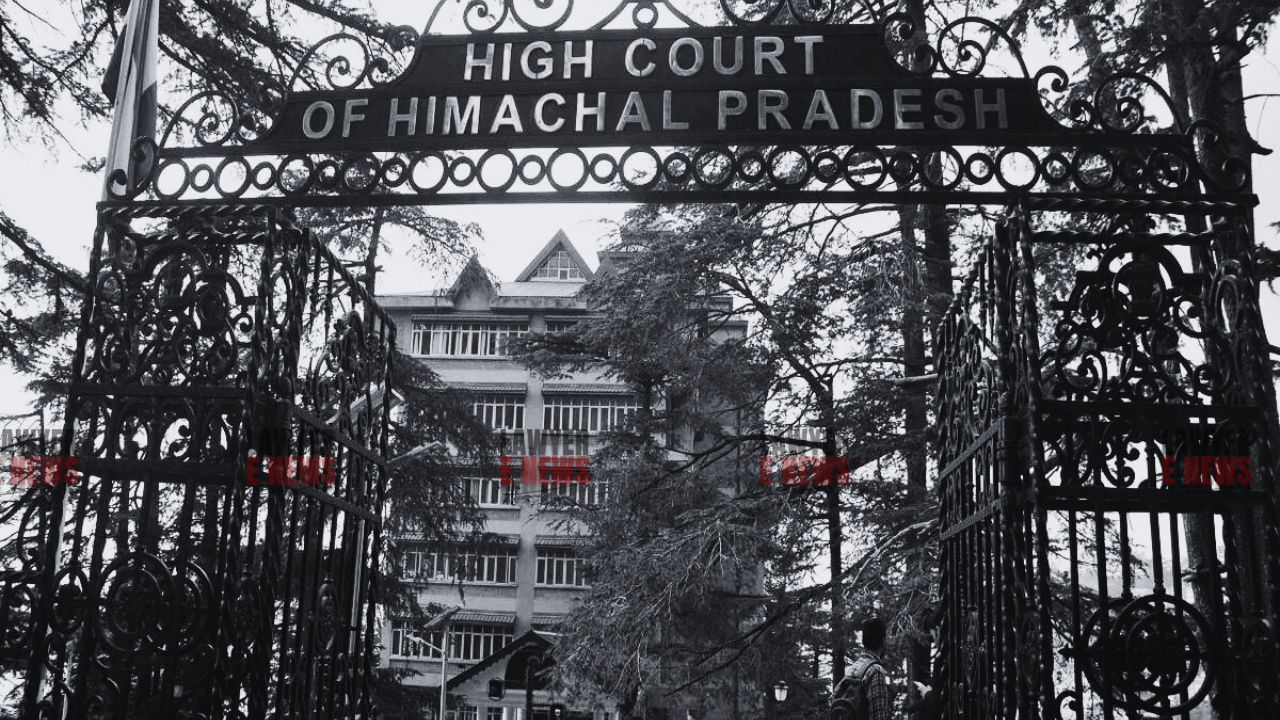
In a strongly worded and reportable decision Himachal Pradesh High Court reversed concurrent findings of the lower courts and decreed a suit for recovery and mandatory injunction against BSNL for illegally erecting a mobile tower on private land without consent. Justice Satyen Vaidya ruled that once unauthorized occupation is established through court-appointed demarcation, refusal to remove the structure or compensate the landowner is legally untenable.
“The Courts below could not have non-suited the plaintiff on non-existent grounds… This Court finds the judgments passed by both the Courts are perverse.” [Para 20]
“Tower Erected 20 Meters Inside Plaintiff’s Land — Demarcation Report Unchallenged, Yet Ignored by Lower Courts”
The case stemmed from the erection of a BSNL mobile transmission tower, which, as per lease agreement dated 28.04.2009, was to be installed on Khasra No. 70, owned by a third party. However, plaintiff Nar Dass alleged that the tower was actually erected on his adjacent land (Khasra No. 71), without his knowledge or consent.
In support of his claim, the plaintiff relied on a Local Commissioner’s report (Ex. PW2/A), which was accepted by the Trial Court:
“Transmission tower of defendant had been constructed in Khasra No. 71 at a distance of 20 meters from Khasra No. 70.” [Para 11]
BSNL’s objections to the demarcation were dismissed by the Trial Court on 19.06.2012, and that order was never challenged:
“The defendant had not opposed the appointment of the Local Commissioner... The order dismissing the objections has attained finality.” [Para 12]
Despite this, both the Trial Court and Appellate Court dismissed the suit, citing lack of personal testimony by the plaintiff and alleged acquiescence in the tower's construction.
“There’s No Absolute Rule That Plaintiff Must Testify Personally — Power of Attorney Holder's Evidence Sufficient”
A pivotal issue in both lower court rulings was the non-examination of Nar Dass, the original plaintiff, who had instead authorized his son to testify through a Special Power of Attorney (SPA). The High Court clarified that such procedural nitpicking was misplaced, particularly when no material question went unanswered.
“Even observation of the learned Trial Court that the son of plaintiff had failed to produce the original of Special Power of Attorney appears to be against record… original seen and returned.” [Para 18]
Justice Vaidya emphatically stated:
“There is no absolute rule that in the absence of examination of plaintiff as a witness, the suit has to fall in all cases.” [Para 21]
In this case, the SPA holder was examined as PW-1 and answered all material questions. His testimony was supported by the Local Commissioner, who was also examined as PW-2. The Court found no legal basis to draw an adverse inference.
“Delay Does Not Mean Consent — Legal Notice Sent in 2010, Suit Filed in 2011 — No Estoppel or Acquiescence”
BSNL also claimed that the plaintiff was barred by acquiescence or estoppel, as the tower had existed since 2009 and the suit was filed only in 2011. The Court dismissed this argument as baseless:
“It was also not the case of the defendant that the tower had been erected in the presence of the plaintiff... to say that the plaintiff was estopped from filing the suit will not be the right proposition.” [Para 19]
The Court took note that the plaintiff had issued a legal notice on 01.12.2010 (Ex. PW1/B), and filed suit on 27.04.2011, well within the limitation period.
“Plaintiff had filed the suit within the period of limitation and for such reason the dismissal of the suit on the aforesaid ground cannot be sustained.” [Para 19]
“Owner of Khasra No. 70 Not a Necessary Party — No Relief Claimed Against Him, No Boundary Dispute”
BSNL contended that the suit was not maintainable due to non-joinder of the owner of Khasra No. 70 — the land originally leased by BSNL. The High Court rejected this as legally irrelevant:
“Plaintiff had no dispute whatsoever with the owner of Khasra No.70... the owner of Khasra No.70 was not even a proper party what to talk of being a necessary party.” [Para 17]
More importantly, the Court noted that BSNL never raised a misjoinder objection in its written statement, and no such issue was framed by the Trial Court, further weakening its position.
“Quantum of Compensation Can Be Assessed Using Lease Rate Paid by BSNL to Adjoining Landowner”
The Trial Court had rejected the plaintiff’s claim for ₹2,90,000 and monthly charges, citing lack of evidence to establish use and occupation charges. The High Court termed this reasoning flawed, noting that BSNL was already paying ₹1800/month to the owner of Khasra No. 70 for an identical use.
“Defendant had agreed to pay Rs.1800/- per month... the said amount could have been adjudged as use and occupation charges in favour of plaintiff.” [Para 22]
Thus, the Court decreed compensation @ ₹1800 per month from 01.12.2010, the date of legal notice, along with 6% interest per annum, continuing until the tower is removed.
Appeal Allowed, Suit Decreed — BSNL Directed to Pay Occupation Charges and Remove Tower at Its Discretion
The Himachal Pradesh High Court allowed the Regular Second Appeal, set aside the judgments of the Trial Court and First Appellate Court, and decreed the plaintiff's suit:
“The suit of the plaintiff is decreed for use and occupation charges @ Rs.1800/- per month from 01.12.2010 along with interest @6% per annum... The use and occupation charges, however, shall be payable till the tower is not removed.” [Para 24]
The Court also clarified that BSNL has the liberty to remove the tower and relocate it, but till such time, it must pay for occupying private land without right or permission.
Date of Decision: 13 October 2025