-
by sayum
28 August 2026 8:44 AM







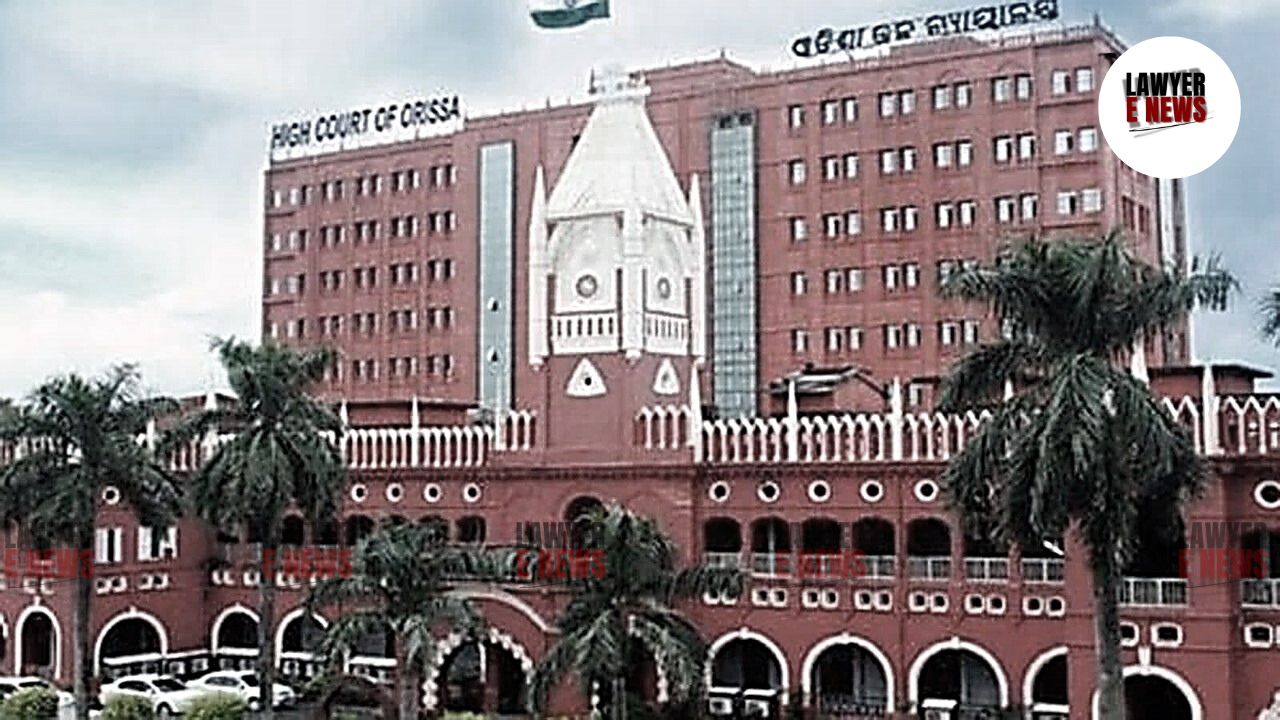
“Suspicion Is Not Proof – Suicide Cannot Be Presumed in Absence of Cogent Evidence” – Orissa High Court, in a significant pronouncement on statutory compensation under the Railways Act, held that once an accidental fall from a train by a bona fide passenger is established, compensation under Section 124A is mandatorily payable. Setting aside a contrary decision by the Railway Claims Tribunal, Justice Dr. Sanjeeb K. Panigrahi ruled that speculative inferences of suicide cannot override concrete evidence such as police reports, inquest findings and recovery of ticket.
The judgment in Santosh Ku. Sahoo v. Union of India [FAO No. 135 of 2020] restores the compensation of ₹8,00,000/- with 6% interest to the family of a deceased passenger who died after falling from an overcrowded train, declaring the death as an “untoward incident” under Section 123(c)(2) read with Section 124A of the Railways Act, 1989.
“Railway Administration’s Liability Is No-Fault and Absolute – It Cannot Evade Payment Based on Conjecture”
Justice Panigrahi emphasized that Section 124A introduces strict liability for “untoward incidents,” where the railways must compensate irrespective of negligence, unless one of the limited statutory exceptions (such as suicide or self-inflicted injury) is clearly established.
“The provisions of Section 124A of the Railways Act embody the principle of strict liability... absence of any wrongful act, negligence or default on the part of the Railway Administration is of no consequence.”
The Court held that the Tribunal erred by accepting the Railway’s suggestion of suicide, a theory based solely on administrative inquiry (DRM report) and without direct evidence or legal proof.
“DRM Report Has No Evidentiary Value – Cannot Override Police and Post-Mortem Records”
Criticizing the Tribunal's reliance on the Divisional Railway Manager’s report, the Court held that administrative reports not supported by primary evidence cannot displace statutory or medical records.
“The Tribunal’s reliance upon the DRM’s report...stands vitiated for want of probative weight and cannot suffice to overturn the consistent and unimpeached conclusions emanating from the statutory and investigative materials.”
It was found that post-mortem report, inquest, and final police report all recorded that the deceased fell from the train during a crowded journey due to a sudden jerk, and died from his injuries. The presence of a valid ticket on the deceased’s person further confirmed bona fide passengership.
“Beneficial Legislation Must Be Interpreted Liberally – Restrictive Views Defeat the Object”
Citing the Supreme Court’s landmark rulings in Union of India v. Rina Devi [(2019) 3 SCC 572] and Union of India v. Prabhakaran Vijay Kumar [(2008) 9 SCC 527], the Court reinforced that the Railways Act is a welfare legislation, and its provisions must be given liberal and purposive interpretation:
“The provision for compensation in the Railway Act is a beneficial piece of legislation... Adopting a restrictive meaning to the expression ‘accidental falling’ would defeat the object of the legislation.”
The Court rejected the Tribunal's approach which had narrowly construed the concept of “untoward incident”, thereby undermining the scheme of prompt and equitable compensation under the Act.
“Mutilation Does Not Mean Suicide – Accidental Fall Often Leads to Run-Over Injuries”
The Tribunal had speculated that the nature of the injuries—particularly that the body was found severed into two parts—suggested suicide or deliberate run-over. The High Court dismissed this reasoning as legally flawed and medically unsupported.
“It is a matter of common occurrence that an accidental fall from a moving train may culminate in the passenger being run over... Such a subsequent development does not alter the intrinsic character of the mishap as an ‘accidental fall’.”
The Court found that no evidence existed suggesting that the deceased was on the tracks for any other reason apart from falling from the train.
“Bona Fide Passengership Proved Through Ticket and Testimony – Railways Failed to Rebut”
The Court noted that the valid ticket (No. VYA-51990424) issued from Berhampur station was recovered from the deceased’s body and was mentioned in the police and inquest records. The Tribunal’s observation that no such document was proved was held to be legally unsustainable.
“The Respondent-Railways neither pleaded nor adduced any evidence to discredit the authenticity of the said ticket... The deceased was a bona fide passenger within the meaning of Section 2(29) of the Railways Act.”
Moreover, the oral testimony of the appellant (wife of the deceased) was found credible and supported by official documents, while the Railways failed to produce any contradictory or rebutting evidence.
Compensation Ordered with 6% Interest – Tribunal’s Dismissal Set Aside
Holding the death to be a clear case of accidental fall from a train, the Court directed the Union of India to pay ₹8 lakhs in compensation, along with 6% interest from the date of application until payment. The Railways were granted three months to deposit the amount before the Tribunal for disbursal to the claimant.
“None of the statutory exceptions to liability enumerated under the proviso to Section 124A stand attracted in the present case.”
The Tribunal’s judgment dated 10.01.2020 was accordingly set aside, and the appeal was allowed in full, restoring the statutory entitlement of the bereaved family.
Date of Decision: 10 October 2025