-
by sayum
04 August 2026 1:39 PM







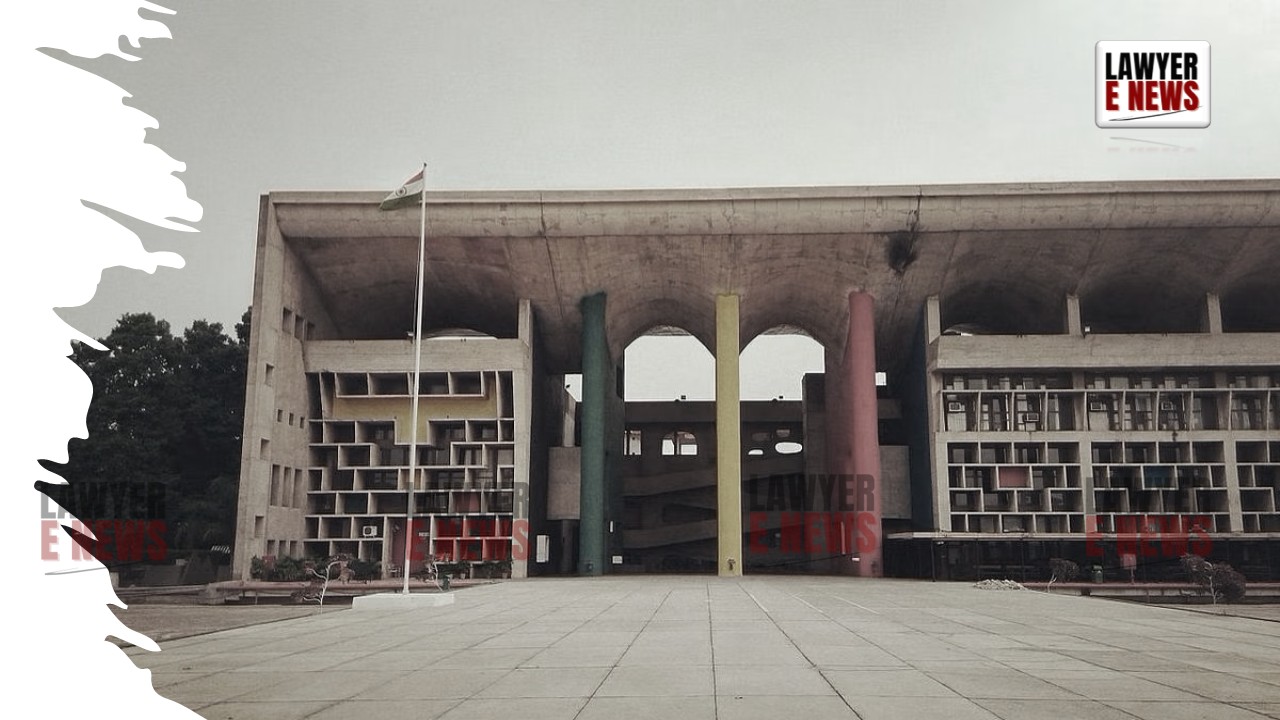
"An Act of the Court Shall Prejudice No One" — Punjab and Haryana High Court delivered a profound and empathetic verdict in the case of Harsimran Kaur v. State of Punjab and Others, LPA-312-2017, where it held that “a student who has completed her entire academic journey under the umbrella of court protection cannot be denied the end benefit of her degree merely due to initial technical ineligibility.” Setting aside the rigid application of admission norms, the Court invoked the equitable principle of actus curiae neminem gravabit, observing that "the act of the court shall prejudice no one."
The appellant, Harsimran Kaur, had secured 49.66% in her PCB subjects in the 10+2 examination, marginally falling short of the 50% eligibility criterion required under the June 10, 2016 notification for admission to the BDS course. Nevertheless, she was admitted in 2016 and attended classes from October 1, 2016.
Soon after, her admission was revoked by the authorities on grounds of ineligibility. She challenged the action in a writ petition, which was dismissed by a Single Judge in February 2017. Upon filing an appeal, the Division Bench granted her interim protection on March 1, 2017, allowing her to continue studies. Relying on this protection, she completed the entire four-year course and the required internship.
The peculiar situation arose when, despite completing the course, her final degree remained withheld due to the original disqualification, prompting judicial intervention.
The central legal issue was whether a student who was technically ineligible at the time of admission, but who completed the full course under court orders, could still be awarded the degree.
The Court reflected: “It is basic to our processual jurisprudence that the right to relief must be judged to exist as on the date a suitor institutes the legal proceeding… If a fact, arising after the lis has come to court and has a fundamental impact on the right to relief, is brought diligently to the notice of the tribunal, it cannot blink at it.”
The Bench leaned heavily on the doctrine of actus curiae neminem gravabit, famously encapsulated in the Supreme Court’s ruling in Pasupuleti Venkateshwarlu v. Motor and General Traders (AIR 1975 SC 1409), and echoed its enduring principle:
“No higher principle exists for the guidance of courts than the one that no act of court should harm a litigant. It is the bounden duty of courts to see that if a person is harmed by a mistake of the court, he should be restored to the position he would have occupied but for that mistake.”
Further invoking State of Maharashtra v. Milind (2001 AIR SC 393), the Court noted that long passage of time, public investment in education, and absence of mala fides militate against nullifying a student’s qualification. The Court emphasized that Kaur's admission and progression were under court’s interim protection, and hence, she was not to blame for the delayed adjudication.
In a strong rebuke to hyper-technical objections, the Court observed: “It would be wholly repugnant to the foundational tenets of equity and fair play if judicial delays or interim orders that facilitated academic progression were to become the basis for denying the fruits of such progression.”
Drawing from contemporary jurisprudence, including Bhupinder Singh v. Unitech Ltd. (2023 INSC 283) and Greater Noida Industrial Development Authority v. Prabhjit Singh Soni (2024 INSC 102), the Bench held that courts possess the incidental power to rectify outcomes where prolonged judicial pendency caused unmerited hardship.
Refusing to let formalistic arguments defeat justice, the Court quoted from its own precedent in Simran Shakya v. GMCH Chandigarh, holding: “It will be universally futile in case the petitioner is not permitted to reap the benefit of having completed her degree; even the society would be deprived of the service of a qualified doctor for whom public resources have been spent.”
Finally, in a firm application of justice, the Court directed that Kaur be conferred the BDS degree within one week, citing that: “To deny a degree after permitting a student to complete the course under interim protection would be not only inequitable, but a travesty of the justice delivery system.”
In a resonant expression of judicial compassion and pragmatism, the Punjab and Haryana High Court reasserted that courts are not just custodians of statutory text, but guardians of equity. This case reaffirms that where litigants act in good faith and complete their obligations under judicial oversight, law must not turn its back merely because of a rule once breached but now overtaken by justice.
Date of Decision: 13 May 2025