-
by sayum
28 August 2026 2:08 PM







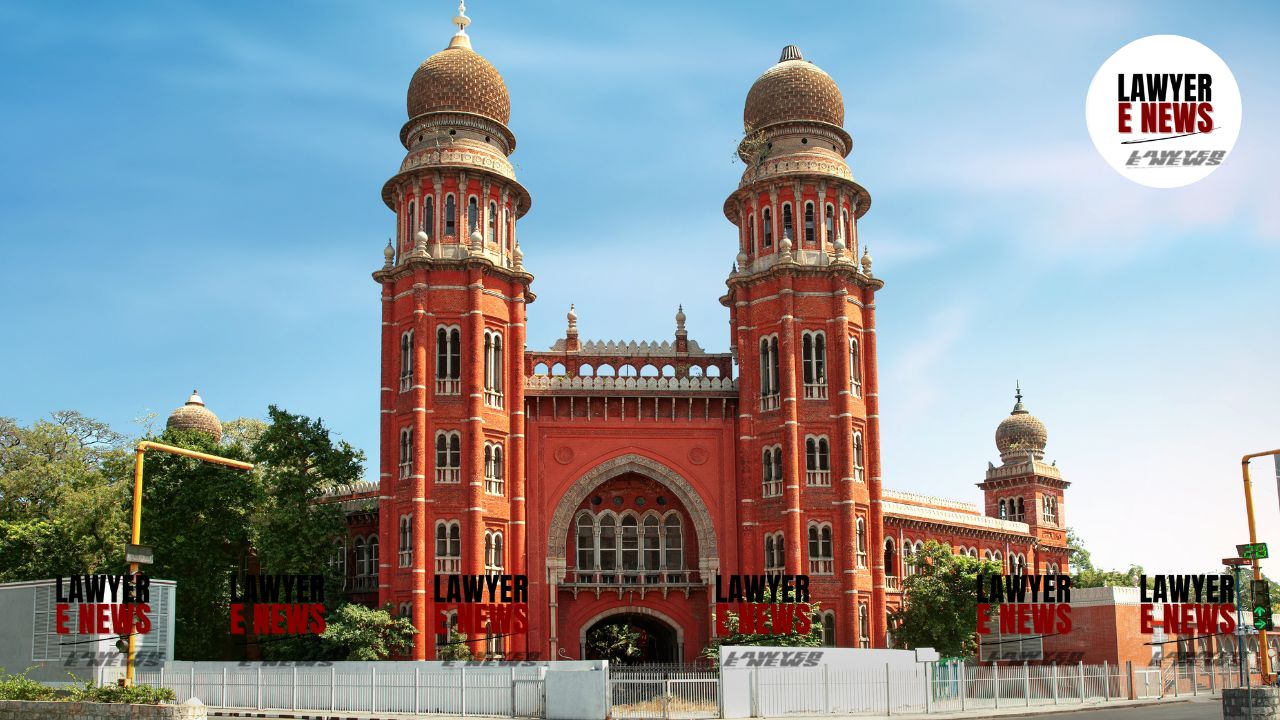
“If Act Is Not Totally Unconnected With Duty, Section 197 CrPC Sanction Mandatory”—In a significant ruling protecting the procedural safeguards available to public servants, the Madras High Court on 10th September 2025 quashed the continuation of a criminal trial against M. Selvaraj, former Secretary of the Tamil Nadu Legislative Assembly, citing the absence of mandatory sanction under Section 197 of the Code of Criminal Procedure (CrPC). The Court held that even if a public servant exceeds his authority, “as long as the act is reasonably connected with official duty, protection under Section 197 CrPC cannot be denied.”
Justice M. Nirmal Kumar emphasized that: “The act of the petitioner cannot be termed totally unconnected with the official duty... The sanction under Section 197 Cr.P.C., is required in this case, and taking cognizance without sanction is not proper.”
A ₹28,800 Travel Allowance Sparks Corruption Charges
The case arose from a 2010 air journey made by Selvaraj from Chennai to New Delhi, for which he claimed ₹28,800 as travel allowance. The prosecution alleged that the trip was a private affair disguised as an official duty, with no records proving a meeting with the Secretary General of Lok Sabha, which was the stated purpose of the trip. As a result, Selvaraj was charged with Sections 409, 468, and 471 of IPC read with Section 13(2) r/w 13(1)(c) of the Prevention of Corruption Act, 1988.
Selvaraj moved to discharge from the case, citing lack of sanction under Section 197 CrPC—a prerequisite for prosecuting public servants for acts connected with their official duties. When the trial court rejected his discharge plea, he approached the High Court.
“Official Cover Was a Cloak for Private Benefit”
The Government Advocate argued that Selvaraj’s trip was a misuse of public funds under the guise of official work, pointing to communications from Lok Sabha Secretariat affirming that no such meeting took place. The prosecution alleged:
“The petitioner conspired with others to prepare a false note file and obtained financial gain. The act was not a part of official duty but a misuse of position.”
Further, they contended that no sanction under Section 19 of the PC Act was required since Selvaraj had retired before the 2018 amendment that extended protection to former public servants. However, they maintained that Section 197 CrPC protection is unavailable when the act is “merely a cloak for unlawful gain.”
“Trip Was Duly Permitted—Dispute Is About Interpretation, Not Fraud”
Selvaraj, represented by senior counsel Abudu Kumar Rajarathinam, countered that the Speaker had formally approved the travel on 21.05.2010 and that he undertook the journey on 23.05.2010, returning the next day. His absence from headquarters was marked as “on duty.” Even though the Lok Sabha Secretariat later claimed to have no records of a meeting, the defence argued that “absence of records does not prove the absence of purpose.”
The defence emphasized that no private activities were proven, and mere presumptions could not substitute legal proof.
The consistent thread: “Sanction is mandatory when the act has a reasonable nexus with official duty.”
“Whether It Was a Formal Meeting or Not, Travel Was Not Totally Alien to Official Duty”—High Court Bats for Due Process
Justice Nirmal Kumar found that Selvaraj had clearly acted under official permission, and there was no material evidence of a private motive. The Court said:
“It is not the case that the petitioner did not travel or that he forged tickets. He did travel, with permission, and the bill was paid to the agency. The only dispute is whether the meeting took place. This cannot be decided without trial.”
Crucially, the Court referred to A. Srinivasulu v. State and Devinder Singh v. State of Punjab, reiterating that “there must be a reasonable connection between the act and the official duty. It need not be absolutely essential, but cannot be a fanciful claim.”
The Court ruled that Section 197 CrPC sanction was indeed required, and the prosecution’s failure to obtain it before filing the chargesheet was fatal.
Cognizance Taken Without Sanction is Invalid—Prosecution Must Now Obtain It by 31 December 2025
In a calibrated directive, the High Court did not quash the entire case, but barred further prosecution unless sanction is obtained: “The respondent is directed to approach the competent authority to seek sanction... In the event of no sanction being obtained by 31.12.2025, the petitioner accrues entitlement of discharge.”
Even If Official Duty Is Excessively Stretched, Sanction Is a Shield Not to Be Disregarded
This decision reinforces the judicial principle that “public servants are not above law—but neither can legal safeguards be diluted when official acts are involved.” The Court cautioned against allowing prosecutions without following the mandatory procedural protections, which act as a bulwark against political vendetta and frivolous targeting.
Date of Decision: 10 September 2025